Labour has promised to cut stamp duty for first-time buyers on homes costing up to £300,000. The pledge is one of a number concerning access to the housing market, with the party also promising to give new buyers first call on half of the homes being built in their area, and to make it harder for foreign investors to snap up properties.
How will it work?
For the first three years of a Labour government anyone buying their first home will not have to pay stamp duty – a tax that is paid by homebuyers when they complete on a property.
Stamp duty and first-time buyers
This isn’t the first time that new buyers have had their duty waived: in 2010 the then Labour chancellor, Alistair Darling, brought in a two-year break on the tax for first-timers on homes costing up to £250,000.
Prior to that, Darling also waived the duty on properties costing up to £175,000 for 15 months – that applied to all buyers, but as first-timers were most likely to be buying the cheapest homes, they were most likely to benefit.
Changes to the duty made in December 2014 also helped buyers across the market. George Osborne scrapped the previous slab structure, meaning buyers were no longer clobbered with the same tax rate on the whole of the purchase price, as well as reducing the cost for anyone buying a home costing less than £937,500.
How much will Labour’s scheme save people?
Currently stamp duty is only paid on homes changing hands for more than £125,000. After that it is tiered so that on the next £125,000 buyers pay 2%, on the next £675,000 they pay 5%, on the next £575,000 they pay 10%, and on the rest (ie anything above £1.5m) they pay 12%.
So 0n a property costing £150,000, a first-time buyer pays £500. On one costing the £299,999 they pay just under £5,000.
Will this encourage people to buy?
Not having to pay stamp duty will leave buyers with extra funds to put towards their purchase. This could help them have enough for a deposit sooner than anticipated, so bring people into the market earlier.
However, analysis of the impact of previous stamp duty holidays on transactions suggests that on its own a stamp duty holiday makes little difference. Neal Hudson of property firm Savills looked at what happened during a previous stamp duty change in 2012.
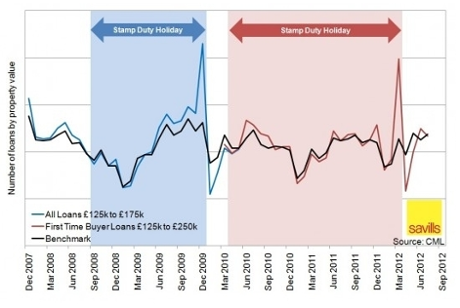
In both cases he found there was little evidence of a general increase in activity during the stamp duty-free period, but there was a rush at the end where buyers sought to take advantage on the rule before it was scrapped. His charts suggest that in many cases these were people bringing their purchase forward – the months after the end of the holidays saw falls.
Hudson estimates there were 13,000 additional sales during the first holiday and 7,000 more during the second – to put this in context there were 886,000 sales in 2010.
Will it push up prices?
Labour’s plans do go hand-in-hand with a pledge to get more homes built, and if supply improves then upwards pressure on prices should be reduced.
However, estate agents and surveyors are currently reporting a shortage of homes for sale – recently the Royal Institution of Chartered Surveyors said a fall in the number of properties coming on to the market could start pushing prices up.
Bringing more people into the market without increasing supply is likely to push prices up. There is a also the possibility that buyers who find themselves with more cash to put down will be tempted to offer more to secure a deal.
In December Matthew Pointon, housing economist at Capital Economics, predicted that the Conservative’s reforms to stamp duty would boost prices by between 3% and 5%. “Assuming buyers use the same level of deposit to buy a home as before the change, we estimate that with a loan-to-value of 85%, most buyers’ deposits will now allow then to bid for homes that are between 3%-12% more expensive than was previously the case,” he said then. “Sellers will respond to that increase in demand by raising their prices.”
Responding to Labour’s plans he says: “The effect will be smaller as this is a holiday rather than permanent change, and some of the increase in value will drop back once the holiday is over, but in the short term it will act to push up prices.”
Neal Hudson agrees. “The Labour party’s proposals may be a welcome gesture for those struggling to save a deposit. However, the impact of it is reduced given the stamp duty reforms already put in place and there is a danger that any savings are just passed on to sellers in a supply-constrained market.”
Howard Archer, chief UK economist at IHS Global Insight, says that any temporary measure is likely to lead to an increase at some point. “You tend to get a surge in housing market activity just before the period of grace ends, and that can cause a spike in prices”.