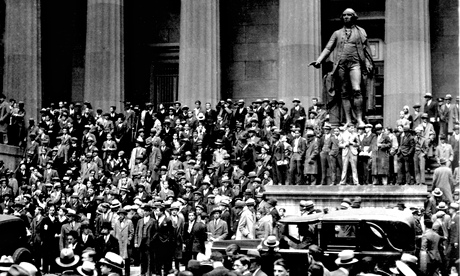
Historically, October is a bad month for stock markets. It took a consortium of Wall Street grandees led by JP Morgan to end the panic of October 1907. Twenty-two years later, October 1929 saw the tumultuous selling that began the slide into the Great Depression. More recently, October 1987 saw the Dow Jones drop by more than 500 points on Black Monday.
Will October 2014 take its place in this grisly hall of fame? No, said the financial experts who profess to be puzzled by the way in which the sell-off of the past 10 days has snowballed. There is, they say, no real reason for the panic. Global growth prospects are solid, if nothing to write home about. Central banks are still providing plenty of stimulus. Interest rates and inflation are both low. Banks have more capital than they did before the financial crash of 2008.
These are all reasonable points to make and, if nothing untoward happens over the coming weeks, it may well be that the big drop in share prices will prompt bargain hunters to come in and pick up shares when they look cheap. In that case, the retreat in stock markets will prove short lived, as it did in 1987.
But there are five reasons why markets are rattled: five factors that have come together simultaneously to create the right conditions for a severe correction.
Problem number one is that global growth prospects keep getting revised down. The start of October’s market tremors can be traced back to the beginning of last week when the International Monetary Fund cut its forecasts for the world economy in both 2014 and 2015.
Problem number two is that markets fear that there is little more that can be done to boost activity. Monetary policy - interest rates and the creation of money through quantitative easing – is pretty much maxed out. Finance ministers are wary of using tax cuts and higher spending to pump up demand when budget deficits are high.
Problem number three is the threat of deflation, already a reality in some countries such as Spain and Sweden, and looming large on the horizon for the eurozone. Deflation makes paying off debts more expensive and encourages consumers and firms to put off spending decisions. Neither is welcome to the global economy in its current state.
Problem number four is the eurozone, and more especially the evidence that the slowdown that formerly affected only the periphery of the single currency area has burrowed its way to the core, Germany.
Problem number five is Ebola. The prospect of a global pandemic is bad for certain stock market sectors but more generally leads to a dampening of confidence.
Taken together, these five factors have been enough to send shares, commodity prices and bond yields crashing. Central banks such as the US Federal Reserve and the Bank of England that were mulling over the possibility of raising interest rates will delay doing so. Growth will take a hit, although it is too early to say how big that hit will be.
As the IMF warned last week, the financial markets have been awash in cheap credit courtesy of quantitative easing. Have some of those investments now gone pear-shaped? Definitely. Are some hedge funds and money market funds now licking their wounds? Almost certainly. Are those wounds deep enough to lead to firms going bust? Perhaps, although we don’t yet. We soon will, however.