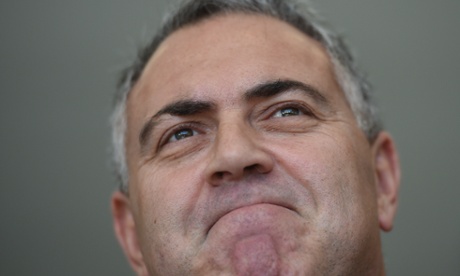
Yesterday’s announcement by the Reserve Bank to cut interest rates to 2.0% was a strong reminder that Australia’s economy remains weak – so weak that the bank believed it required more stimulus. But the cut also sent a message to Joe Hockey for his budget next Tuesday. If, as the RBA has indicated, it is near the limit of what it can do with monetary policy, the question is if the next budget will see the government will provide stimulus to the economy.
The RBA on Tuesday sent an unusually pointed note to the treasurer. The governor’s statement covered the standard boilerplate aspects that is always covers when explaining the reasons for cutting the cash rate.
It noted that there have been “improved trends in household demand over the past six months and stronger growth in employment”. This alone would suggest no need to cut rates, but the statement also noted that “looking ahead, the key drag on private demand is likely to be weakness in business capital expenditure in both the mining and non-mining sectors over the coming year”.
The big drop in investment after the end of the mining boom continues to worry the bank, especially as it has not seen the increase in the non-mining sector investment that it would like.
It then turned its attention to the government’s role, and noted that “public spending is also scheduled to be subdued. The economy is therefore likely to be operating with a degree of spare capacity for some time yet”.
In effect, private investment is weak, and the bank doesn’t expect the government to step into the breach in any significant way.
Thus with no fiscal stimulus expected to come, the bank felt the need to once again do the heavy lifting and cut rates.
But how will Joe Hockey react next week?
In his press conference after the RBA’s announcement, he offered some conflicting responses.
He began by suggesting that “monetary policy and fiscal policy must work together” and he suggested that the budget would show that “everything we are doing is going according to plan”. That plan involved “monetary policy and fiscal policy working together in the same direction.”
But what is that direction?
The standard view would be that if the RBA is providing monetary stimulus through a rate cut, then working in the same direction would mean the budget next week will provide some fiscal stimulus.
But later in the press conference, Hockey said that the government “wanted to give the Reserve Bank room to move. You could do that by reducing government expenditure as we have been doing, even in the face of falling revenue on expectations.”
Thus he claimed that the government’s expenditure cuts have allowed the RBA to cut rates. But that also acknowledges that had the government not cut spending so much, the RBA might not have needed to cut rates.
Certainly that is the RBA’s view.
Hockey then argued that “we have given the Reserve Bank room to move by structural changes, but importantly, we are also working in tandem with the Reserve Bank to strengthen the Australian economy”.
So it is not clear if Hockey sees working in tandem with the RBA means cutting spending in order to allow them to further cut rates, or to provide fiscal stimulus at the same time asthe RBA provides monetary stimulus.
At least talk of austerity appears to have been put to one side. Hockey’s rhetoric of last year about horror budget has been dialled right down.
Austerity has been given a bit of a gee-up recently with the supposed success of the UK Conservative party’s austerity policies. But as economist Paul Krugman has noted, the strongest growth in the UK has come after they effectively stopped being austere.
Indeed, after two very austere years in 2010 and 2011, GDP growth plummeted in 2012. While it improved in 2013 which coincided with another year of austerity, 2014 and 2015 have seen the austerity breaks eased, and growth is booming – in UK terms at least:
Australia has not gone down the severe UK-style austerity path and 2014, if anything, saw Hockey provide a small stimulus to the economy:
But that stimulus came more from collapsing revenue rather than through increased spending as lower than expected company and income taxes saw the budget deficit increase. But when we look at the amount of public demand being put into the economy we see a very weak amount:
Public demand over the three years from 2013-14 is expected to average just 1.3% annual growth – compared with the average annual growth from 1994-95 to 2012-13 of 3.5%.
And it is not a case of the government getting out of the way of the private sector. The 2014-15 Mid-year Economic and Fiscal Outlook estimates just an average of 1.5% annual growth over the three years to 2015-16 – well below the 4.2% average observed from 1994-95 to 2012-13.
Next week the forecast amount of public demand in the economy over the next three to four years will give us an indication of what working in sync with the RBA means.
If there is no change then it would appear Hockey sees little need for the government to provide any more fiscal stimulus than it has in the past. If it increases, it may be that Hockey has decided the RBA has done enough lifting and that it is time for the fiscal side of the economy to provide some boost.