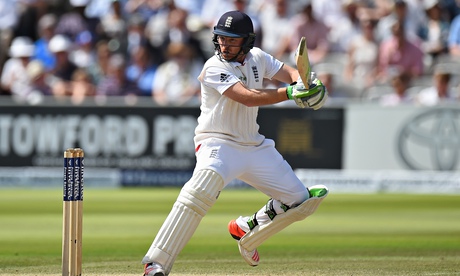
It would be wrong to say that Ian Bell and the No3 position are unhappy bedfellows. He bats there for Warwickshire, and in his last match, before the start of this series, scored an accomplished century for them. At international level, though, it has been a different story in which various attempts to put the most stylish England batsman of his time in such a pivotal position have rarely brought any success.
Bell has batted there 38 times in the last decade, the lengthiest period being in 2006 and 2007, against India, Australia and Sri Lanka, but until the 34th time, he had never made a hundred, something rectified only in the second innings against India at Trent Bridge in 2011 (an innings which brought its notorious tea-time run-out controversy), and reinforced at the Kia Oval two matches later where he made 235 and shared a 350-run partnership with Kevin Pietersen.
That is not much to show for a player of enormous talent, capable, as the Australians well remember, of scoring hundreds against them at Trent Bridge, Lord’s and Chester-le-Street during the last Ashes series in England. Now, the collective failure of the top order, something that ought to have been addressed well before last week’s Lord’s defeat, has seen the demotion from both the No3 spot and the team of Gary Ballance, whose technical deficiencies have been exposed now that word has got round, and the consequent promotion not of Joe Root, as some advocated, but Bell.
How he reacts to this will be a key factor in whether England, winners of the first Test lest we forget, can respond to the nature of the Lord’s hammering. No matter what is said for public consumption, will he in his own mind see it as the opportunity for which he has been waiting, the chance to be the batting fulcrum of the team? Or will he, as someone who is currently struggling early on in an innings, look on it with some trepidation as have so manyEngland batsmen in the past? It is revealing that the badge of honour worn by Bradman and Ponting, Richards and Lara, Sangakkara, Dravid and Amla, has been largely avoided by England’s finest batsmen so that no one has come in to bat for them at the fall of the first wicket more than Jonathan Trott.
This wariness must be a function of the type of pitches that were produced in England, particularly in the days before the new state-of-the-art drainage sucked moisture away so rapidly to produce shirt-fronts such as that at Lord’s recently. Lateral movement has always been a feature, with openers consequently less secure, and therefore the No3 more vulnerable. It is significant, for example, that Ponting’s career average of 56 at three goes down to 40 in England.
But in any case, this ubiquitous position demands rounded skills that are not necessarily those specifically of an opener, or a middle-order player but an amalgam of the two. Along with Ponting, Greg Chappell is regarded as Australia’s greatest batsman after Bradman, and he spent the last 24 of his 87 Tests, after his elder brother Ian had retired and when, in 21 of them, he was captain, batting at three. During that time, he averaged 43 against a career of 53, and in England his average was only 40. A part explanation would be the lack of consistent opening partnerships: only five times did he get to the crease with more than 50 on the board, 10 times it was single figures, and eight it was five or fewer. So much of the time, as was the case with Ballance, he was effectively an opener.
This, though, is one of the qualities that the position requires, especially when the opposition have a formidable seam attack. “As captain, I felt I had to bat at three,” Chappell says. “Ian had been there, and I was comfortable at four. But I needed to take on the lead. There are different demands, particularly in England where there were seam-friendly pitches and bowlers to exploit them. That you might have to go in against the new ball might be seen as a drawback, but it can also be an advantage because you will be batting with the field up, so there are more gaps in which to score.
“Whoever goes in first wicket down has to have a good temperament, and the ability to keep good bowling out. But – a really important point – he has to have the mindset to counterattack. He cannot be passive but should be looking to put the team on top rather than simply get through the new ball. He needs to be able to defend properly against the good ball, but still be able to punish anything that is remotely loose. What he will be saying is: ‘If you stray into my areas, I will just pick you off.’ You are there to play the new ball if necessary but keep the game flowing for your team, and put the pressure back on to the bowler. It is simple: the earlier you get runs, the more chance there is to lead the game. Fail to do that and you are playing catch-up, and you don’t win many games like that.”
This then is the challenge for Bell. Can he rise to it, beginning at Edgbaston, his home ground but one on which he has never made a Test century? Or is his early vulnerability a function of ageing eyes not picking the length and lines so readily? Will the conversion be too late for him at 33 and is he just keeping the seat warm for Root to take it sooner rather than later? He has the playing ability, and the qualities Chappell outlines, of that there is no doubt. Now we shall find out if, after 112 Tests, he has the temperament.