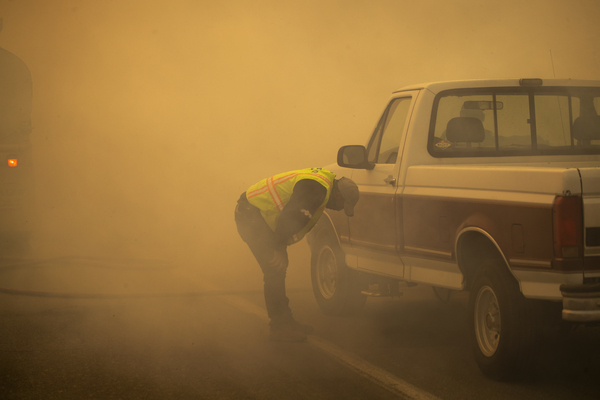
LOS ANGELES — A pair of wind-driven wildfires actively burning in Orange County and a couple of nearly extinguished blazes in Los Angeles and San Bernardino counties have spawned the worst air quality in the nation, according to the government's air quality monitoring agency.
Parts of Los Angeles and Orange counties and the city of Corona are all hovering in the "unhealthy" range, the website Air Now shows.
On Tuesday, the South Coast Air Quality Management District issued a windblown dust and ash advisory in Los Angeles, Orange, San Bernardino and Riverside counties, warning that hazardous particulate matter from recent wildfires may be spread by strong gusts of wind.
The advisory, which remains in effect through Tuesday evening, said that sand, dust and ash are being carried from the scars of past blazes, including the Bobcat fire and the El Dorado fire.
"As a result, the Air Quality Index (AQI) due to particulate matter ... has reached unhealthy to hazardous levels," the agency said.
Active fires are making it hard to breathe too. Smoke advisories are in effect in Orange County because of the ongoing Silverado and Blue Ridge fires, which erupted Monday and quickly burned through a combined 20,000 acres.
"The Silverado fire is producing substantial amounts of smoke," the air quality management district said, adding that residents should limit outdoor activity and remain indoors with windows and doors closed.
The latest air quality concerns follow months of orange skies and ash-dusted neighborhoods from California's worst wildfire season. In September, dozens of concurrent blazes across the state created a plume of smoke that spanned more than 1,000 miles and traveled as far as Europe.
Smoke — and its resulting hazardous air — has even spawned a new subfield of fire science: aeropyrobiology, which studies how fire-powered plumes can waft about landscapes, like "an atmospheric analogue to ocean currents."