Right now, the American west is in the midst of a deep heatwave. California’s drought continues unabated, and central Washington is on fire. All weekend, the sun beat downtown Denver into submission with a series of near-90-degree days.
No one at the Western Conservative Summit, however, was taking this as an opportunity to rethink their views on climate change. Indeed, Mike Huckabee got his biggest cheer when he mocked the president for rating global warming as a bigger danger than Isis, as if “a sunburn is worse than a beheading”.
If the climate itself can be dismissed, ignoring the supreme court is a cinch. Along with the five other Republican presidential candidates who addressed this big tribal gathering of evangelical and Tea Party conservatives in the west, Huckabee condemned the “judicial tyranny” that had led an “imperial court” to uphold Obamacare, affirm the Housing Rights Act, and overturn the ban on same-sex marriage.
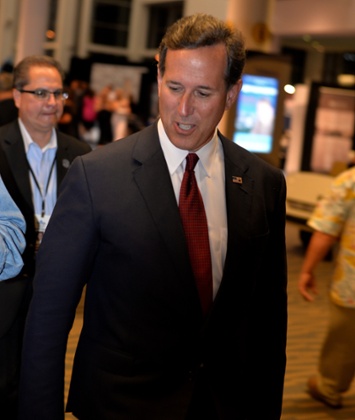
He counselled resistance.
When the moderator asked him what that might mean in practical terms, he invoked a mighty precedent. When the supreme court made the Dredd Scott decision upholding slavery, Abraham Lincoln “simply ignored the decision. He said that’s not correct.”
Dredd Scott limited, rather than expanded civil rights, and “ignoring” it was dependent on the Union’s victory in a bloody and calamitous civil war – but those considerations were neither raised or pondered. The idea of a president selectively dismissing the court’s interpretations of the constitution was greeted by the audience not with foreboding, or even puzzlement, but with glee.
Movement conservatism has always depended on an aggrieved sense that it is an endangered beacon of light in a sinful world. It has always derived energy from the fact that it is deeply at odds with liberal, secular society, and even modernity itself. In the past, this energy has given it great influence in the Republican party.
But now, in mid-2015, you get the sense that the movement has departed so far from the mainstream that it has lost touch with what is politically possible in a democracy.
One way that’s exemplified is in the very idea that unfavourable laws might simply be disregarded, which appears to permeate the movement from top to bottom. After hearing it from leaders like Huckabee, I also heard it from exhibitors on the floor of the convention center.
When I asked Steve Schreiner of the Colorado Firearms Coalition whether he was worried about new firearms controls in the wake of the Charleston shooting, he said no, and made a fair point: “Remember who owns the House and Senate”.
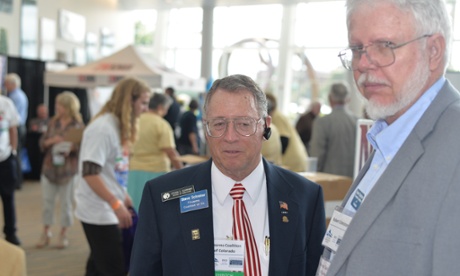
But what if a future, duly elected Democratic congress attempted an assault weapons ban, like the one that was in place from 1994 to 2004? No dice: “There’s too many of them out there.” When local and state governments try to make laws about the registration of automatic weapons, “most of the guys don’t obey them. The public’s already voted on this and the government lost.”
This strange, shifting, inconsistent notion of what counts as “voting”, and what constitutes legitimacy depends on a fierce allegiance which is not to the law or the government (let alone the president), but to an almost mystical sense of the constitutional essence of America and “our way of life”.
That loyalty is taught and nurtured in the array of parallel institutions that conservatives have created, which can envelop adherents from cradle to grave.
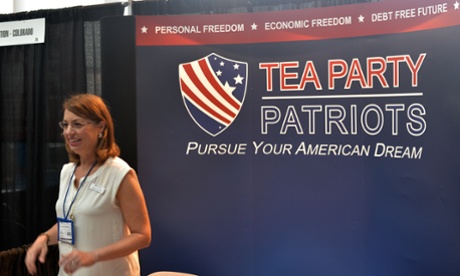
These institutions were all on display at the summit, deluging attendees with agitprop and swag. There’s a special focus on the young, with home-schooling resources, Christian colleges and schools, and generous internship and leadership programs. For some, the circle is closed when they themselves go on to plum jobs in well-funded movement organisations. The summit featured a job fair, and one organisation, Campus Reform, was offering posts to “campus correspondents” who would “investigate and report liberal bias on college campuses throughout their state”, so that they could not only burnish their CVs but “get paid!”.
Those who do well enough at reporting on their liberal professors might get more than a college allowance by becoming professional conservative activists. A parade of these movement tribunes filled out the gaps between presidential pitches. Australian immigrant Nick Adams (described as an “honorary Texan” by his mentor, Rick Perry) spoke on a panel on the “decline of the mainstream media” and fawningly introduced former governor Perry. He has a couple of books (including Boomerang America), an obsessive hatred of “political correctness”, and a place on the Fox News talking-head conveyor belt. Any youngster with a gimmick, patronage, and a strong pitch could enjoy his success.
The trouble is that this is all a bit of a bubble. If you spend your whole life in it, you necessarily lose touch with what the non-conservative world is thinking. If your values are never challenged, there is no need to moderate them. And it means that you are perpetually surprised and angry when candidates who answer to those values turn out to be unelectable.
You could read the conservative movement’s unchanging verities off from the speeches of the presidential candidates who were invited. Ben Carson, Carly Fiorina, Rick Perry, Rick Santorum, Scott Walker, Rafael Cruz (father of Ted) and Huckabee all offered the same prescriptions, and only varied in plausibility and presentation.
All were hawkish on foreign policy, promising (with varying degrees of specificity) to get tougher on Isis and Putin, and to stand with Israel. All pledged to cut corporate taxes and red tape. All condemned Obama, Hillary, and the “imperial” supreme court’s “assault on the family”. All demanded that states’ rights be respected.
Closing the conference on Sunday, and trailing whiffs of sulphur, former Clinton confidant Dick Morris all but told those in attendance that they were bound to lose the next election. Conservatives could only win, he said, by breaking up “ethnic voting blocs” by selling them on the issues, by making Hillary herself the biggest issue of the campaign, and by picking an experienced candidate who could deftly respond to the attacks that the Clinton campaign would so skilfully make on the Republican nominee.
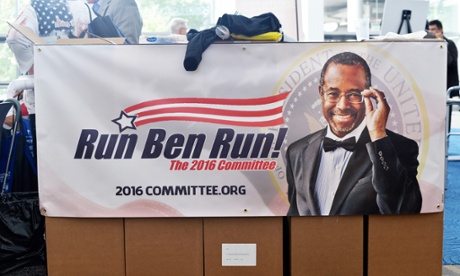
But after ignoring so much else, the summit chose to ignore Morris as well. In the event’s straw poll, Walker came third, beaten handsomely by Carly Fiorina (who is both new and charismatic), and the comfortable winner, Ben Carson. Carson won last year, too, and superficially, you can see why conservatives like him. He’s a storied surgeon, and he manages to deliver the requisite hard-right talking points in a relaxed and plausible way.
But more importantly, perhaps, Carson makes a virtue of his complete lack of political experience. President is the first office he has run for. That’s why he’s a darling of a conservative universe that so frequently pits itself against real-world governmental processes and outcomes.
Unfortunately, he’s exactly the kind of candidate who, by Morris’s rationale, can’t possibly win.