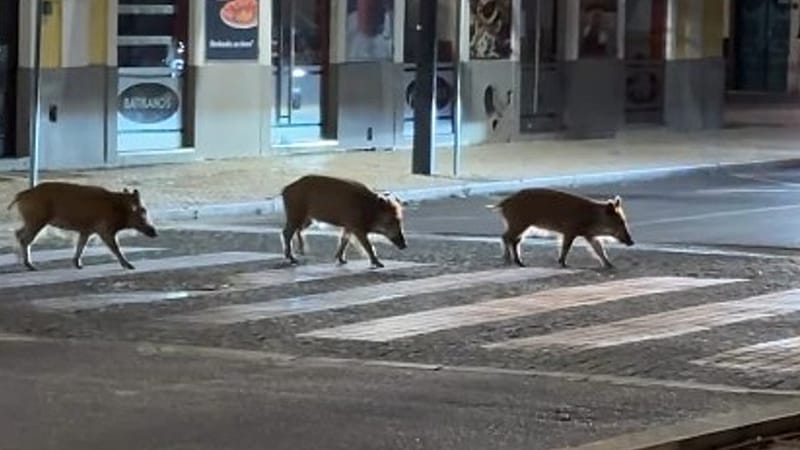
A group of wild boar was recently spotted roaming the streets of the city of Setúbal in Portugal. As regular visitors to the beaches of the Serra da Arrábida, these animals now appear to be encroaching on urban areas.
A video shared on social media by a local resident shows a group of wild boar using a pedestrian crossing on a road where cars are passing at night. The footage also shows the animals in planted areas, rooting around in the soil with their snouts, apparently foraging for food.
Ver essa foto no Instagram
In a statement shared on social media, Setúbal City Council acknowledges that "in recent months there have been several sightings of wild boar in urban and peri-urban areas of the municipality, particularly in gardens, parks, beaches and areas close to natural spaces".
The council notes that the presence of these animals within the city limits "is neither natural nor desirable".
"As a wild animal with unpredictable behaviour, it poses risks to the safety of people and pets, as well as public health concerns," the statement explains.
What to do if you encounter a wild boar
Setúbal City Council has also shared a guide setting out the precautions to take if you encounter a wild boar. The advice includes not approaching the animal, backing away slowly if it comes towards you, not feeding it and not leaving food scraps outside bins.
Recently, wild boar have been seen with greater frequency on the beaches of Setúbal, particularly in the Serra da Arrábida. In summer, it is common to see these animals approaching towels and rummaging through cool bags and food bags left on the sand when less attentive beachgoers head into the sea.
Portugal faces a severe overpopulation of wild boar, with estimates ranging between 300,000 and 400,000 animals. This is partly because shrinking and fragmented habitats have reduced numbers of natural predators like the Iberian wolf, which also face backlash from farmers due to predation on livestock.
Severe dry weather and a lack of natural food is forcing wild boar into urban areas, where they risk causing damage and road accidents.
The beaches of Portinho da Arrábida, Creiro and Galapinhos, in the district of Setúbal, record the highest number of wild boar sightings. Galapinhos is especially prone to such encounters, as it lies deep within the Serra da Arrábida.
This text was translated with the help of artificial intelligence. Report a problem : [feedback-articles-en@euronews.com].