Eamonn McManus, the St Helens chairman, is fond of quoting the current 19th Earl of Derby, who confirmed, on attending the last match at the club’s old Knowsley Road ground in 2010, that his family had lent their name to two sporting events – the horse race at Epsom and rugby league fixtures between St Helens, at one end of their Knowsley estate, and Wigan from the other.
The local rivalry will be played out 20 miles to the west, on the grand stage of Old Trafford as these two Lancashire towns continue to punch well above their weight in the sporting arena.
Wigan have won two of the past three Super League title deciders, and Saints will be extending their record number of appearances to 10, in the 17th Grand Final, and are desperate to claim their fifth victory after suffering five consecutive defeats between 2007 and 2011.
Both clubs would be regarded as wealthy and glamorous, by the modest standards of British rugby league. But the days of building teams around big-money signings from Australia or rugby union have gone, at least for the moment. That leaves them increasingly reliant on local talent and both are reaping the reward for enriching a sporting culture in which balls do not have to be round.
Nine of Wigan’s 19-man squad have come through their youth system and St Helens could include eight products of theirs, albeit having staged a raid over Billinge Hill to sign the winger Tommy Makinson from the Wigan St Jude’s amateur club. “It’s quite fitting that we’re in another Grand Final with Wigan because most people would probably say that in terms of scholarships and academies it’s us and them who have been leading the way,” says Mike Rush, the St Helens chief executive who has been closely involved with the youth set-up since 1999.
Rush explains that Saints work with “hundreds of kids at under-12s, -13s and -14s, because we believe at that age it should be about mass participation and not elitist”. There are 10 amateur clubs in the town, and the same number of high schools, and Saints have taken several groups of schoolboys on tour to Australia – the first, in 2004, including James Graham, who now lives in Sydney and captained Canterbury Bulldogs in last Sunday’s NRL Grand Final.
The numbers in Wigan are even higher, partly because they take in neighbouring Leigh, another traditional league hotbed, into their system. “Wigan had the first scholarship system, which the Rugby League pretty much copied and introduced around the game,” says Matty Peet, now the coach of their under-19s. “But since Ian Lenagan took over as chairman and Shaun Wane joined the coaching staff [in 2010] it’s gone to another level. Shaun had been working with the juniors for years – he knows that’s where the best players in the world are and he’s desperate to give them the chance. He’s opened up the pathway.”
The showman in Lenagan relished announcing on Grand Final eve that Wane, who has frequently been tipped to follow Sam Tomkins to New Zealand Warriors, has signed a three-year contract extension with Sean O’Loughlin, the club captain –and another product of the Wigan way.
There were fears that Wigan Athletic’s promotion to the Premier League in 2005 might undermine the town’s reputation as a rugby nursery, especially with the club enduring an unusually lean spell at the time. Instead it has coincided with a bonanza, which culminated in six Wiganers playing rugby for England on one Saturday afternoon last autumn – three in union and three in league.
“There’s a genuine belief in this town, among the kids but also the teachers and junior coaches, that if you work hard on your rugby, it can change people’s lives,” says Peet. “They know it’s a genuine career path – different to football in that respect, where it’s a much longer shot to make a career. A 13- or 14-year-old in Wigan knows who Sean O’Loughlin is, knows who Liam Farrell is, because they see them in the street every day. It’s attainable.”
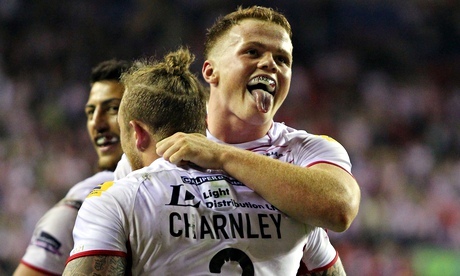
The latest Wiganer living the dream is Joe Burgess, a tall winger from the Rose Bridge amateur club who turns 20 on Tuesday and who had made two first-team appearances this time last year. He received a late call to the senior squad for a pre-season trip to Florida – and a telling-off from his mum when he was quoted swearing about it in the Daily Star – and made such a positive impression that he has become an automatic selection on the left, scoring 17 tries including the dramatic late winner in last Friday’s semi-final against Warrington.
“He nearly signed a scholarship for Leigh,” Peet says, with some relief. “But Wigan brought him in relatively late, about 13 or 14, and after that he grew about two feet. We always knew his ability but being a 6ft 4in winger has a lot of advantages.”
Kris Radlinski, the former full-back who has proved such an inspired appointment by Lenagan as rugby manager heading up a boot room comprised entirely of Wiganers, compares Burgess’s physique to that of Pat Richards, the Australian who became one of the club’s most popular imports and played in their last two Grand Final wins.
“I can still see Joe now, making a crucial cover tackle for our under-16s in a game against St Helens a few years back,” Peet says. “That’s what stands our lads in such good stead. There would have been 1,000 people watching that game and from a young age they’re playing in games that mean a lot, especially against Saints. We do hate them but probably because we know they know what they’re doing. There’s a healthy respect.”
The rivalry, and Lord Derby’s derby, may have nowt to do with the vast majority of the country but whether on a Good Friday in St Helens or Wigan, or a Saturday night at Old Trafford, it is always a treat to have a ringside seat.