LOS ANGELES _ The latest and most powerful in a series of three winter storms slammed into California on Sunday, flooding roads, forcing evacuations in communities near burn areas and adding more snow in mountains from the Sierra Nevada to the San Bernardino Mountains.
Numerous roads around Southern California were flooded by sustained bursts of intense rain. The 710 Freeway flooded near Pacific Coast Highway, and the 110 Freeway experienced high water near Torrance. Numerous surface streets were also blocked by standing water and fallen trees.
The National Weather Service issued flash flood warnings for a large swath of the region, including the South Bay, harbor area, Long Beach, Anaheim, Santa Ana and the Inland Empire. Several people had been rescued from cars in flooded intersections, and thousands have lost power.
Forecasters had been warning this storm could be the strongest in Southern California in seven years, and it appeared to be delivering. While earlier storms produced periods of heavy showers, this storm delivered several hours of pounding rain, which caused the street flooding.
The heaviest rain was hitting Sunday afternoon and evening, with forecasters anticipating as much as an inch per hour during the storm's peak, said Stuart Seto, weather specialist for the National Weather Service in Oxnard. Some areas were to see up to 3 inches of rain by the end of the day, Seto said.
Evacuation orders were issued for burn areas in Glendora, Duarte, Silverado Canyon in Orange County and parts of Santa Barbara County.
The city of Glendora issued voluntary evacuation orders for residents adjacent to the burn area of the 2014 Colby fire. The order affects about 1,000 homes in an area bounded by the Little Dalton Wash, Sierra Madre Avenue and Yucca Ridge Road. Officials established an evacuation center at the Teen Center.
Also Sunday, the city of Duarte issued evacuation orders for residents living in the areas burned in last year's Fish fire in the San Gabriel Mountains near Azusa. An evacuation center was set up at the Duarte Community Center.
The city of Santa Clarita issued evacuation notices Saturday evening for about 120 homes in the vicinity of last year's Sand fire. Fast moving waters flooded several roads leading to the Val Verde area Sunday afternoon, where residents were being urged to shelter in place.
The city of Hermosa Beach closed its pier as a precaution because of high surf, and it was to remain closed until further notice, said Sgt. Mick Gaglia of the Hermosa Beach Police Department.
Orange County officials were also bracing Sunday for possible flooding, particularly in Silverado Canyon, which is still recovering from a fire in 2014. Extra emergency crews were brought in to help, including a bulldozer operator and two additional swift-water rescue teams.
At Disneyland, heavy rains poured and a flash flood warning was issued as the sparse number of guests hid under the monorail. Some were clearly unprepared for the rain _ wearing jeans, sneakers and hoodies, with some even without umbrellas. "Star Wars" light saber umbrellas were selling briskly, despite a hefty price tag of $65.
But the visitors who braved the weather enjoyed short lines _ less than half an hour for Hyperspace Mountain, where lines typically can last for 2 hours.
In Ventura County, a few homes in the Camarillo Springs area along the base of a hill were under voluntary evacuation. The La Conchita Area, which has a history of destructive mudslides, was also under an evacuation order, according to Tom Kruschke, spokesman for the Ventura County Fire Department.
During the heaviest period of rain on Sunday, coastal areas were expected to see up to an inch of rain, the San Fernando Valley up to 1 { inches, the San Gabriel Mountains up to 2 \ inches, and downtown Los Angeles up to 1 1/3 inches.
"It looks like it's shaping up to be the strongest storm of the season," said Carol Smith, of the National Weather Service.
A Southern California Edison official said Sunday morning that about 5,500 customers in its service area had lost power as a result of the storm. The worst outages were in the San Bernardino Mountains, where 1,500 customers had lost power, said spokeswoman Susan Cox. Nearly 10,000 customers of the Los Angeles Department of Water and Power had also experienced power outages caused by trees and branches falling onto power lines, according to a release.
Flooding forced multiple road closures across the region.
A homeless encampment off of the Pacific Coast Highway in the Harbor City neighborhood was submerged in several feet of water. Los Angeles fire rescue teams helped three people walk out of the flooded area and brought two others out by boat. One of the rescues, a 39-year-old man, was transported to a hospital. Swift-water rescue teams were still searching the area, a roughly 300-square-foot patch of land with dense vegetation off the highway, for other victims late Sunday afternoon.
Thunderstorm conditions will ease slightly late Sunday into Monday. But the rainfall is expected to continue until Tuesday and end sometime before noon. All told, the storm system is expected to generate 4 to 6 inches of rainfall over three days, with the most rainfall in the foothill and mountain areas. Clearer skies and temperatures in the mid to high 60s are expected to return beginning Friday.
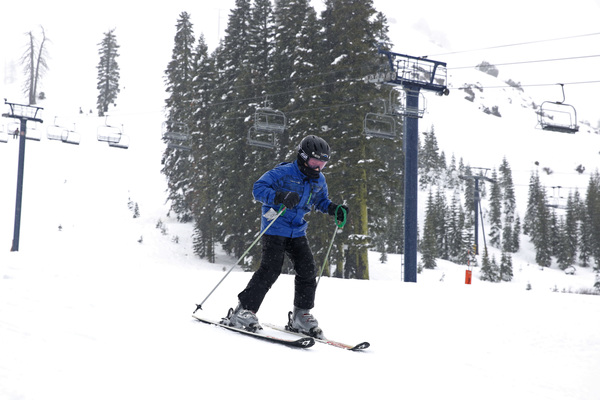
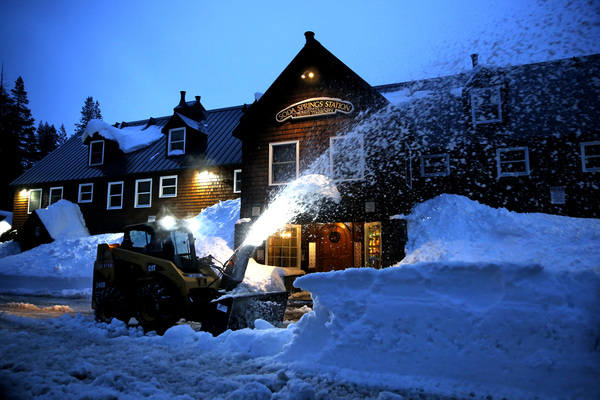
The storm is also expected to hit the Sierra Nevada hard. The weather service warned of "crippling snow amounts on top of existing snow cover" and urged residents to stock up on food, water and firewood, and "essentially prepare for being stranded at home for multiple days." Power outages are likely, and mature trees are expected to fall. It's possible that residents could endure multiple-day power outages, failures of carports and decks, and avalanches.
As of Sunday morning, there was flooding reported in some areas including Santa Cruz County. Snow once again closed Interstate 80 in the Sierras, where a new avalanche warning was issued. For the second time in as many days, mudslides closed Highway 17, the main route between Silicon Valley and Santa Cruz.
The forecast is heightening concerns about mudslides and flooding across the state. Another powerful storm that hit California on Friday caused numerous road closures and mudslides in areas burned by recent fires, including a major incident near Santa Barbara that destroyed cabins and cars, and forced rescues.
So far, California is on pace for its wettest year on record after six years of drought, according to the Department of Water Resources. Months of above-average rainfall have only accelerated in January, with three consecutive weeks of rain from the Sacramento Valley to the Los Angeles Basin with only days of clear skies in between.
The storms have built up the snowpack for the whole Sierra Nevada, with the southern third of the range at nearly 200 percent of average for this time of year. The state's biggest reservoirs are brimming and more rain is on the way, forecasters say.