With Britain's exit from the European Union looming, an increasing number of companies are leaving or reconsidering their positions in the country.
Honda Motor Co.'s announcement Tuesday that it would close a factory in Britain in 2021 sent shockwaves through the country. There are now less than 40 days until Brexit on March 29. The embattled administration of British Prime Minister Theresa May is facing growing uncertainty over the future of the British economy.
'Devastating'
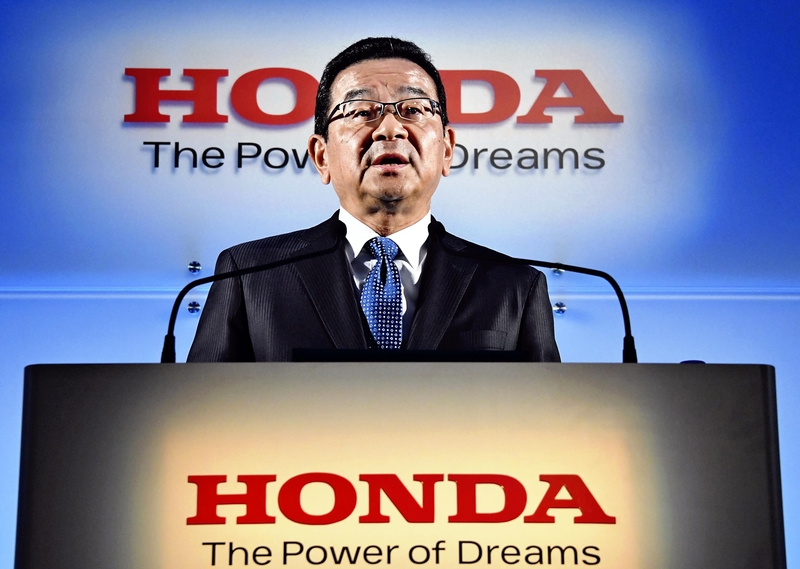
In a press conference Tuesday, Honda President Takahiro Hachigo emphasized that the company was ending production in Britain after more than 25 years -- it has been there since 1992 -- as part of the restructuring of its production system, and not because Britain is leaving the EU.
Nevertheless, if Britain leaves the union without an agreement, a so-called no-deal Brexit, automobiles exported to the EU would be subject to a 10 percent tariff.
The economic partnership agreement between Japan and the EU that went into effect Feb. 1 states that tariffs on Japanese exports to the EU will be reduced to zero in the accord's eighth year.
In the press conference, Hachigo cited Japan's "increasing competitive edge," suggesting the effects of tariffs were a consideration.
Nissan Motor Co. announced Feb. 3 it was scrapping plans to manufacture a new sport utility vehicle at a factory in central Britain. Toyota Motor Corp. has said it is considering temporarily halting production in the event of a no-deal Brexit.
Britain has made efforts to bring automobile manufacturing to its shores since the administration of Prime Minister Margaret Thatcher in the 1980s. There are now more than 2,500 parts makers in the country, with the auto industry and related fields providing about 800,000 jobs.
Withdrawals or production stoppages by Japanese companies would have a major impact on the British economy. On Tuesday, British Secretary of State for Business, Energy and Industrial Strategy Greg Clark called Honda's decision a "devastating blow" that was "deeply disappointing."
UK firms exiting too
Japanese manufacturers are not the only ones withdrawing from Britain.
BMW of Germany has said it would halt production of its Mini model in Britain for a month in April. Ford Motor Co. of the United States has suggested it could withdraw from engine manufacturing in the country.
British companies are also looking to move overseas. The major home appliance manufacturer Dyson Ltd. intends to move its headquarters to Singapore. Nearly one-third of British companies are considering moves overseas due to Brexit, according to the Institute of Directors, a British business association.
Thomas Enders, chief executive officer of European aircraft manufacturer Airbus SE, has urged the May administration to act, saying, "Please don't listen to the Brexiteers' madness which asserts that, because we have huge plants here, we will not move and we will always be here."
Fears of contraction
The confusion over Britain leaving the EU has already started to negatively impact the British economy.
According to the Society of Motor Manufacturers and Traders, a British auto industry group, investment in the industry in 2018 was about half what it was in the previous year.
The British real economy grew 1.4 percent in 2018 adjusted for price changes. This is down from 1.8 percent in 2017, with the Bank of England only expecting 1.2 percent growth in 2019.
A no-deal Brexit could shrink Britain's gross national product by as much as 8 percent in a single year, according to the BOE. Warnings about the possibility of the worst recession since the end of World War II have been voiced.
Bank of England Gov. Mark Carney has said Britain's exit from the EU could impact the outlook for the global economy. "It is in the interests of everyone, arguably everywhere" for a Brexit solution that works for all to be found in the weeks ahead, he said.
Read more from The Japan News at https://japannews.yomiuri.co.jp/