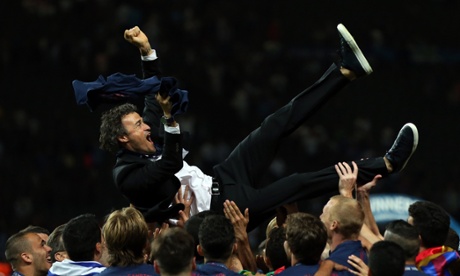
I knew Barcelona would win from the minute I saw Luis Enrique’s shoes. I should admit that Barça were one up before I noticed his shoes, so you might argue I was a little after the fact. Like predicting that Sobers might score a lot this over, after he’d already carted Malcolm Nash five times around the St Helen’s Ground. But the shoes confirmed it. If Sobers had been wearing those shoes in 1968, the next over would have gone for 36 as well.
I knew it because I have data to prove there is a meaningful correlation between the style of a football manager’s shoes and the relative success of his team [1]. Enrique’s shoes – a black number, with thick white soles, possibly in the trainer family, but certainly not the kind of thing you pick up from Sports Direct, almost like deck shoes – were something special. And between the top of the shoe and the bottom of the trouser, when his leg rode up, could be seen … bare skin. Luis Enrique was going sockless in a two-tone shoe, with a skinny suit. This was total football of the feet.
Since December I have been studying football managers’ shoes from close quarters in the front row of the West Paddock at Loftus Road. At every game since the visit of West Brom, I have taken a photograph of the away manager’s shoes and posted it to Twitter and Instagram under #oppositionmanagershoes. It was only for my own amusement at first, but now I’m fairly sure that by this time next year you’ll be watching me at the cinema, being played by Brad Pitt in an Oscar-nominated adaptation of this article.
It’s been proven that there is a correlation between a club’s wage bill and its league position. That explains general patterns, but it doesn’t account for outliers. How come Swansea and Southampton were able to punch above their weight, and finish high up the table on a modest wage bill? How come QPR paid the GNP of several central Asian republics to their players, but still ended up relegated? That’s where my work comes in. The study of shoes takes care of those outliers. Because what I have learned is that the better the shoe, the better the club’s chance of relative success.
The day West Brom visited, Alan Irvine wore what I would come to recognise as loser’s shoes. Trainers, and not even unusual ones. Comfortable and practical, perhaps, but not the shoes of the kind of manager you want running your team. Within nine days the West Brom board came to the same conclusion and sacked him – maybe they had been researching the area longer than I had, and had already seen the pattern in the data, because I did not notice the connection. Eight days after the West Brom game, on 28 December, Keith Millen brought a pair of similarly uninspiring white Nike trainers to Loftus Road. On 2 January, Alan Pardew took the manager’s job at Selhurst Park.
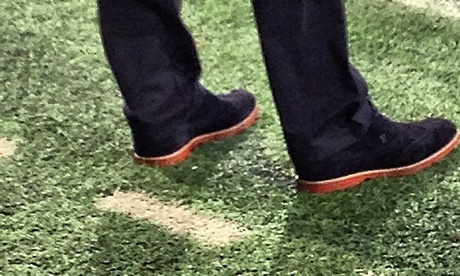
New’s Year Day brought Garry Monk, and the first great shoe of the season. Black suede uppers, with a tan sole, separated by a thin white seal. Garry Monk has just led Swansea to their best season since before John Toshack started speaking Spanish, with a team playing stylish and daring football. The Swansea game was the one where I started wondering if a manager’s team reflected their shoes.
I could go on describing the shoes of subsequent managers, but we would all get bored, so here’s the science. For the bit in the film where Jonah Hill explains to Daniel Levy that whatever the league table says about Mauricio Pochettino, he’s got to get rid.
Football managers’ shoes can be divided into three sorts. First, the stylish, including shoes that favour suede over leather, or eschew black. Shoes some of us pick up and think, “They’re nice. But I’d never get away with them.” Second, the efficient and conventional, meaning plain black leather, usually a lace-up. The shoes your dad wore, if he had any kind of job that didn’t require boots. Third, the practical and dull, meaning trainers of the kind you do get from sports shops. Not whatever Luis Enrique was wearing on Saturday night. Now look at who wore what.
Stylish
Garry Monk, Swansea City – the best: see note above
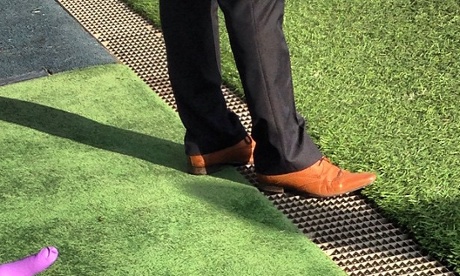
Roberto Martínez, Everton – a sharply tapered toe, in a richly autumnal very pale brown
Ronald Koeman, Southampton – simple and classic brown suede
José Mourinho, Chelsea – simple and classic brown suede [2]
Efficient and conventional
Louis van Gaal, Manchester United
Arsène Wenger, Arsenal
West Ham United, Sam Allardyce
Practical and dull
Alan Irvine, West Bromwich Albion – well-worn black Adidas
Keith Millen, Crystal Palace – dull white Nike
Nigel Clough, Sheffield United [3] – more well-worn black Adidas
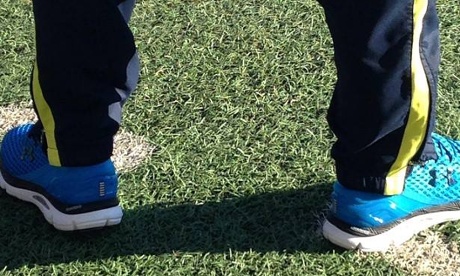
Mauricio Pochettino, Tottenham Hotspur – a vile electric blue pair more suited to someone a third his age
John Carver, Newcastle United – Pumas as grey as the North Sea on a sunless midwinter day
In the top category, you have the winner of the Premier League. There’s Monk, whom we’ve already discussed. Martínez has had a poor season, and many Everton fans are sick of him, but he had a fine first season and won the Cup the year before; his shoes reflect a commitment to progressive football. A good close season in the transfer market and a switch to something slip-on should see Everton return strongly in August. Koeman is arguably the managerial success story of the season, renewing a seemingly strip-mined team and taking it to seventh, having challenged for a Champions League place for much of the season.
The second category offers three managers who all did OK, but equally have reason to feel they might do better, and who each have been told by fans they need to do better. Louis van Gaal had to hear United fans demanding he “attack, attack, attack!”. However, he did manage to get United into the Champions League on a budget of only £149m. He needs to change shoe to get the best out of his squad, but may not have the tactical imagination to do so. Arsène Wenger redeemed himself with a Cup win, but his annual insistence that his team is nearly there and then to find them at the end of the season still nearly there suggests a man unwilling to admit he has the wrong shoes. Arsenal will not win the Premier League again while he remains manager: I’m calling that now. Sam Allardyce did as well as could be expected at West Ham, but he had a shocker of a second half of the season, the fans never liked him, and the board didn’t much, either. Jobless then, but it’s hard to see West Ham’s season as a complete failure.
And in the final bracket, three managers at clubs who were struggling to avoid relegation while they were in charge (that all did so is none of their doing, with the necessary qualifier that Millen was only caretaker at Palace), one League One manager who no longer manages that club, and Pochettino, the outlier. Tottenham will slip away if he remains in charge, because he does not have the shoes to achieve long-term success. Given good enough players, even a man in these shoes can hide his defects. And all managers have freakishly good or freakishly bad seasons. But Pochettino will be found out: I’m calling that now. I’m not looking at league tables, or points per game, or goals conceded in the last five minutes. That’s irrelevant, just as whatever everyone thought mattered in baseball was irrelevant in Moneyball. The shoes tell the truth [4].
Viewed through the prism of science, then, the truth is evident: the better the shoe, the more succcessful the manager. The very best managers realise that. Mourinho probably would have won the league anyway, given the strength of the Chelsea squad. By wearing brown suede, he ensured it. Whereas Chris Ramsey condemned QPR the minute he slid on his old trainers.
I do not know yet what causes the shoes to have this power, but there appear to be two options: either good shoes cause a manager to feel confident, and allow him to access a greater level of tactical innovation; or good shoes fill players with confidence in their manager, unlocking their ability to play to their potential. Or perhaps it is a combination of the two. But only a fool would deny the significance of a manager’s show in the modern game.
[1] Disclaimer: the words “data”, “meaningful”, “correlation”, “relative” or “success” are not used in their scientific senses.
[2] It should be noted that some believe brown suede to be unacceptable in the city.
[3] FA Cup third round.
[4] At QPR Harry Redknapp favoured efficient and conventional. But on resigning he insisted his knees hurt too much for him to do any actual management, so we must assume all responsibility rested with Kevin Bond (practical and dull). Redknapp’s successor, Chris Ramsey, opted for practical and dull. QPR were relegated.