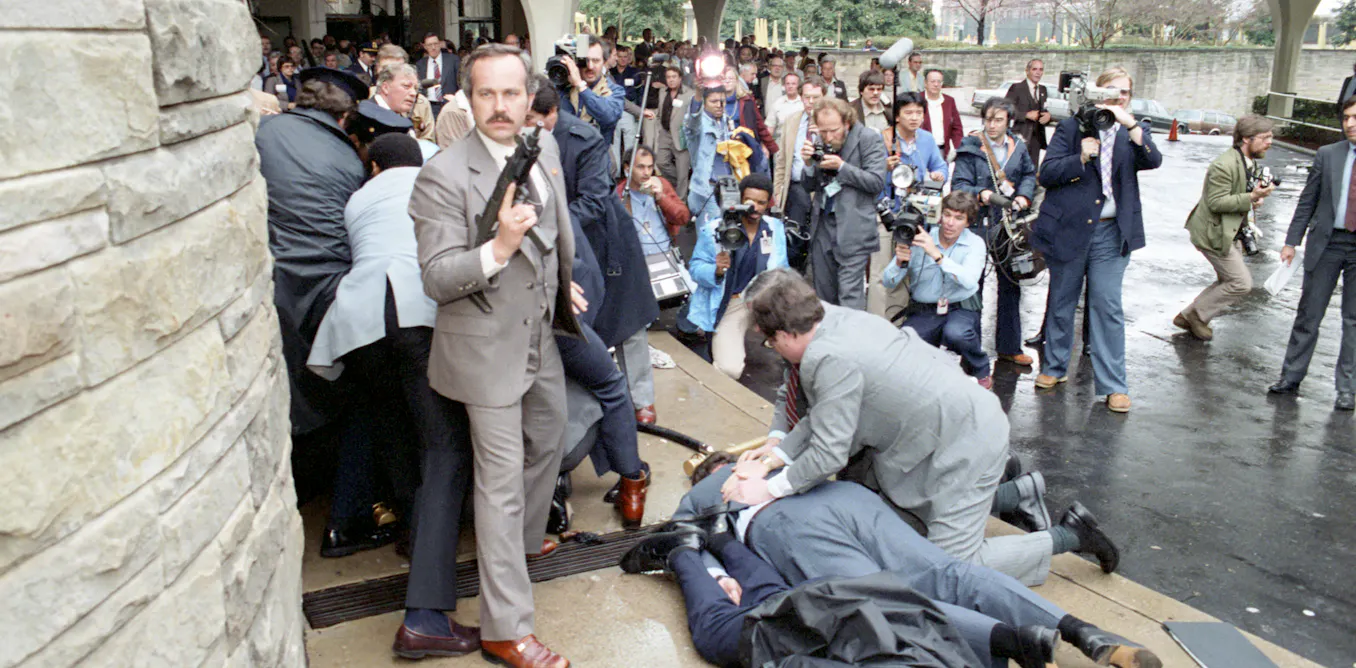
The assassination attempt targeting Donald Trump and several of his most senior cabinet members on April 26 took place at Washington’s Hilton Hotel, the very site where Ronald Reagan had been seriously wounded in a shooting 45 years earlier.
This parallel invites us to examine how the physical attacks suffered by the two Republican presidents reshaped their public image, as well as the ways in which they responded to them.
Forty-five years after the assassination attempt against Ronald Reagan on March 30, 1981, another attack targeting Donald Trump has occurred in the very same place: Washington’s Hilton Hotel.
This detail is far from insignificant, because it transforms an isolated event into a sense of continuity. The location itself becomes a stage. Political violence no longer appears merely as a singular event; instead, it seems to reenact itself, linking two presidential figures through a shared ordeal.
A place that turns violence into narrative
In 1981, Ronald Reagan, whose lung had been punctured by a bullet fired at point-blank range by John Warnock Hinckley Jr.., emerged from the episode profoundly strengthened.
Images of his discharge from the hospital, his humour in the face of mortal danger, and the media narrative surrounding the event all helped to durably establish the image of a leader who had endured, and survived, a major ordeal. Only hours after being shot, Reagan joked to his surgeons, “I hope you are all Republicans.”
The remark immediately spread across the country and helped shape the image of a courageous president, composed and self-assured even in the face of death.
Today, Trump – who had already experienced a similar moment on July 14, 2024, when he emerged with a raised fist and a bloodied ear after surviving an assassination attempt at a campaign rally — appears in a different yet comparable situation in one crucial respect: exposure to violence reinforces the posture of a besieged leader. For nearly a decade, his political rhetoric has largely rested on the idea of an America under threat, surrounded by enemies both foreign and domestic. Each attack therefore strengthens an already established narrative: that of a leader targeted precisely because he embodies a form of political resistance.
In both cases, the event therefore extends beyond the violent act itself, as it is immediately absorbed into a political narrative. Yet this narrative does not operate on its own. It relies on sustained media coverage that transforms violence into a major political sequence. If violence creates the event, the mediated narrative turns it into a political moment.
A premeditated attack in a highly symbolic space
The information now available about the April 25 attacker, Cole Tomas Allen, confirms that he had planned the attack well in advance. The 31-year-old man had crossed the United States carrying several weapons and had booked a room at the Hilton weeks beforehand.
According to investigators, he intended to target Donald Trump as well as several political officials attending the White House Correspondents’ Dinner.
His writings, a mixture of confession, political manifesto, and farewell message, reveal an accumulation of personal and political grievances directed at the Trump administration.
Authorities also indicated that he did not expect to survive the attack, anchoring his actions in a sacrificial logic that has become relatively common in contemporary mass violence. This dimension is important because it moves away from the idea of a purely impulsive or irrational act. Research on mass shooters has highlighted trajectories often marked by social isolation, forms of humiliation, or a search for recognition. In many cases, the act of violence emerges within an environment saturated with violent and highly mediatised narratives.
Media coverage therefore does not merely function as a channel of information. Through the repeated circulation of images and attackers’ names, it can, for certain individuals, contribute to making such acts seem genuinely possible — that is, imaginable. As violence is replayed continuously, it becomes embedded within a familiar mental horizon in which acting out violently may come to appear as a brutal means of attaining public visibility.
The location as a political stage
The choice of location plays a central role in this dynamic. These attacks do not occur in neutral spaces: schools, shopping malls, universities, sites of political power, and government buildings all concentrate visibility and media resonance. They function as stages exposed to the nation as a whole.
The Washington Hilton functions, in this respect, as a space of political memory. Already associated with the assassination attempt against Ronald Reagan, it instantly transforms the event into part of a historical continuity. This site of memory generates meaning even before any political interpretation takes shape and extends far beyond the individual act itself.
The comparison between Cole Tomas Allen and John Warnock Hinckley Jr.. nevertheless highlights important differences. Hinckley acted within a deeply personal and obsessive logic combining media fascination with a fixation on the actress Jodie Foster. Allen, by contrast, appears to have been engaged in a far more overtly political and ideological undertaking.
Yet one common feature remains: in both cases, the act targeted a highly visible space now heavily charged with symbolic meaning. Contemporary political violence therefore does not target individuals alone. It also targets places, symbols, and narratives.
A media polarisation that immediately transforms violence into political confrontation
This evolution cannot be understood without situating these events within the recent history of the American media landscape. The Ronald Reagan presidency marked a major turning point with the gradual disappearance of the Fairness Doctrine in the late 1980s. Until then, this regulation had required broadcast media to cover controversial issues in a balanced manner.
Its repeal gradually paved the way for a far more polarised media system, in which information became a space of permanent ideological confrontation. The rise of conservative talk radio, followed by cable news networks and social media platforms, fragmented the American public sphere into competing narratives.
In this context, every violent event immediately becomes the object of competing interpretations. For Donald Trump supporters, the attack reinforces the idea of a leader persecuted for challenging parts of the political and media establishment. For his opponents, by contrast, the attack reflects a climate of political tension to which Trump’s rhetoric and his tendency to polarise public debate are seen as having contributed.
Violence thus ceases to be merely a shared tragedy and becomes instead an element of political struggle, used by each side to reinforce its own interpretation of the country, power, and threat.
Firearms as a political imaginary
The issue of firearms occupies a central place in this dynamic. Their widespread circulation sustains a political imaginary grounded in self-defence and the perception of permanent threat. In the United States, firearms are not merely associated with security or recreation; they also function as a cultural and identity marker deeply rooted in sections of American conservatism.
This system operates in a self-reinforcing loop: fear encourages armament, while the omnipresence of firearms makes violence more likely. Each new attack generates a sense of insecurity that, in turn, further legitimises gun ownership.
It is precisely within this tension between gun culture and the direct experience of violence that the comparison between Ronald Reagan and Donald Trump becomes particularly revealing. Reagan, despite being a major figure of American conservatism and a defender of the Second Amendment, gradually shifted his position after surviving the 1981 assassination attempt, notably in an op-ed published in The New York Times. In the 1990s, after leaving office, he publicly supported the Brady Act, legislation strengthening background checks on firearm sales — named in honour of James Brady, the White House press secretary who was severely wounded alongside the president on March 30, 1981, and left permanently disabled by his injuries. Reagan then acknowledged that stricter gun regulations could have saved lives.
Donald Trump, by contrast, has maintained a firmer defence of gun rights, including after having personally been targeted by violence. This difference reflects a deeper transformation within the Republican camp: for Ronald Reagan, violence led, at least partially, to a form of reassessment, whereas for Trump it has tended instead to reinforce an already consolidated political narrative centred on danger and confrontation.
When the place outlives the event
The attack against Donald Trump is not an isolated event. It occurred within a broader context of political polarisation and violence targeting public officials in the United States.
The January 6 United States Capitol attack had already revealed the intensity of a polarisation in which part of the political conflict has now shifted onto the physical and security terrain.
Perhaps most striking, however, is the persistence of the place itself. Forty-five years after Reagan, Washington’s Hilton Hotel reemerges as though certain spaces retain the memory of the violence that has passed through them. The location no longer merely hosts the event; it gives it an immediate historical depth and connects multiple moments of American political life through the same stage.
From Reagan to Trump, the political effects may differ, but one constant remains: exposure to violence can strengthen the symbolic power of political authority. While political violence has long been part of American history, its constant media circulation and its inscription within a deeply polarised landscape now give it a particular resonance, in which every attack immediately becomes a political and media confrontation that extends far beyond the event itself.

A weekly e-mail in English featuring expertise from scholars and researchers. It provides an introduction to the diversity of research coming out of the continent and considers some of the key issues facing European countries. Get the newsletter!
This article was originally published on The Conversation. Read the original article.