THOSE LITTLE THINGS
Sport, wrote George Orwell, is war minus the shooting. As the World Cup moves on, the casualty rate seems to increase and a few more stretcher-bearers may be needed in Cardiff and Twickenham this weekend.
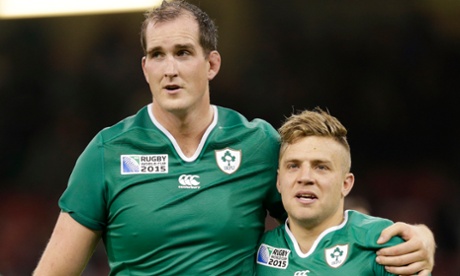
Sunday’s match between Ireland and France at the Millennium Stadium was brutal even by modern standards. It brought to a premature end the international career of one of the most influential players in the professional era, Paul O’Connell, a giant of a man as well as a player whose pain after suffering a serious hamstring injury was never going to wipe away his victory smile.
For O’Connell, the team, be it Munster or Ireland, has always come first and it is that ethos which helps Ireland, and Wales, overcome adversity. O’Connell followed Jonathan Sexton off the pitch on Sunday and the flanker Peter O’Mahony was helped off with what turned out to be a tournament-ending injury. Joe Schmidt’s team were three key players down, but it made no difference: up stepped Ian Madigan, Iain Henderson and Chris Henry who all made rather large boots fit them comfortably.
It was the same with Wales against England at Twickenham a few weeks before. Already depleted through injuries, they found themselves with 12 minutes to go having an outside-half at full-back, a wing in the centre and a scrum-half on the wing. They were seven points down against the hosts, their tournament heading for the knockout stage a few weeks early.
The disruption did not shrink the whole. Wales, like Ireland, have highly talented players but they are not teams of individuals. The end of the group stage promoted a flurry of pundits picking their teams of the tournament. Very few players from Ireland and Wales were chosen, a cue for outrage.
It should be taken as a compliment rather than an insult. Wales and Ireland are teams in the full sense of the word and as the Rugby Football Union conducts its review into England’s Word Cup campaign, it may reflect on how two of their Six Nations rivals have, with fewer resources, made themselves so hard to beat, armed with emotional intensity.
Was it a coincidence that Wales and Ireland defeated the two major nations in the world who have club systems where the national side does not come first? England and France had an intense buildup to the tournament with the squads taken away on camps to help with conditioning and bonding, but when they found themselves in the battleground trenches, did they have mates alongside them or colleagues?
The England No8 Billy Vunipola was not being flippant when he suggested the England players should have bonded over a beer during the World Cup to help break down barriers. “You want to get to know someone on a deeper level because, when you are on the pitch, it helps,” he said, referencing the way Brendan Venter brought players closer together when he took charge at Saracens.
Little things make a difference in the furnace of a World Cup, a tournament that is different to the Six Nations and far more so than friendly autumn internationals. It is not to say that England were divided tribally during the tournament, but the squad was drawn from nine clubs (counting Kieran Brookes as a Newcastle player before his move to Northampton), the same number as France.
No country used to be more tribal than Wales when it had a club system. Their 1995 World Cup campaign, which admittedly never threatened to amount to much, fell apart completely when players from Cardiff and Swansea fell out. There had been numerous examples of club differences fracturing squad harmony before that, but since regions were introduced 12 years ago, the bitter rivalry has been diluted to such an extent that the lack of impact made by the four regions in Europe has not impeded Wales.
Their togetherness has helped paper over certain deficiencies, three tries in their three major pool matches with none supplied by an outside-back is not the most impressive return, as well as giving them a collective strength that has helped them overcome adversity; ditto Ireland.
In the final 10 minutes at Twickenham last month, it should have been Wales, forced to change three of their backs in quick succession, who should have been on the back foot, but it was the voluntary switch made by England, George Ford for Sam Burgess on 69 minutes, that seemed to have the negative effect.
Had England kicked the penalty at the end and secured a draw against Wales, they would have been preparing for a quarter-final this week if the subsequent group matches had panned out as they were to, but when they needed to dig deep, when they had matches either in their grasp or within reach, they were unable to seize the moment, poor decision-making and indiscipline costing them. England had in the previous 10 months beaten both Australia and Wales but when it most mattered, playing in front of their own supporters in a tournament they were hosting, they were not as strong collectively as their opponents and did not harness emotion positively.
While Wales and Ireland overcame setbacks to vanquish familiar Six Nations foes, they now have to prove themselves against teams who are cut from the same cloth while having greater skill levels. That may not come in the form of Argentina for Ireland on Sunday, although the Pumas have developed their attacking game since being part of the Rugby Championship, but if they make the semi-finals for the first time Australia will probably lie in wait.
For all their achievement in making the semi-final in 2011, Wales defeated Samoa and Ireland on the way, and while they will not be bullied by South Africa in Saturday’s quarter-final at Twickenham, they will need more than courage and an indomitable spirit. The moment skill under pressure became the key against Australia last weekend, they came up short.
Ireland have so far beaten Italy and France, but under the head coach Joe Schmidt they have downed Australia and South Africa and been within a minute of securing a first victory over the All Blacks. They will have to take a step up without the player who for more than a decade has been the first out of the trenches. And it will be the spirit of Paul O’Connell that drives them on.
• This is an extract taken from the Breakdown, the Guardian’s weekly rugby union email. To subscribe, just visit this page, find ‘The Breakdown’ and follow the instructions.