A stomach that kills anthrax
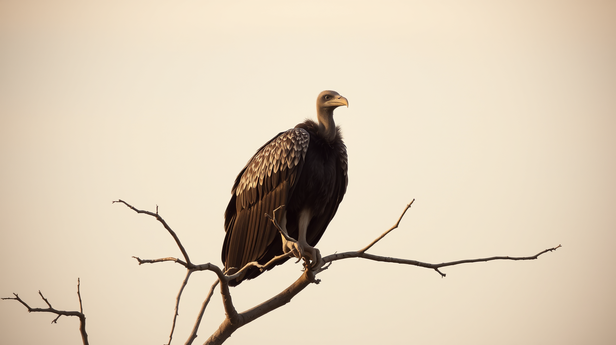
Vultures have gastric acid with a pH close to 1, among the most corrosive digestive environments measured in any vertebrate. A carcass infected with anthrax, botulinum toxin, or rabies virus passes through that acid and exits neutralised. No other scavenger in India's food web does this. Jackals spread disease. Feral dogs spread disease. Vultures end it.
This is not a secondary function. It is the ecological reason vultures exist. A single white-rumped vulture can consume two kilograms of carrion in minutes, and a group can strip a large carcass to bone in under an hour. Speed matters because the longer a carcass sits, the wider the contamination radius. Vultures are, in the most literal sense, a disease-containment system.
What diclofenac did to three species in a decade
In the 1990s, Indian farmers began using diclofenac, a common anti-inflammatory, to treat livestock. The drug is safe for cattle. For vultures that feed on cattle carcasses, it causes visceral gout and kidney failure within days. By the early 2000s, populations of the Oriental white-rumped vulture, the long-billed vulture, and the slender-billed vulture had collapsed by more than 95%. The IUCN lists all three as critically endangered.
The Bombay Natural History Society documented the speed of the collapse in field surveys across Rajasthan, Madhya Pradesh, and Uttar Pradesh. Colonies that counted thousands of birds in the late 1980s recorded fewer than a hundred by 2003. Diclofenac for veterinary use was banned by the Indian government in 2006, but the birds breed slowly, one egg per pair per year, and recovery has been agonisingly gradual. Meloxicam was approved as a safe alternative, but its adoption across rural India remains uneven.
The feral dog problem that followed
With vultures gone, feral dog populations expanded to fill the carrion niche. Dogs are far less efficient and far more dangerous. A 2008 study published in Ecological Economics, led by Anil Markandya and colleagues, estimated that the vulture collapse in South Asia contributed to a rise in feral dog numbers that resulted in tens of millions of additional dog bites and tens of thousands of human rabies deaths over a fifteen-year period. The study calculated the economic cost at billions of dollars in healthcare and livestock losses.
This is the cascade that makes vulture extinction categorically different from losing a charismatic species people happen to like. The loss restructured disease transmission across the subcontinent. Rats, jackals, and dogs filled the gap, none with vultures' pathogen-destroying capacity, and the public health system absorbed the cost invisibly, through hospital admissions and livestock mortality that no one attributed to a missing bird.
Why biodiversity cannot substitute one bird for another
Conservation biology uses the term "keystone species" for organisms whose removal causes disproportionate structural change. Vultures qualify on every measure. Their raptors status, their feeding speed, and their unique gut chemistry place them in a functional category with no redundancy. Crows eat carrion. Hyenas eat carrion. Neither processes the volume, neither neutralises the same pathogens, and neither operates at the same ecological scale.
India has nine resident vulture species, ranging from the Egyptian vulture to the Himalayan griffon. Each occupies a slightly different niche, altitude, carcass size, feeding position within a group. Losing even one species compresses the functional range of the guild. Losing three critically endangered species simultaneously, as India has, removes a tier of carrion processing that took millions of years of evolution to build.
What recovery actually requires
Vulture Safe Zones, areas where diclofenac-free livestock management is enforced, have been established in parts of Assam, West Bengal, and Uttarakhand, often in partnership with the Bombay Natural History Society and BirdLife International. Captive breeding programmes at Pinjore in Haryana hold small populations of white-rumped and long-billed vultures. Releases have begun, but reintroduction without guaranteed diclofenac-free feeding sites produces birds that die before they breed.
The harder problem is cultural. Vultures are not loved. They appear at death, they look severe, and they smell of what they eat. Conservation campaigns built around tigers or elephants draw public sympathy because those animals carry a different cultural weight. Vultures require a different argument: not affection, but the plain acknowledgment that the ecosystem service they provide is irreplaceable, measurable, and already gone in most of the country.
The collapse of India's vultures was not a warning. It was the event. What has followed, the dog bites, the disease, the slow carrion, the compromised biodiversity, is the aftermath of a system running without a part it cannot manufacture again.