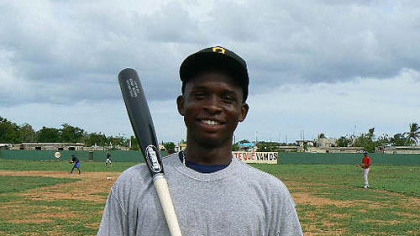
Where are the Minnesota Twins without Miguel Sanó? Probably sitting with all the other ends of the sticks, balancing out the ethics of playing September spoiler while trying not to compromise a high draft position. Instead, the slugging Sanó is a big reason the Twins are in with a shot, just a short hot-streak away from a high-stakes wildcard date with the Yankees or Blue Jays.
Of course, Minnesota aren’t a one-man team - Sanó wasn’t actually on the field during the Twins magical 20-7 month of May, one in which Paul Molitor’s Twinkies popped the bubble of pundits who picked them to finish last in the AL Central: he was down in double-A for one last shake of baseball seasoning.
But once he was promoted in July, Sanó, more than any other Twins bat became responsible for keeping their already overachieving offense afloat, and the Twins in the race for the post-season. His .965 OPS doesn’t say it all but it says a lot, as do home runs that feature flight plans and a beverage service – no wonder the baseball world can’t stop ogling.
How good has he been? Well, despite playing in just 67 games this season, the 22-year-old (possibly/probably/maybe) Dominican is still very much in the American League Rookie of the Year conversation, that despite facing the fastest fastballs in baseball, despite playing most of his games at DH (he also plays third base) and despite playing fewer games than, say, Carlos Correa of the Houston Astros.
In short, during an era in which the power-bat prospect has overtaken the pitching phenom in terms of excitement and rarity, there isn’t a team in baseball that wouldn’t move the earth to have that type of player on their roster.
Especially the Pittsburgh Pirates.
Ask almost any Pirates fan about Miguel Sanó and chances are their mood will quickly turn sour. That’s because the prospect who entered the season as No13 in all of baseball is widely believed to have slipped through the organization’s fingers nearly six years ago.
The account of how Sanó, who was widely expected to sign with the Pirates, eventually signed with the Twins varies widely and is extremely complex, which makes sense when you consider the lack of structure in baseball’s most vital international talent pipeline, one that brings an estimated $50m of Major League Baseball’s money into the Dominican Republic during the signing season.
The shorter story is that back in 2009, the Pirates who had then spent the last 17 years finishing under .500, were heavily courting the then (possibly) 16-year-old Sanó, whose can’t miss skills were featured widely across the various US publications and the subject of a documentary titled Pelotero.
In the documentary, Rene Gayo, Pittsburgh’s Latin America scouting director, is seen to use a debate surrounding the accuracy of Sano’s age, (if a player is older than he says he’s less valuable and also subject to MLB penalties for lying, not to mention the visa ramifications) as a tool to hammer out a better deal for the Pirates, which was said to be $2.6m. Tensions between the family, the team and the representatives opened the door for the Twins to swoop in and sign Sanó for $3.15m, shocking Pirates fans who had seen the slugger-in-waiting wearing a Bucco’s hat, denying them the talent they dubbed “Hanley Pujols”, one pegged to become the franchise centerpiece for years to come.
It’s a pain that lingers, even after Pittsburgh managed to completely turn around their organization, transforming themselves from the perennially tormented to tormentors as they head towards their third consecutive post-season appearance.
For a time, Bucs fans could only imagine what it would be like to juxtapose their stellar pitching pitching staff with a lineup that features Miguel Sanó and Andrew McCutchen - now that he’s up with the Twins and tearing up the league, they avoid Twins box scores at all costs.
Having said that, the emergence of Jung Ho Kang, the South Korean who surprised this season by providing unexpected production at the hot corner, did help ease that pain, at least temporarily. Then, last week, Kang suffered a broken left leg and torn MCL when slid into by the Chicago Cubs’ Chris Coghlan, an injury that ends his season, and creates a large hole in the lineup and at third base. That’s the position Sanó might have played with Pittsburgh, thus opening those wounds surrounding their lost-slugger all the wider.
Aside from this season, having Sanó in the lineup over the long haul would’ve served as protection in the NL Central, which has, rather incredibly, gone from a graveyard to MLB’s division of death in a relatively short span. The Chicago Cubs have churned out phenom after phenom, while the St Louis Cardinals continue to be a force regardless of the issues thrown at them.
The Pirates do have a deep farm system, but even so their window to win seems short. Should it close without their first World Series title since 1979, the sting of losing out on Sanó will continue to haunt the franchise for years to come.