
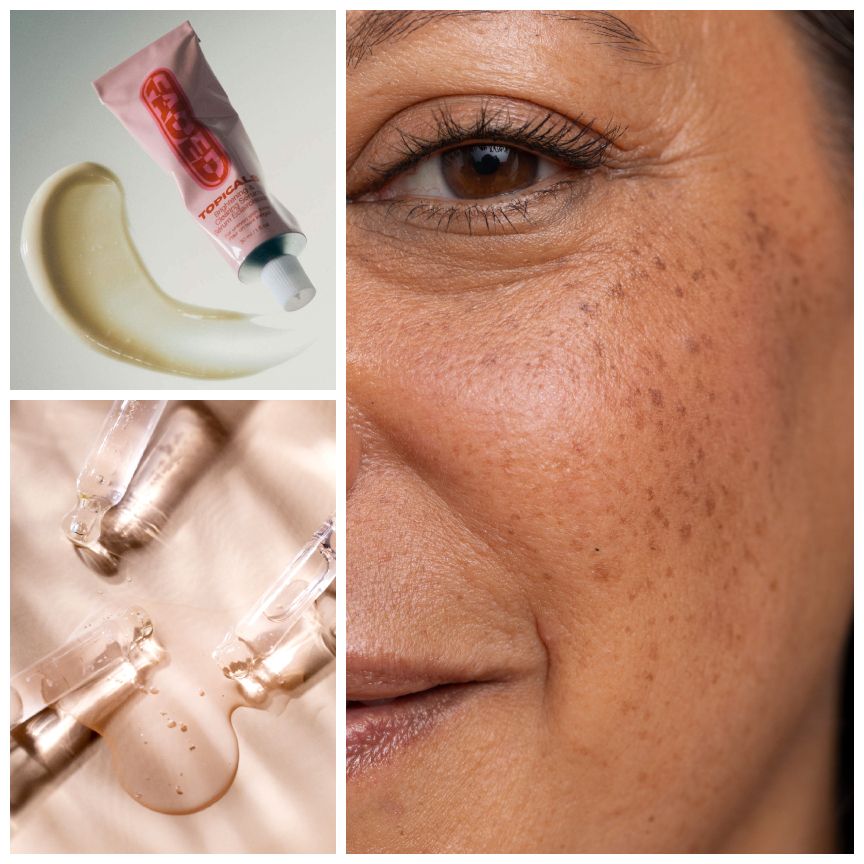
I used to treat my dark spots with the best ingredients in the book—vitamin C, niacinamide, and retinoids. I can’t deny that they work; they’re the gold standards, backed by solid scientific evidence. That said, while they help discoloration disappears, it comes back just as quickly after just one beach weekend, heat wave, or hormonal flare. The truth? Not all discoloration behaves the same way. Some pigment is simply more reactive and can be triggered again by third-party factors, even after you’ve seen real improvement. That’s why consistency alone doesn’t always fix the problem.
That’s where the hot ingredient on the block, tranexamic acid, comes in. Instead of focusing only on fading what’s already visible, it works earlier in the process—helping prevent pigment from being triggered in the first place. It’s why this ingredient has become one of the most reliable tools I reach for when my dark spots get a little tricky.
Research shows that tranexamic acid’s effectiveness can rival that of hydroquinone, long considered the go-to for lightening hyperpigmentation. Hydroquinone works by directly suppressing melanin production, but it can be irritating and isn’t designed for long-term use. Tranexamic acid takes a more gentle approach, helping prevent pigment from being triggered rather than shutting it down outright. Which is why it’s often better tolerated and suitable for extended use, including for melasma-prone skin.
TL;DR: Tranexamic acid is worth adding when dark spots improve, but don't stay gone. Below, board-certified dermatologist Mona Gohara, MD, breaks down exactly how it works, who benefits most, and when to use it in your skincare routine.
What Is Tranexamic Acid and What Does It Do?
To understand how tranexamic acid works, it helps to first understand how hyperpigmentation forms. When skin is triggered by UV exposure, heat, hormones, or inflammation, it releases little chemical messengers that tell melanocytes (i.e., the skin’s pigment-producing cells) to ramp up melanin production. Over time, that chain reaction leads to dark spots and uneven tone.
Tranexamic acid is a targeted brightening ingredient that helps interrupt that process, rather than only fading dark spots after they've already formed. The ingredient, interestingly, wasn’t originally created for skincare. In fact, it’s long been used in medicine—most commonly in oral and injectable forms during surgery—to help control bleeding and clotting. Dermatologists later realized that tranexamic acid also affects inflammation and blood vessel activity in the skin—both of which play a role in how pigment forms—so they began studying it for pigmentation concerns like melasma.
As Dr. Gohara explains, “Tranexamic acid blocks those messages, specifically the pathways between inflammation, blood vessels, and pigment production.” Instead of aggressively attacking pigment as it appears, it helps to stop the process that causes it. Dr. Gohara paints a picture: “Tranexamic acid turns off the faucet that keeps refilling the sink.”
Today, tranexamic acid is still available as a prescription oral form in select cases of melasma, but it's also been adapted into topical skincare formulas. Because it’s non-exfoliating and doesn’t bleach the skin, tranexamic acid is generally easier to tolerate than many traditional brightening ingredients, especially for sensitive or reactive skin types.
What Types of Pigmentation Does Tranexamic Acid Work Best For?
Tranexamic acid works best for pigmentation caused by inflammation and hormones. That includes melasma, post-inflammatory hyperpigmentation from acne or insect bites, and lingering sun-induced brown patches.
According to Dr. Gohara, it’s especially effective for people whose pigment worsens with heat, sun, or irritation—and for those with medium to deep skin tones, who are more prone to reactive pigmentation. “Patients who feel like their dark spots ‘come back no matter what’ often respond well,” she says, because tranexamic acid targets the signaling process, not just pigment already sitting in the skin.
Why Choose Tranexamic Acid Over Other Brightening Ingredients?
One of the biggest reasons to choose tranexamic acid is tolerance. Many people can’t use strong retinoids or high-strength acids every day without irritation. Tranexamic acid is non-exfoliating, generally well-tolerated, and Dr. Gohara says it's safe for daily, long-term use. This makes it especially appealing for sensitive, rosacea-prone, or melasma-prone skin. It is also a great alternative to ingredients like hydroquinone, which can be effective but aren’t intended for prolonged use.
The best part? It fits easily into an existing routine instead of replacing anything. Think, vitamin C in the morning, a retinoid at night (as tolerated), and tranexamic acid layered in to help prevent pigment from returning is often a smart, low-lift approach. Rather than competing with other brighteners, it helps stabilize and enhance the results they’re already delivering.
How Long Does It Take for Tranexamic Acid to Work?
Tranexamic acid rewards consistency. Most patients start to see visible improvement within six to eight weeks, with more noticeable results after about three months of regular use. That said, pigment treatments, like most skincare, only work if you protect your progress. As Dr. Gohara puts it, “Pigment treatments are marathons, not sprints”—and daily sunscreen is essential, or you’re undoing the work you’ve already done.
Can Tranexamic Acid Be Used on Rosacea-Prone Skin?
Because it’s non-exfoliating and helps calm inflammation-driven pigment, Dr. Gohara says that tranexamic acid can be appropriate for rosacea-prone skin, but your approach matters. She emphasizes that extra ingredients are often a no-go with rosacea, so starting slowly is key. If you have rosacea, avoid layering tranexamic acid with strong acids or retinoids at first, and pair it with barrier-supporting moisturizers.
If redness is the primary concern, calming the skin should always come before correcting discoloration. “Calm the skin first, correct second,” she says. When inflammation is under control, pigment is much easier to manage.
The Best Tranexamic Acid Products
When talking to a slew of dermatologists, SkinMedica's Even & Correct Advanced Brightening Treatment always popped up. Dr. Gohara agrees, saying, "It's a standout because it pairs tranexamic acid with niacinamide and peptides to address discoloration while supporting overall skin health."
The Vichy LiftActiv B3 Serum is another Dr. Gohara recommendation as it combines tranexamic acid with niacinamide and gentle exfoliating acids to improve tone and clarity. It's not "overly aggressive," she says.
For a drugstore pick that has the seal of approval from many of Team MC Beauty, look no further than the Naturium Tranexamic Topical Acid 5%. It combines tranexamic acid with kojic acid, niacinamide, and licorice root extract for a one-two punch against dark spots.
Dealing with a hormonal flare that results in post-breakout dark spots? Snag the Topicals Faded Brightening Serum. It features azelaic acid, an ingredient that kills acne-causing bacteria, alongside tranexamic acid to help achieve bright, clear skin.
If your melasma is on the trickier side, opt for a prescription-strength topical. Musely pairs you with a provider who will prescribe a specific formulation right for your skin type. (FYI, "HQ Free" is the formula that features tranexamic acid.)
An easy way to incorporate tranexamic acid into your skincare routine is with this exfoliating toner. I find that the Eadem one—featuring tranexamic acid—is gentle enough to use on my retinol nights, and gives me the softest, brightest skin.
Why Trust Marie Claire
For more than 30 years, Marie Claire has been an internationally recognized destination for news, fashion, and beauty trends, investigative packages, and more. When it comes to the products Marie Claire recommends, we take your faith in us seriously. Every product that we feature comes personally recommended by a Marie Claire writer or editor, or by an expert we’ve spoken to firsthand.