A month before the independence referendum, Piers Morgan, the former editor of the Daily Mirror, took time out from defending all things Kevin Pietersen and turned his attention to Scottish politics. “Ok Scotland, you’ve had your fun. Now just quietly vote No and we’ll say no more about it,” he tweeted.
It may have been a deliberate provocation, but the sentiment that this independence business was a colourful aberration that would quickly fade away was dominant in Westminster. Indeed, as far as the Labour party was concerned, the whole point of the referendum was to deal a crushing blow to the Nats, watch them implode, have a good laugh at Alex Salmond and then restore the proper order of things by harvesting votes with dire warnings of the impact of a Tory victory in May.
But like some of Pietersen’s reverse sweeps, today’s poll results from Lord Ashcroft suggest this might have been an overoptimistic plan.
Of course, Labour may yet turn things round. It’s only five years since the party recorded an impressive performance in Scotland in the last Westminster general election. But there may also be more deep-seated trends that point to continued Scottish National party success.
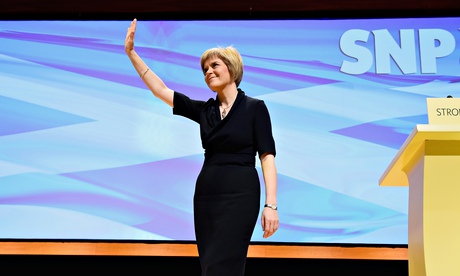
Among Scottish commentators it’s tempting to see everything through the prism of September’s referendum, while those in London see it through an “anti-Westminster politics” narrative. Although both factors are important, they also ignore a simple, perhaps obvious, factor: a lot of people in Scotland like the SNP. At Holyrood, both the first minister, Nicola Sturgeon, and the SNP as a whole enjoy poll ratings almost unheard of for a party approaching the end of its second term in government. This has been the result of years of sometimes painful, engagement and, crucially, of building a sense of optimism and possibility. The old cry from opponents that the nationalists have prospered by fostering grievance perhaps explains why those opponents have struggled so much in recent years.
In fact, the SNP relentlessly talks Scotland up. It uses the language of the future, it welcomes immigrants, it makes a positive case for EU membership and has managed to show a good proportion of the electorate that it is on their side. Working for the party back in 2003, amid a disappointing Scottish parliament election result, I remember trying to convince myself that there were signs of hope. In big city constituencies in Dundee and Aberdeen we had taken seats from Labour in first-past-the-post contests. In hindsight, these results now look significant. Yet at the time they were no doubt ignored by Labour as a flash in the pan, as it settled down to take its “traditional” vote for granted.
The big change that may occur this year is that until now the SNP has not been able to repeat its success at Holyrood in UK general elections. This is where the referendum could be a major factor. During the campaign, when the Westminster parties acted in concert day after day to warn of the catastrophe that would befall Scotland should we vote yes, it seemed even then as if there may be a price to pay.
Although George Osborne and Ed Balls appear to be at each other’s throats now, they clearly coordinated their responses during the referendum, particularly on the currency issue. Bizarrely, throughout that campaign we had senior Labour figures defending not only the Conservatives’ right to govern Scotland with just a single elected MP, but also in effect defending the Tory record.
Even with Osborne as chancellor, the Scots were told, there was economic strength and security. Even with Iain Duncan Smith’s dismantling of the welfare state we were guaranteed to live in a UK that pooled and shared resources. And when the Scottish government said Tory privatisation of the NHS in England would lead to budget cuts in Scotland, Labour assured people this was all “a big lie”.
This all matters because Labour in Scotland has moved seamlessly to warning people about the impending doom of an independent Scotland to warning about the coming disaster of another Tory government and the need to get Miliband into Downing Street. But as a party if you’ve stood shoulder to shoulder with the Conservatives, coordinated a campaign behind the scenes, assured people that David Cameron is alright really, it’s not surprising that many voters are turning to the SNP to protect Scottish interests.
Most people in Scotland want proper devolution of tax and welfare powers. Many will be worried about the extent of the spending cuts coming from Westminster. For a good number, in these straightened times the idea of spending £100bn on a new generation of nuclear missiles based on the Clyde will seem like madness.
For all these reasons, it seems people in Scotland are increasingly unwilling to “say no more about it” and have decided that this is, in fact, a time to say a lot.