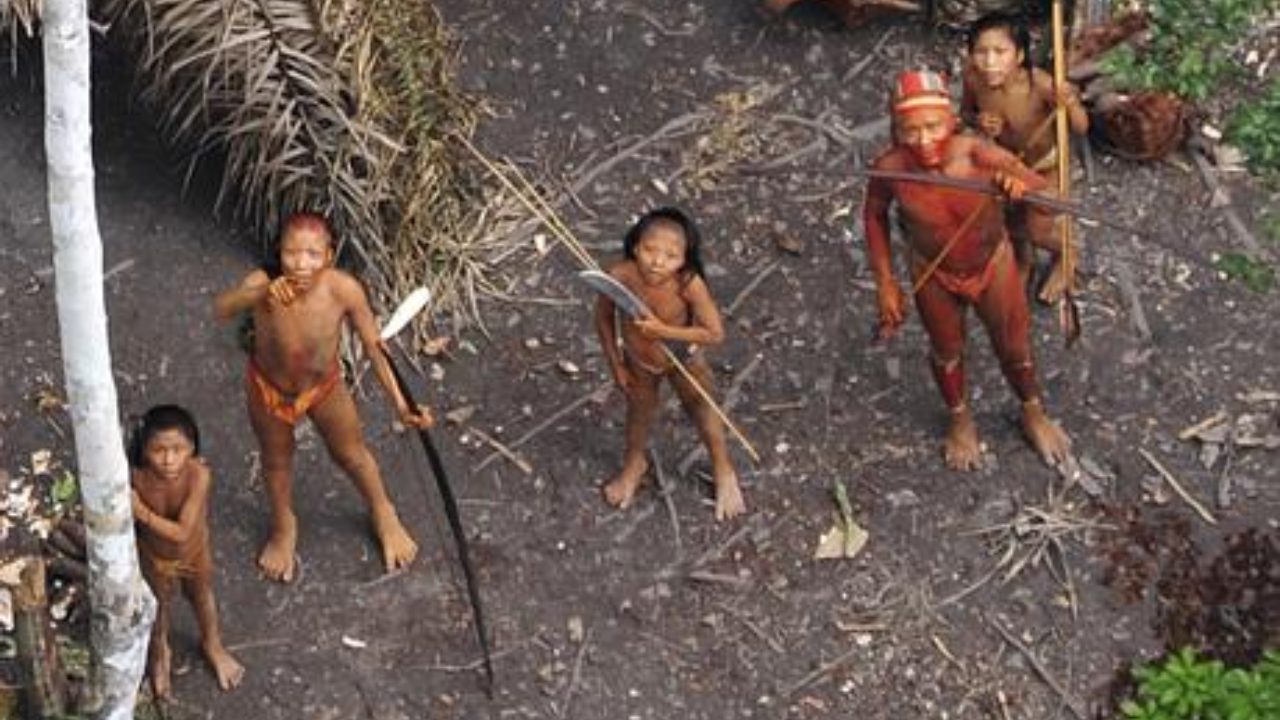
In the eastern Indian Ocean lies a forest-covered island roughly the size of Manhattan, home to one of the last communities on Earth living in complete voluntary isolation. The Sentinelese, an Indigenous people inhabiting North Sentinel Island in India's Andaman and Nicobar Islands, have resisted outside contact for centuries. Armed with bows, arrows and spears, they continue to hunt, gather and fish using traditional methods while defending their island from anyone who approaches. Their language has never been deciphered, and almost nothing is known about their culture because meaningful communication has never been established. Their determination to remain isolated has made them one of the world's most protected and least understood human communities, raising important questions about anthropology, disease, ethics and conservation.
Get breaking news anytime, anywhere. Download the TOI app now!
Why do the Sentinelese reject all contact with outsiders
Sentinelese have consistently resisted contact with the outside world, responding to approaching boats, helicopters and people landing on their shores with warning gestures or attacks. Anthropologists believe this behaviour is rooted in a long history of isolation and self-sufficiency rather than hostility alone.
Unlike many Indigenous communities that have gradually interacted with neighbouring societies, the Sentinelese have maintained their independence for thousands of years. According to Survival International, they continue to obtain food through hunting, fishing and gathering, relying entirely on the island's natural resources. Their isolation has allowed them to preserve a unique way of life that has changed little over generations.
As per a press release by the Ministry of Home Affairs , the Government of India recognises North Sentinel Island as a protected tribal reserve and prohibits anyone from approaching its shores, both to safeguard the Sentinelese and to protect outsiders from potentially dangerous encounters.
Why is the Sentinelese language still a mystery
One of the greatest unanswered questions surrounding the Sentinelese is the language they speak. Despite decades of anthropological interest, no outsider has held a sustained conversation with a member of the community, leaving their language undocumented and undeciphered.
According to a study titled Sentinelese contacts: anthropologically revisiting the most reclusive masters of the terra incognita North Sentinel Island, “The conundrum is that their language, customary laws, traditional knowledge systems, and other social practices are still unknown. They are the most well-built and reclusive band of people with no affinity to neighbouring tribes of the same archipelago.”
Linguists believe it is likely distinct from the languages spoken by neighbouring Indigenous groups in the Andaman Islands, but there is insufficient evidence to classify it with certainty. Without prolonged interaction or mutual communication, researchers cannot determine its vocabulary, grammar or linguistic origins.
Every language represents a unique store of human knowledge and cultural identity. In the case of the Sentinelese, that knowledge remains entirely inaccessible because respecting their wish for isolation takes precedence over scientific curiosity. On the other hand though the neighboring tribes such as Onges, Jarawas, and Great Andamanese had shed their hostility and are now somewhat partially dependent on the Andaman & Nicobar Administration for daily sustenance.
How have the Sentinelese survived in isolation for thousands of years
North Sentinel Island provides the resources necessary for the Sentinelese to sustain themselves without outside assistance. They hunt wild animals using bows and arrows, catch fish in the island's surrounding reefs and gather fruits, roots and other edible plants from the forest.
In 2004, the Tsunami had wreaked havoc in the region. Despite such adversities, the Sentinelese had miraculously survived, as discovered during post-tsunami expeditions. This might be due to their closeness to Mother Nature and their indigenous knowledge system. The foresight and wisdom gained by such a populace are through experience, and such experience is passed down from one generation to the next
Anthropologists believe they also salvage useful materials, such as metal washed ashore from shipwrecks, repurposing them into tools and weapons. This ability to adapt available resources while maintaining a traditional hunter-gatherer lifestyle has enabled the community to remain self-sufficient despite centuries of global change.
The wreckage of ships on the coastline of North Sentinel Island led to the use of metal tips of arrows. Moreover, a rescue mission in 2006 showcased the presence of hunting strategies and formation among the Sentinelese populace.
The Sentinelese are among the few remaining peoples whose lives remain almost entirely independent of the modern world, making them an invaluable example of human cultural diversity.
The aforementioned study mentions that “Sentinelese” as a populace is completely separated and very little data is available on them. The rest of the autochthons such as the Andamanese, Onge, and the Nicobarese or even the non-tribal people think of them as unfriendly tribes who would not be able to adjust to their social coterie.”
What happened to American missionary John Allen Chau in 2018
On 17 November 2018, John Allen Chau, a 26-year-old American missionary, illegally travelled to North Sentinel Island despite strict legal protections prohibiting contact with the Sentinelese. He illegally paid local fishermen to take him to the protected North Sentinel Island in an attempt to preach Christianity to the Sentinelese, despite strict restrictions on approaching the tribe. According to his diary, he was initially driven back after being struck by an arrow shot by a young Sentinelese before returning to the island, where he was killed on 17 November 2018.
The incident drew international attention and reignited debate over the ethics of contacting isolated Indigenous peoples. Health experts warned that even peaceful encounters could prove catastrophic. Because isolated communities have little or no immunity to many common infectious diseases, illnesses that cause only mild symptoms elsewhere can spread rapidly and become deadly.
Following the incident, Indian authorities reaffirmed the exclusion zone surrounding North Sentinel Island and reiterated that protecting the Sentinelese from outside contact remains the government's priority.
Why do scientists believe the Sentinelese must remain isolated?
Modern anthropology increasingly supports a policy of non-interference with voluntarily isolated peoples. Researchers argue that the greatest threat facing communities such as the Sentinelese is not their isolation but unwanted contact. A direct physical contact can result in the transmission of various diseases for which they might be unprepared, which can lead to the extinction of the entire “Sentinelese” populace.
According to the World Health Organization (WHO) , isolated Indigenous groups are especially vulnerable to infectious diseases such as influenza, measles and respiratory infections because they have never developed immunity through previous exposure. Throughout history, first contact has often led to devastating population declines among Indigenous communities.
For this reason, India's protection of North Sentinel Island is regarded not simply as a legal measure but as a public health necessity. Preserving the Sentinelese's right to remain isolated also protects one of the world's last surviving examples of an autonomous hunter-gatherer society, offering a rare reminder that human civilisation has followed many different paths.