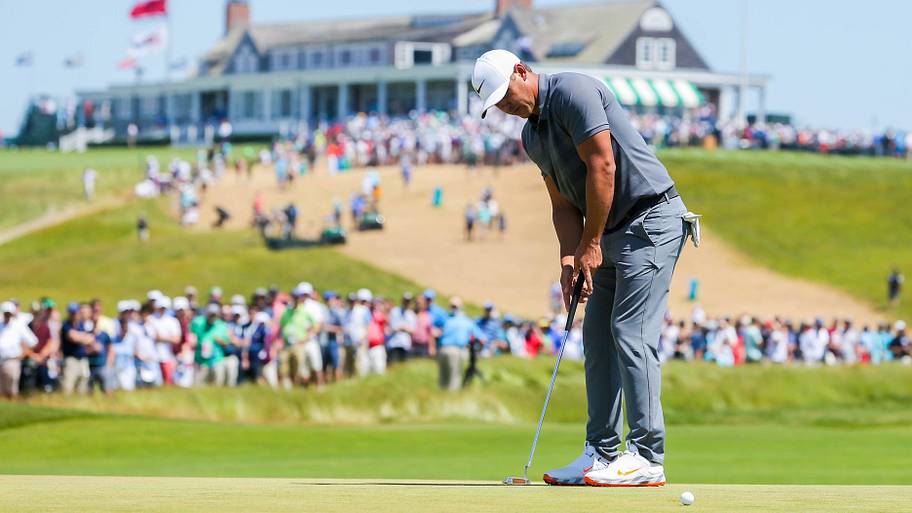
The 2026 U.S. Open kicks off Thursday at the famed Shinnecock Hills Golf Club in Southampton, N.Y., in what should be a fun four days for those watching the action, and a treacherous four days for those trying to take home what is usually the hardest major championship to win.
The legendary course has hosted the U.S. Open five times, dating back to 1896 when James Foulis got the win (and a $200 payday) in a field that had just 11 golfers battling it out.
2026 U.S. OPEN ODDS: Scottie Scheffler Betting Favorite to Complete Career Grand Slam
While there isn’t much that we can learn from that U.S. Open, there is one thing that we can pick up from the other four that have been played at Shinnecock. These lessons are something that will have every player in this year’s field trembling in their shoes from the moment they arrive on the grounds until their ball finds the bottom of the cup on their final hole of the weekend.
To put it simply, Shinnecock is hard. Like, really hard. In the four U.S. Opens played there since 1986, a total of just three players have finished under par for the tournament. Ray Floyd, the winner in 1986, finished at one under. Corey Pavin, the winner in 1994, finished at even par. Retief Goosen, the winner in 2004, made things look relatively easy when he won it at four under. Phil Mickelson finished second that year at two under, with the rest of the field being at one over or worse. And in 2018, Brooks Koepka won it at one-over par.
If there’s one thing all golf fans love, it’s a bloodbath at the U.S. Open. We want rough weather conditions. We want brutal greens. We want to see professionals cursing out the golf gods (or the USGA) for making one week of their year really difficult for them.
RELATED: The 10 Best Golfers Who Haven’t Won a U.S. Open Yet, Including Scottie Scheffler
And it feels like that’s exactly what we’re going to get this week at Shinnecock.
We need it, too, because in recent years the U.S. Open has played far too easy for our liking. After Koepka’s win in 2018, the winning scores at the U.S. Open have been -13 (Gary Woodland, Pebble Beach), -6 (Bryson DeChambeau, Winged Foot), -6 (Jon Rahm, Torrey Pines), -6 (Matt Fitzpatrick, The Country Club), -10 (Wyndham Clark, LACC), and -6 (DeChambeau, Pinehurst No. 2). Last year at Oakmont brought things back to normal with J.J. Spaun being the only golfer to finish under par (-1).
So what makes Shinnecock so hard?
That’s a great question and it has two easy answers.
First, the wind. Shinnecock sits on the eastern shore of Long Island and has no defense for the winds that come ripping off the Atlantic Ocean.
Second, the course set up. There are a ton of elevated greens with false fronts, backs and sides that leave the best players in the world looking like us weekend hackers. There are some blind tee shots where you have to hit and pray you somehow find the fairway once you’re able to discover where your ball landed.
There’s also a fear-inducing par-3 11th hole that the great Lee Trevino once called “the shortest par-5 in golf.” What makes this hole so difficult is that the very small green sits 40 feet above the tee, it’s surrounded by bunkers, the false front can lead to balls rolling pretty far from the green and any ball that’s hit long will carom down a hill and put a double bogey very much in play.
Here’s a hole-by-hole look at Shinnecock, which includes two par-4s that are over 500 yards and one par-5 that is over 600 yards.
| Hole | Yards | Par |
|---|---|---|
| 1 | 399 | 4 |
| 2 | 252 | 3 |
| 3 | 500 | 4 |
| 4 | 475 | 4 |
| 5 | 589 | 5 |
| 6 | 491 | 4 |
| 7 | 189 | 3 |
| 8 | 439 | 4 |
| 9 | 485 | 4 |
| 10 | 415 | 4 |
| 11 | 155 | 3 |
| 12 | 469 | 4 |
| 13 | 374 | 4 |
| 14 | 520 | 4 |
| 15 | 409 | 4 |
| 16 | 614 | 5 |
| 17 | 175 | 3 |
| 18 | 485 | 4 |
Brooks Koepka’s all-world bogey in 2018’s final round shows you just how brutal Shinnecock can be
If you need any proof of how difficult things can be at Shinnecock, just look back to Koepka’s final round in 2018 when he made the bogey of his absolute life on the par-3 11th.
Usually pro golfers are mad when they make a bogey, especially on a short par-3. But that wasn’t how Koepka felt on this one. There was no hanging his head after his ball finally found the bottom of the cup. Instead, there was a fist pump because he knew how lucky he was to escape with relatively minimal damage.
Koepka started the hole with a bit of a pulled tee shot down the big hill behind the green and came to rest in the fescue rough. He said after his round that he was “in jail” with that second shot and could see his chances of winning the U.S. Open coming to an end right then and there. That’s when things got really interesting. Instead of risking a shot short of the flag, he deliberately hit his second shot really hard with the hope that it would race through the green and land in the bunker. His thought was that he could at least get an uphill putt for a bogey with a good shot from a bunker, and that’s exactly what he did.
“From where we were honestly I would have taken double [bogey],” Koepka said after the round. “We were in jail. You can’t miss it there and to make that big of a mistake you just want to walk away with bogey, and luckily that putt went in and that built so momentum down the stretch and made me feel a little bit better with the putter.”
You can watch how that hole played out for Koepka right here:
View this post on Instagram
What will it take this year? Probably pretty close to what Koepka did in 2018. The winner is going to be forced into making difficult decisions all week long and sometimes will have to take his medicine the way Koepka did on the 11th in his final round.
This likely won’t be a birdie fest. It will likely be a bloodbath. And there’s no better way to decide a U.S. Open than to have the last man standing being the one with just a little less blood on his clothes than everyone else.