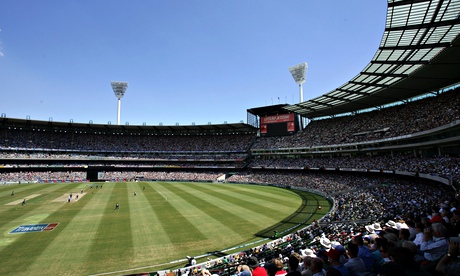
The MCG is an imposing structure, even as you approach it from a few hundred metres away. Before Sunday’s World Cup final a predicted crowd of 100,000 will enjoy a glorious stroll through Yarra Park, autumn leaves beginning to fall along the tree-lined paths. From there they’ll reach a broad concourse dotted with bronze statues of the men and women who conquered nerves, the piercing roar of the crowd and their opponents at the famous ground.
But even winners feel the darkness amid the beauty inside this cavernous, epic structure. Brent Crosswell, an Australian Rules football champion with a keen sense of these things, once said: “You can never really understand the MCG’s capricious nature, its cruel potential, its terrible inscrutability.” That from someone who walked off a hero more often than not.
When Australia meet New Zealand in Melbourne on Sunday they will enter a contest between two evenly matched teams; both possessed of left-arm pacemen of destructive capabilities, back-ups of more understated qualities and batting lineups of an explosiveness that no ground could contain.
Or can it? On the modern cricketer’s endless summer traversing the globe, he might dismiss with a quiet smirk the concept of home-ground advantage, but you wonder how much confidence Australia take into this game from knowing the venue like the back of their collective hand, not a confidence their opponents boast.
Australia’s XI on Sunday – likely to be unchanged from the semi-final win in Sydney – boasts a reassuring volume of MCG experience, the kind of spatial awareness and adaptation to idiosyncrasies that comes only via repetition. It might not help in ducking a bouncer or nailing a yorker, but the senses are perhaps better tamed, runs more judiciously appraised and the expanses of the outfield more confidently traversed.
Between them the Australians have played 312 games of professional cricket on the ground. New Zealand’s corresponding figure of 30 is bolstered by 23 belonging to a combination of ex-Western Australian Luke Ronchi and veteran Daniel Vettori, who will one day regale his grandkids with tales of the way their nation’s cricketers once felt relatively welcome across the ditch. Aaron Finch alone has played twice as many games on the ground than the Kiwis combined. Four of them haven’t even set foot on it as players.
New Zealand might have been neglected by Australia and cricket’s new administrative power structure but that has an unfortunate rider for the home side too; as their batsmen were decimated by Trent Boult’s swing at Eden Park a few weeks back one could not help but ponder what role the unfamiliarity of their opponents played. After their swift downfall, none other than David Warner and Brad Haddin could claim to be any more informed for the experience.
You can turn yourself in knots crunching Australia’s numbers in Melbourne and surprises emerge. In Tests, the ground has been the happiest of hunting grounds for Shane Watson, making him twice the batsman he is at Sydney and quadruple that in Brisbane, but in limited overs games a mere mortal and a bowling non-entity to boot.
A roaring MCG was the first international venue in the world to hold Warner in its warm embrace, back in 2009 when he appeared to have answered a newspaper classified listing before smashing 89 in his debut T20 game for Australia. Yet in limited overs games since he’s never bettered that mark, scratching out only a single half-century across seven ODIs in as many years.
On the other hand, Warner’s opening partner Finch should take up residence such is his barnstorming record in his home town. Michael Clarke, Steve Smith, Glenn Maxwell, Haddin and James Faulkner boast only middling ODI records at the ground with the latter a drastically reduced bowling threat. Forebodingly for the Kiwis but also the batsmen who’ll face up to Boult, Mitchell Starc tends to bowl like a dream in front of Victorian crowds.
Perhaps at the core of this jumping at statistical shadows and submission to myths and vibes lies a simpler truth; it’s almost impossible to split these two talented and aggressive sides. Both boast captains of steel and flair, and play in a manner that continues to push the 50-over format out of the doldrums and into the light. For Clarke at least, this game is surely a swansong of some kind.
That we have seen Australia and New Zealand play each other only thrice in the last half-decade adds refreshing exoticism to the dormant but keenly felt trans-Tasman rivalry. Both could rightly claim they played the best cricket of the past two months and perhaps something special here could provide the impetus to make sure they meet more often.
We’ve taken turns in decrying and rejoicing in what this World Cup has thrown up, but for producing a final as tantalising as this one you have to submit yourself to whatever mood the MCG turns on.