Last Friday, a few hours before the Mavericks and Lakers met at Crypto.com Arena, the two top decision-makers in Dallas’s basketball operations department huddled in a pair of courtside seats. For nine months Michael Finley and Matt Riccardi were in a bunker with Nico Harrison, the recently deposed Mavs general manager, riding out the aftershocks of February’s trade that ended Luka Dončić’s run in Dallas. With Harrison gone, Finley and Riccardi, elevated to interim co-general managers by team governor Patrick Dumont, now run basketball operations, part of a group charged with deciding whether to continue down the path Harrison set the team on—or choose a new one.
In conversations, Mavs officials will insist: We believe we can recover. Dallas, 7–15 after Monday’s 131–121 win over Denver, isn’t getting boat-raced like say, Washington and Sacramento, two teams with double-digit negative net ratings. The Mavs have played an NBA-high 17 “clutch” games—defined as games decided by five points or fewer—and have won six of them, results Dallas sees as an indication the team is close to breaking through. Close games, said Mavs coach Jason Kidd, are “only going to make us better as the season goes on.”
So, too, will a healthy roster. Nothing justifies Harrison’s decision to deal Dončić—it will forever live on the Mt. Rushmore of terrible trades—but the time the team he hoped to field has played together is literally measurable in minutes. Dallas’s injury list has been cartoonishly long. Kyrie Irving has been out all season, Anthony Davis recently made his return after a monthslong absence while Dereck Lively II and Daniel Gafford remain on the injured list. P.J. Washington was healthy … until Washington stepped on a basketball during pregame warmups in Los Angeles and was lost with an ankle injury.
Realistically, any hope for a fast-ish start disappeared when Davis went down five games into the season. The Cooper Flagg–at–point guard experiment failed, leaving Kidd to try a collection of backups (D’Angelo Russell, Brandon Williams and, most recently, Ryan Nembhard) at the position. The result was a brutally bad offense that entered Monday night’s game a full point behind even more injury-ravaged Indiana in offensive rating.
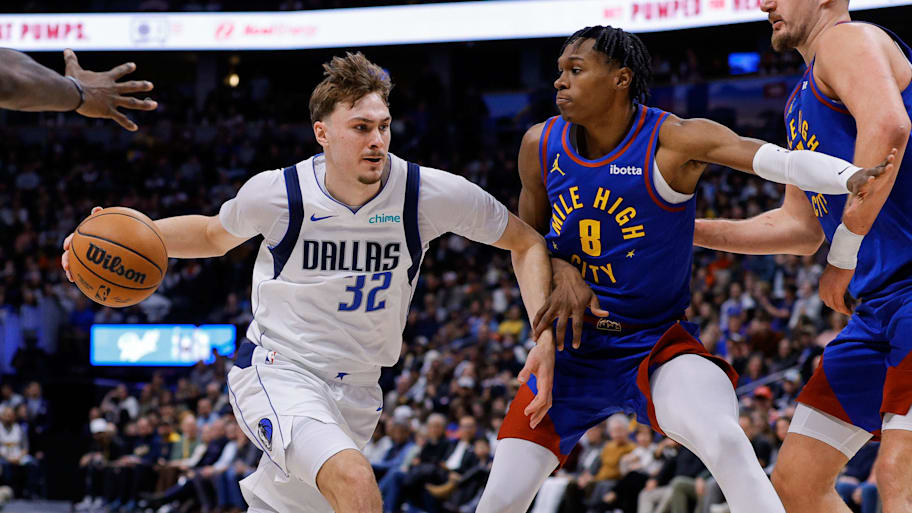
Davis’s return will boost that. Davis isn’t the playmaker Dallas needs (more on that later), but he is an offensive hub. He scored 12 points in 27 minutes in his return against the Lakers on Friday. On Monday, he racked up 32 points in 32 minutes, collecting 13 rebounds and four assists. The attention on Davis helps open the floor up for Nembhard (28 points), Flagg (24) and Klay Thompson (15).
“Offensively and defensively, he’s the anchor for us,” said Nembhard on Monday. “We throw it in to him, he can go get a bucket and defensively he’s a shot blocker and he takes care of our little mistakes.”
Irving’s return will mean more. Dallas’s half-court offense is, well, awful. The Mavs are averaging 90.9 points per 100 plays in the half court, per Cleaning the Glass, nearly seven points off the league average. That’s worse than New Orleans (yikes) and just a fraction of a point better than Indiana. Irving—even a lesser version of the one from last season—will instantly boost that. Adding a 40%-plus three-point shooter to a bottom-five three-point shooting team doesn’t hurt, either. To hear some of Dallas’s folks sell it, Irving rejoins a healthy Davis and a rapidly developing Flagg and the Mavericks squeeze into the playoffs.
But do they really want that? A turnaround isn’t impossible—it is just December—but Dallas is a long way from becoming a contender. And this team isn’t getting any younger. Davis is 32. Irving is 33. Thompson, 35. After dealing Dončić, Harrison said he believed the Mavs had opened up a three- or four-year championship window. He wasn’t wrong there. But the first year is gone and the second isn’t going anywhere. And a top-10 pick in what is being hailed as a deep draft would look awfully good next fall.
Post-Harrison, Dallas has discussed all of its options. This isn’t some revelation. In the aftermath of Harrison’s dismissal, the Mavs’ decision-making group grew considerably. Finley and Riccardi are leading it, but Kidd, who was rewarded with a contract extension in October, is an influential voice and Mark Cuban, the formerly exiled minority owner, is back at the table. And Dumont has taken a more hands-on role. It’s hardly a surprise that stripping away some of the aging parts has been discussed.
Which includes Davis. Flagg is the future, and Dallas is convinced that the dynamic wing needs a strong point guard alongside him. Irving has thrived in Dallas, reviving his career after turbulent stints in Brooklyn and Boston. He was an All-Star last season and remains one of the league’s most reliable clutch scorers. There’s a pretty big age gap between Irving and Flagg, but the Mavs envision at least a couple of years of a productive partnership.
Davis’s future could be murkier. There’s no real market for Davis today. Teams, understandably, want to see how Davis responds in his return from a calf injury. “I’d want to see at least a few weeks of him,” texted a rival team executive. “Maybe more.” But one could materialize. At his best, Davis is a two-way force. Chicago, which has cooled off after a strong start, is often cited as a potential Davis destination. Atlanta, with some draft capital and Kristaps Porziņģis’s expiring contract, could get interested, too. Hell, half the teams in the jumbled mess of an Eastern Conference could look at Davis and talk themselves into believing he can get them to the NBA Finals.
An argument the Mavs would make is dealing Davis doesn’t guarantee a Wizards-like free fall. Flagg is good. Like, really good. On Saturday, Flagg scored 35 points—the youngest player in NBA history to rack up that number. He was 10 of 19 in high altitude Denver on Monday. Trade Davis, shelve Irving and Flagg still might drag a group of role players to a back-end of the lottery record.
“Cooper’s upside is limitless,” Thompson said. “He has every tool to be great. Sometimes I can’t believe he should be a [sophomore] in college.”
Dallas’s new brass could have some tough decisions to make. Davis’s return has generated optimism. Irving’s return would create more. The playoffs are not out of reach. The Mavs may have to decide if they want to go for it. Or if a shot at a high draft pick matters more.
More NBA from Sports Illustrated
Listen to SI’s NBA podcast, Open Floor, below or on Apple and Spotify. Watch the show on SI’s YouTube channel.
This article was originally published on www.si.com as Why the Mavericks Are Suddenly at a Make-or-Break Moment in the West.