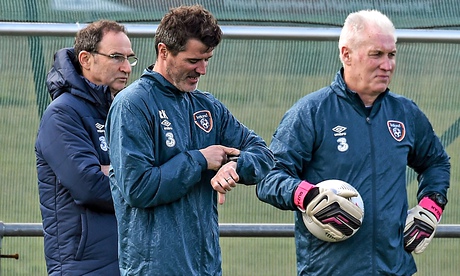
It is time for the dream team to deliver. When Martin O’Neill announced that Roy Keane would be his assistant after he was appointed Republic of Ireland manager in November 2013, a wave of excitement swept over the country.
Could the charismatic, enigmatic duo usher in a new era of Irish success? Or at least banish the sense of unfulfilled potential that stained the end of Giovanni Trapattoni’s reign? Hopes were high. The performance in Sunday’s critical European Championship qualifier against Poland will give a strong indication of whether those hopes were well-founded.
So far the jury is out on O’Neill. The 13 matches that he has presided over have offered scant evidence of progress. The most important of those games brought a scruffy performance against Scotland in Glasgow last November and a 1-0 defeat that puts the pressure on Ireland to beat Poland. Group D was billed as the most competitive of all, but if Ireland were to lose at home to the group leaders on Sunday they would realistically be out of the running by the halfway stage.
O’Neill has stressed, since the start of his tenure, that he intends to take a far bolder approach to home matches than away ones. Ireland were adventurous in their only home match of the campaign so far – albeit against a deeply inadequate Gibraltar team – and their 4-1 friendly victory over the United States the week after the defeat by Scotland stoked an ember of optimism that O’Neill’s side will be capable of producing a much more fluent and incisive performance in Dublin than the base hurly-burly of their Glasgow display.
Poland’s defender Kamil Glik, making an admirable deviation from diplomacy, said this week that he watched that game and found Ireland so rough at times that he had to avert his eyes. Glik said he anticipated a brutal physical encounter on Sunday but Ireland’s fate is likely to be decided by whether they can show more brains than brawn.
O’Neill has nearly a full squad to choose from and his selections will be intriguing. It is expected that the need for creativity will convince the manager to start with Wes Hoolahan, who is seldom used in away matches. The riddle of whom the Norwich City schemer will supply is another that O’Neill must resolve. The manager caused a minor surprise by leaving Robbie Keane out of the starting lineup in Scotland but Shane Long and Jonathan Walters did not seize their chance and O’Neill may feel tempted to revert to the 34-year-old. Long or Walters would give the Poland defenders a far more strenuous workout but, in a match in which chances must be taken, O’Neill may judge Keane’s finishing skills to be more reliable.
Poland have no such concerns about firepower. In Bayern Munich’s Robert Lewandowski they have one of the world’s most dangerous strikers, and the 21-year-old Ajax striker Arkadiusz Milik is showing signs of developing into a formidable goalscorer too. O’Neill must decide whom to charge with containing that pair. John O’Shea looks a sure starter and he will be partnered by either Aston Villa’s Ciaran Clark, Stoke City’s Marc Wilson or Derby County’s Richard Keogh.
Behind them, O’Neill must decide who to play in goal, and here he faces another choice between a waning veteran, Shay Given, and a younger player about whom there are doubts. Chances are the manager will stick with David Forde, who has performed well for Ireland. The identity of the left-back could give a strong clue about O’Neill’s approach. The audacious choice would be Robbie Brady, who thrived in the role when scoring two goals in the friendly win over the USA. Deploying him on the left and Séamus Coleman on the right would give Ireland ample scope to attack from both the full-back positions.
Not since the epoch-defining 2001 victory over Louis van Gaal’s Holland have Ireland recorded a competitive home win over a high-calibre team. There would be no better time than Sunday for Ireland to get another. That would kickstart the O’Neill era. Defeat, by contrast, could raise questions as to how long it should last.