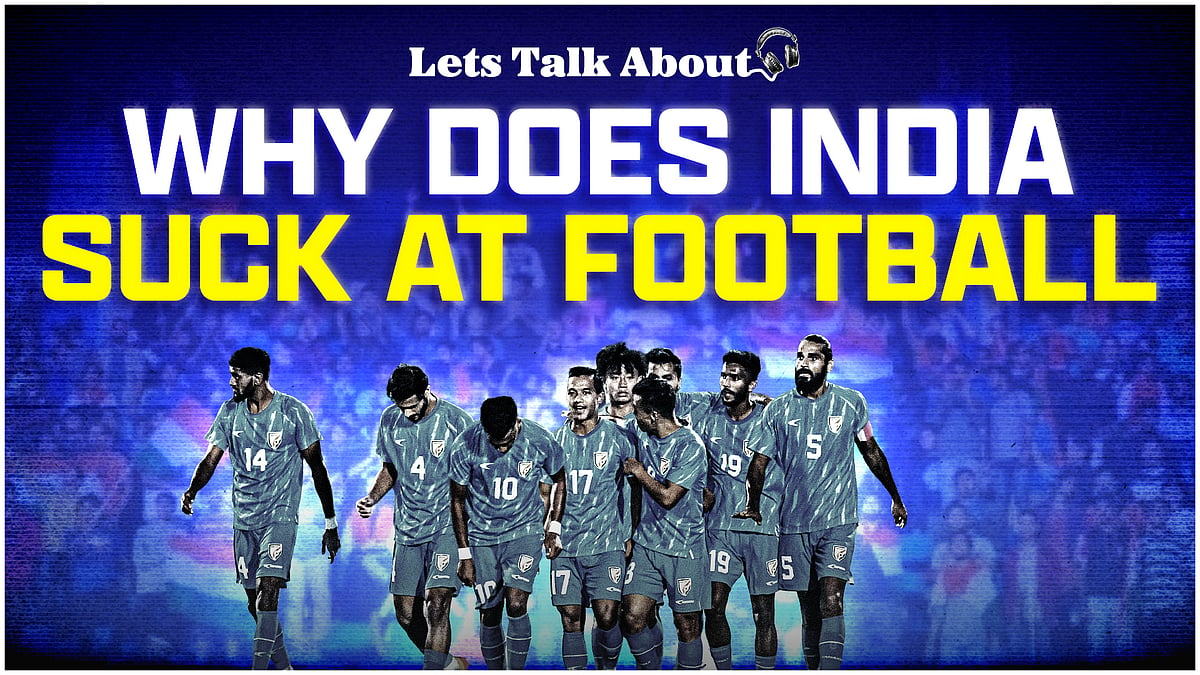
This episode of Let's Talk About: Indian Football cuts through the lazy excuse that India is strictly a cricket nation. The domestic game has massive pockets of fierce fan devotion, yet remains trapped by its own failings.
Abhinandan Sekhri sits down with Dr Shaji Prabhakaran, former AIFF Secretary General and current AFC Executive Committee member, alongside Anuj Gupta, president of the Delhi Soccer Association, to diagnose why the sport isn’t capitalising on its potential in India.
Prabhakaran argues India’s failure stems from a narrow approach to youth development that prioritises short-term talent scouting over building a lasting sporting culture. He notes that up to age 11, Indian children match their global counterparts in technical terms, but there is an immediate structural drop-off thereafter. Making matters worse, standalone football academies in India function like “kirana shops”, isolated from any real competitive calendar, he argues.
Gupta sharpens the point with the age window that matters most: “After 12, there’s only a few percent improvement you can do. We have lost the ability to develop talent after the age of 12.” For him, India’s academies simply haven’t focused hard enough on the 6-12 age bracket, and the ones that exist rarely have the best coaches training there.
On the economics of the sport in India, Prabhakaran rejects the idea that there’s a lack of demand. With roughly 300 million fans, he remarks, “[Indian] Football has a bigger story to tell, and we are failing to communicate that.”
Ultimately, both agree the money and passion already exist, but what’s missing is a federation-led push to organise and amplify it.
Watch this interview.
This is a News Laundry podcast, and you're listening to Let's Talk About
Intro: Listen to that. Sounds like a fierce European football rivalry, doesn't it? It's not. It's India, and those are the fans of West Bengal's biggest state clubs, Mohun Bagan and East Bengal. So when people say football never had a following in India, are they right? Is the problem really a lack of support, or is there something else that explains the poor state of Indian football today?
Let's find out. This is Let's Talk About Indian Football. Joining us in this episode are two influential figures shaping Indian football. First up, joining [00:01:00] us is Dr. Shaji Prabhakaran, former AIFF Secretary General and current AFC Executive Committee member. A former footballer whose playing career ended at 22, he went on to serve as FIFA's regional development officer for South and Central Asia, contributing to three FIFA World Cups.
He is also the co-founder of Khel India Sports Foundation and the author of Back to the Roots, a book on grassroots football development.
Abhinandan: Welcome, Shaji. Uh, thank you for making the time. My pleasure. Uh, Shaji Prabhakaran joins us today. So Shaji, as our audience has already seen in the intro, you have been football Delhi president, Asian Football Confederation senior consultant, you have been, uh, director for vision and national team for youth for AIFF Chandigarh Football Academy manager cum coach, regional development officer for FIFA in India, AIFF General Secretary 2022-2023, [00:02:00] which was a turbulent time for Indian football.
Um, so and there have been several ... You know, you were sacked, Baijang backed you, then in a vote your sacking was upheld, but it wasn't attended by two very important members of the committee. So you've seen it all inside, outside, et cetera You're most welcome to tell us from a personal point of view, but what we're trying to achieve through this podcast series is to identify from people who have experienced Indian football as coaches, as players, as managers, as administrators, to identify what's wrong and come up with solutions of what can be done.
And now the World Cup is probably happening as we are gonna be streaming this, so I don't even know where to start with you. So why don't you help me out and start as what is the fundamental problem that a country like India is so [00:03:00] miserable in our football rankings in the world?
Shahji: Uh, thank you, Abhinanda, for having me.
It's very, very pertinent and, you know, as a ritual we'll start, uh, every four years, you know, we will try to look for answer. Mm. That what happens every four years when the World Cup is on, and then we will completely go to shell, uh, don't care about football, where it is and what it is, and, uh, that's the problem, you know?
Mm. And what I feel is, uh, this should be, you know, 24 into 7 dialogue, uh, uh, at least among the people who love the game. Yeah. Mm. And unfortunately, that is not the case.
Sting: Okay.
Shahji: Uh, as you rightly asked, you know, what is the problem? The problem is, you know, we don't have the right players. We don't, we are not producing players.
Unless you have players, you can't compete. So we, we don't have our structure, we don't have the system which produces players, uh, and that's the problem. That's the core [00:04:00] of the issue.
Abhinandan: Okay, so let me just tell you what all we have identified in season one so that, you know, you don't have to repeat for our audience, and because your experience can give us a lot more answers.
One thing that, I don't know whether you've watched season one of our series, uh, you know, we've had everyone from Ranjeet to Eric Benny to, um, the current players. We've had past coaches, we've had past managers. We've had, you know, current coaches who are actually also managing professional teams. One thing that everybody said is that grassroot doesn't exist, and without that you cannot, you cannot suddenly pluck out 20 amazing players at the top.
Absolutely. It has to come from there, so that is one. Who can do that, states or center? Specific question to you because you have the experience- Yes ... of having been in that. If it is to be done, what are the kind of money allocation resources we need, and how practical is it to get that? Let's start with that.
Shahji: Yeah, no, very absolutely pertinent question. Uh, grassroots is key. You know, when I [00:05:00] said that we don't have the players, uh, we don't have the system to produce players, and that is where we lack, and that is precisely because we have a very weak grassroots structure.
Abhinandan: Yeah,
Shahji: and-
Abhinandan: So is that a state or a center who can solve that?
No, absolutely. It's not about state or center. You
Shahji: know, gra- when we look towards grassroots, uh, it ha- it is the responsibility of everyone. The problem is we focus on, uh, the grassroots only thinking talent That is absolutely narrow. And no system can produce players if you look for talent only at the grassroots.
It
Abhinandan: has to be cultural. So
Shahji: therefore- Every place, sub-fellow ... there it is an integrated approach.
Abhinandan: Okay.
Shahji: Uh, it is an inclusive, uh, sector for anything. You know, the grassroot means, uh, everyone should play everywhere, any time, uh, all across, you know? And that is the philosophy. And that philosophy you can implement when [00:06:00] everyone comes together.
It is not that one organization is responsible, but then there has to be a policy framework, there has to be, uh, you know, uh, a kind of a, a structure where everyone comes together. Because, uh, from grassroot, y- everything has to be gained for everyone, huh? It is only-- it is not limited to football. We have to think.
So we have to broad base grassroots. So when I say, you know, the grassroot should be looked, uh, in the perspective, in the prism of, of a broader, uh, concept, uh, I mean how you make our citizen, uh, you know, like simple as, you know, having seen them healthy, productive, and developing character, developing civic sense, uh, dev- uh, you know, giving them exposure, uh, to having a meaningful life, healthy life, you know, having a, a life where they see a [00:07:00] sport becomes, you know, part of our day-to-day life.
And that is the perspective we are not having. Unless we have, we will struggle in every sport. And that is where cricket is distinct because it is, it is like, you know, every, uh, street, uh, every park, uh, you will-- the children are playing. That's because, you know, you have more icons. But-
Abhinandan: And also just half a dozen countries play serious cricket.
Shahji: No, that is fine. See, I am not- Yeah. I- Not see whether you are world champion or you are a world champion. Sure. You are good, you are good, you know? It is not about numbers. So but what our problem is, you know, grassroot still is in a-- we are seen as in a, uh, we are working on a very narrow sense. And unless until we come out of that system where we bring everyone together, because government is a key funder-
Abhinandan: Hmm
Shahji: for this anywhere in the world. Wherever the grassroot is working, the government is a key funder because [00:08:00] if government is not funding the grassroot to see that you produce Messis or Ronaldos. No. Because-
Abhinandan: They're just funding it be- for the sake of sport.
Shahji: No, not for the sake of the sport. For creating a healthy society, for creating a productive society, for creating a cohesive society, for, uh, creating a meaningful citizen, you know, where responsible citizen.
Abhinandan: So you're saying sport is not part of that mindset in our country?
Shahji: Absolutely. Unless until ... See, because, uh, I, you know, like if you go to school, you know, uh, how many children play? It is coming down. Mm-hmm. Yeah? And now we need more and more sport because of the children's screen time is going up because everything is digital oriented, yeah?
Everything, yeah? And it is getting higher and higher penetration, uh, in the children itself because in school itself, uh, you need screens to study, to do your homework, uh, to do your- So you, you
Abhinandan: can't wish it away. It will-- it's
Shahji: inevitable. It will be there. It has to happen. But [00:09:00] therefore, it need to be, you know, uh, planned in a structured way where every kid will have the opportunity to play some sport, and football becomes the cheapest sport.
See, football becomes a sport which develops a holistic individual because every body part comes into play.
Abhinandan: So one of the ... So I get what you're saying, and it's a cheap sport. One ball, you know, 15 kids, 18 kids, 20 kids can play with just that one ball, which can cost as little as 500 rupees also. Now, one of the guests who had come on this series earlier said, "Just buy, you know, a million footballs, every state.
From the state budget it's not much. And just distribute in every neighborhood." That kind of ... Now, that's a specific input, right? It will just get people to start playing. Can AIFF do that? You worked with it. Like, someone has to. Like, I can understand the prime minister right now is probably figuring out, "How do I make sure people don't get hung- go hungry?"
You know, [00:10:00] people are dying. There's all sorts of other issues. But AIFF is a body, your sports ministry is a body. The reason they're separate bodies is they can focus on that. What is something that you can start off with the body that is responsible for this?
Shahji: No, I ... See, this idea need to be propagated, yeah?
And this can only be done when the highest decision makers comes together. Because as you said, the prime minister cannot do, yeah? Prime minister has got, uh, its, the other priorities. Yeah,
Abhinandan: war is happening.
Shahji: Yeah, absolutely. There's, there's too many things happening. But, you know, I have a different take on it.
Abhinandan: Mm.
Shahji: Because I have to see that as a prime minister, you know, how my health budget will come down, how my ... I don't have to build more, uh, hospitals. If
Abhinandan: you have a healthy
Shahji: society. I don't ... Yeah. Because right now we have more hospitals than play fields.
Abhinandan: Mm.
Shahji: We have, uh, less stadiums than, uh, hospitals. So what I want to propagate is w- if you have one hospital, you need to have 10 play field And that is [00:11:00] where, uh, because, you know, it is a cost you are not calculating So you are talking of
Abhinandan: fundamental level of health.
Shahji: Absolutely. You have to start fundamental. So without that there
Abhinandan: is no-
Shahji: No, no, absolutely. Because see, we have to s- That's interesting.
Abhinandan: That's
Shahji: it ... we have to serve, you know, 150, uh, uh, 1.5 billion people, yeah, in every aspect. So therefore, you know, my objective cannot be in taking decision that I want to produce a winning team-
Abhinandan: Hmm
Shahji: you know, as a prime minister. No. I have to see that every citizen of my country need-
Abhinandan: Playing a
Shahji: sport ... need to be healthy.
Anuj: Hmm.
Shahji: So therefore, what are the interventions I would require? Therefore, today I am spending this much, you know, and in 10 years' time, how much I will spend on what, you know, h-how that money will come, and where can be, uh, this would get reduced.
The load on the exchequer, how it will reduce. So therefore, fundamentally, I think differently.
Abhinandan: Hmm.
Shahji: And that is where-- It is the prime minister is not [00:12:00] wrong, but it is the policymakers will have to give him that, and that is not we are discussing. Nice. And that is where I have, you know, I feel really, you know, what I say is that, uh, you know, worried Because, you know, our children are, uh, going to be a liability for the country then.
Abhinandan: If they
Shahji: don't- Because, because- ... healthy
Abhinandan: adults ...
Shahji: healthy adults, because they are spending more time on the gadgets, the e-sport, you know, and all the game, game time is good, but then, you know, they are having a body which is not going to be useful. Hmm.
Abhinandan: That's an interesting perspective.
Shahji: So that, that is-- So therefore, fundamental problems are this.
Unless we tackle this, you know, then rest is everything is plus and plus. Hmm. So, uh, that is where the discussions have to come, [00:13:00] and then the p- decision makers will think. So therefore, if I work for the grassroot, then I will integrate health ministry or your social justice, women empowerment, sports, education- You have to work together
everyone. And they need an empowered group of ministers, because this is-- we are going for a crisis, because we will be in four leg unless.
Abhinandan: Hmm.
Shahji: Because we are going to sit and do everything in life except walking, running, you know, jogging. Everything we'll do because everything will be accessed now, the technology.
So you're saying it- So technology is going to make us take back to, you know, the, uh, the years where we'll have to go to four legs.
Abhinandan: So you think our, our actual health parameters may come down instead of going up
Shahji: with technology? Absolutely, it will go down. That's- And, and other problem is, see, if as our economic parameters are growing, you know, we have, uh, lifestyle diseases going [00:14:00] up.
Abhinandan: Hmm.
Shahji: That also there.
Abhinandan: Hmm.
Shahji: Yeah? Our obesity rates are high, our diabetic rates are high. Why? Lifestyle diseases are high. Why? The economic reason and at the same time our lifestyle.
Abhinandan: Life-- lack of exercise
Shahji: clearly. And, and you cannot start exercise when the doctor says. Hmm. By that time you are late.
Abhinandan: Hmm.
Shahji: So therefore I say, you know, you, uh, you should marry a sport.
There can never be a divorce.
Abhinandan: Hmm.
Shahji: Yeah? And that should become your day-to-day life from a very early age. And therefore schools are the fundamentally responsible for that, because as they teach maths, you need to bring, you know, that. Hmm. And I want the, the sport, the physical activities to be graded
Abhinandan: Hmm.
Shahji: Why it should be graded? Because that's where you bring the interest.
Abhinandan: You have to
Shahji: [00:15:00] incentivize, you have to incentivize kids to do that also. Because then, then the parents will see, "Oh, why you're scoring less? You have to devote time."
Abhinandan: Hmm.
Shahji: Huh? And that is what we need to bring. And, and otherwise, you know, we will keep discussing everything, every problem.
And we are-- we have very high potential to do well. We are not able to do it because these are our fundamental problems.
Abhinandan: Right. So you've provided some, you know, solutions or some prescriptions for at a fundamental level. Before we become good at football, let's start playing any sport.
Intro: Yes.
Abhinandan: And once we start playing any sport, then a chunk of those people will play football, and a chunk of those people play football, then something will emerge.
I think that's a very excellent vision. It's a long vision. I don't know how many leaders think long these days. Everyone is just looking at the next election. But I, I mean, point taken. Now, coming to the technical aspects of you having been a, been a manager, you were a player when you were young, uh, uh, an [00:16:00] injury in your 20s kind of ended your career as a player.
But I just want to, uh, find out from someone who has been on the ground with kids, and you've seen kids overseas, you have also been a consultant for FIFA. What do Indian kids lack as compared to the European counterparts? I mean, I've seen, you know, semi-professional clubs, I've seen academies in Europe, I've seen, uh, you know, some in the US as well.
You know, the-- they have these camps where colleges come to identify players who they wanna pick up. What do you see different in kids, Indian kids who are playing? and European kids? Is it physicality, technical, football brains, prone to injury? What are the things?
Shahji: Up to say age 9, 10, 11, uh, we are no different than any kid.
Abhinandan: Wow. Okay.
Shahji: Yeah. But then, uh, we have all those essential elements with us as any other [00:17:00] kid in Europe or South America or best of the football nations they have got.
Intro: Hmm.
Shahji: The problem comes, you know, when they are above 10, 11. Why? Because we don't have that level of system, uh, the competitive environment at the youth level, and our coaches are also not ready to handle that aspect
Abhinandan: because- That growth spurt when they get
Shahji: not growth spurt.
Abhinandan: Hmm.
Shahji: Because our competitiveness, competitive structure is weak. Hmm. Like, you know, uh, if you are not playing the game, a competition for set number of weeks, set number of-
Abhinandan: Right ...
Shahji: months, uh, periodically, you will not know that where you are headed.
Abhinandan: Training is not enough. You gotta play
Shahji: matches.
Yeah, like we, you know, we'll-- we keep reading like, oh, this is a center of excellence, [00:18:00] world-class facility, uh, 30 kids are selected and, uh, by this time they will play, you know, in the India team, all that. Hmm. But then did we come across any, any player who has grabbed the global attention?
Anuj: Hmm.
Shahji: No. Why? You know, they all started with good intention.
There were investment, there were players scouted with, uh, whatever the best possible way, but then we have not reached cross that benchmark.
Abhinandan: Hmm.
Shahji: Why? Because, oh, you cannot build a football in isolation. You need to compete. That competitiveness doesn't exist. And that to competitiveness to exist, we need to create that structure system where, you know, like in Delhi itself, you have more than 20 academies of the same level getting the same facilities, same food, same coaching, everything.
[00:19:00] Yeah? Uh, and that is where when they play every week, you know as a coach-
Abhinandan: Hmm ...
Shahji: you know what I'm doing. Today, you know, we have lot of academies, but, uh-
Abhinandan: But there's no system where they play each other regularly.
Shahji: No, for that they are like, uh, kirana shops.
Abhinandan: Hmm. Also, they don't play each other regularly. I mean, I know a lot of academies-
Shahji: No, they, they-
but they
Abhinandan: don't
Shahji: even- They might be playing some friendlies here and there- Not often enough ... but that, that doesn't help. Okay. Yeah? You need to have a competitive structure, uh, where there is-- you're focused on excellence. Yeah? And there are clubs who are looking for talent.
Abhinandan: Hmm.
Shahji: Yeah? And that is where it grows.
The w- uh, the, the main point, you know, what I started with, uh, we don't have players of that level, and that is The primary reason. And like say, if you see, you have talked about cricket. Now cricket is successful because they are [00:20:00] able to, uh, of every season they are able to throw out big star.
Abhinandan: Hmm.
Shahji: Yeah?
Unless there are stars, you cannot, uh, you know, the society cannot think that, oh, this sport has a future. You know, why I should invest in my kid, uh, to play this sport. And that is where cricket has, you know, found its rhythm, its path, its pipeline. It is going, and it will go on. Uh, you know, you don't need, uh, in a leader, you don't need a, you know, structure.
It will go on like that because, you know, now we have the latest is Suryakumar Yadav of-
Abhinandan: Yeah, IPL throws up new stars every season ... so,
Shahji: so every season. And so that way football doesn't have anyone, not one. And unless we crack that, oh, because our Indian mindset, we also need to think we, we love those icons.
Abhinandan: Hmm.
Shahji: The iconic [00:21:00] figure will be the glue. Then you will see that the migration happening.
Abhinandan: Hmm. You
Shahji: know, big time from, uh, this sport to-- Why cricket is a, uh, is, as you said, is limited, yeah? It's, uh, it's, uh, influence, interest globally. Football is the biggest. So therefore, once we have that mega star, and I feel that is going to come early- Mm-hmm
because we might not have a team which will beat, uh, Brazil Or Argentina or France or Spain, Portugal, uh, in next 10 years. But we will have one player who will be the mega star.
Abhinandan: And
Shahji: then- And that is, and-
Abhinandan: That can inspire a lot of other kids of the next generation to-
Shahji: Oh, that would inspire everything because that would like, you know, a big floodgate opens.
Abhinandan: Mm.
Shahji: And this you cannot compare. Like, it will be like a, [00:22:00] like a, you know, bigger moment than, uh, Sachin Tendulkar.
Abhinandan: Mm.
Shahji: No? Like, say, oh, Kapil Dev definitely exist. Uh, he did, you know, opened up, but then Sachin Tendulkar was one of the biggest in terms of, like, because his arrival, uh, and the opening of the economy, liberalization, the brands- All that happened at the same time, right
you know, and the social media era, everything.
Abhinandan: Mm.
Shahji: So that's the era, huh? We-
Abhinandan: So you're saying football can m- even top
Shahji: that? Be bigger. Bigger. Oh, big- it can ... It will be double than that.
Abhinandan: Wow.
Shahji: So we need one mega star.
Abhinandan: I see.
Shahji: Unless we have... And we, we have the potential. Why? Because we have more people.
Abhinandan: Mm.
Shahji: But then we need to do something right.
Abhinandan: That's fantastic. That's some great insights. Now, in the end, I want to ask you to give our youngsters some tips about football, because other than administrators watching this and other people, we also have children watching. Yep. So someone like you can also, you know, give them value through specific tips.
But we've spoken about the grassroot [00:23:00] level about this. Now let's talk about right at the top, the economic model for ISL. As a value proposition for whether it is sponsors, broadcasters, players, companies, why has that economic model not worked? Are we paying the players too much, so the, the, the cost is too high, the model collapses?
Because I do believe we may not have the kind of viewership that a Premier League or Bundesliga has, but I think there is enough viewership to at least justify some sponsorship. I mean, I know for a fact that, you know, even NewsReilly does events. Even if you can get 10,000 people for an event, there are people who are interested in sp- I mean, they
Not everybody wants to sell Coke. You know? Not everybody wants to sell paan masala type stuff. So what... Where are we going wrong on the economic model? Why can we not have a sustainable model for club, even if it's not as big as IPL or Premier League? Where are we failing on that top end?
Shahji: Uh, see, as I said, uh, before, we don't have- [00:24:00] Stars
Abhinandan: Right
Shahji: Yeah.
And that is where the brands are staying away.
Abhinandan: Okay
Shahji: Because in India, everybody, every brand, the broadcaster, advertisers, they are the key, right? Taking decision where to put the money. Yeah. It is not that, uh, the sporting people deciding. No. Yeah It is the people, uh, the media, uh, the brands, and the advertisers- Mm-hmm
together they decide where to put the money. And the problem is they always compare everything with cricket And that's the problem. You cannot, because that, you know, say 600 million viewership cricket, IPL, and here, uh, 300 million, around 30 crore are the football fans.
Abhinandan: Hmm.
Shahji: The most-- the predominantly global football fans.
Hmm. Maybe, uh, 25% will be the-
Abhinandan: Indian ...
Shahji: [00:25:00] domestic fans.
Abhinandan: Hmm.
Shahji: That's big enough.
Abhinandan: Yeah, it's big enough.
Shahji: So w- the problem is the football community has failed to communicate this enough.
Abhinandan: Hmm.
Shahji: There has to be a strategy because, you know, I was working on it. Like, I don't know, uh, when I was the general secretary, I made a public statement that we will make our football budget from 100 crore to 500 crore by 2026.
It was a deliberate plan, and we could have reached it based on communication, based on projecting things, based on data, based on research, based on coming together because-
Abhinandan: And there are enough fans to be able to do
Shahji: that. Oh, absolutely.
Abhinandan: We just have to organize it-
Shahji: Yeah ...
Abhinandan: and amplify it.
Shahji: Yeah. It's a st- it's a bigger story.
Football has a bigger story to tell, and we are failing to communicate
Abhinandan: that. We are not being able to tell that story.
Shahji: Absolutely.
Abhinandan: That's interesting.
Shahji: Because there are pockets, if you see the football is the, [00:26:00] like a heart of the economy.
Abhinandan: You know, your home state, in a village you can get thousands of people watching a match.
I mean, I've, I've had guests here that in a small village in Kerala, they've had an audience of 5,000 people watching a match. And, um, I had a guest on this show, the, uh, in Bengal last week in Kolkata, there was a match, 66,000 people came.
Shahji: Yeah. That's, that is what I'm saying. You know, we have like say the derby between East Bengal and Mohun Bagan is one of the biggest sporting product in India.
Abhinandan: Hmm.
Shahji: The problem is, uh, that, uh, again, we have failed to, uh, create that hype.
Abhinandan: When you say we, who? Who can do it? Let's say take this example.
Shahji: It is the stakeholders, and we are not coming together. The problem is everyone thinks, uh, unfortunately, that we are better than others or we alone can do everything.
And that way-- See, any sport is a [00:27:00] service. Yeah? And it is you, you have to bring people together. Unless you bring people together, like today, uh, say all influencers. I don't mean the, the internet, the digital influencers here. The people who really are in positions of influence And they, they are-- they know globally what is happening.
What I feel is football can be bigger soft power for India than any other thing, because football is the biggest sport in the world, and we can be... We can take football to that level it can be bigger soft power. Like as we are hosting Olym- planning to host the Olympics 2036, and football there in Olympics, though it's not a big sport in Olympics, but still what we will do in Olympics with [00:28:00] football will be the biggest talking point-
Abhinandan: Right
Shahji: globally.
Abhinandan: Sure.
Shahji: Yeah. And it will all-- it also brings bigger footfall to, uh, the game, yeah. Like hockey, no doubt we are, you know, top, yeah. But-
Abhinandan: Were.
Shahji: No. Now also see we have back to back we won, uh, medals- Mm ... bronze medals, you know. No other team sport, yeah. So that way we are there.
Abhinandan: Mm.
Shahji: But the football appeal is, uh, 10 times more than hockey.
Abhinandan: Mm.
Shahji: So therefore, the decision makers have to think it is not the medal which gl- brings people together alone.
Abhinandan: Right.
Shahji: It is also the popularity of the sport, the interest of the sport also brings people together. Mm. So therefore, what I see is we need, you know, everyone to come together and somebody has to take lead to bring people together.
And that is where we will be able to break the sustainability side also. [00:29:00] And as you said, uh, like players are overpaid, I don't think. You know, it is the market which decide it.
Abhinandan: Mm.
Shahji: If player is asking X, if market is ready to give, it is not the player's problem, it is not the sport problem, because there's a demand and supply gap there.
Abhinandan: Mm.
Shahji: And that is where those who are good within our standard, they are able to get more money, and that is fine. And that is not disturbing the economic balance of football. No, the bala- the, the disbalance is because we are not able to generate money from the market.
Abhinandan: I see.
Shahji: And that is not a problem because-
Abhinandan: And that is a storytelling problem.
Shahji: Yeah. It is, it
Abhinandan: is a- We're not gonna tell that story because there is an audience, there is a fan base- Absolutely ... we're not able to amplify it. Got it.
Shahji: Absolutely. That is the problem. And, uh, and if we break that, there'll be enough money coming in. And see, the problem is we have to try and [00:30:00] try. As a football administrator, if you go to 100 people, 100 people will reject you.
So that doesn't mean that you, you stop trying. So you have to be ready to innovate. Come and tell in a d- tell your story in a different way. But unless you take all the stakeholders together, bring them into one platform and go with one vision, one goal, and everyone is aligned, that alignment is not there.
Abhinandan: That leadership will emerge from where? 'Cause there has to be a leader for that.
Shahji: Yeah, it has to be, the federation has to take the lead.
Abhinandan: It has to be the federation. The f-
Shahji: absolutely. There is
Abhinandan: no other way. So it is possible if the federation takes that lead, is that proactive, it is possible to do, you think?
Shahji: Absolutely. '
Abhinandan: Cause there are enough people in the country who want the same thing.
Shahji: Yeah. See, because see, I tell you, when I was the president in Delhi, uh, we didn't had anything.
Abhinandan: Mm.
Shahji: [00:31:00] Yeah. Then, uh, I- when I left, I le- the bank had, uh ... our bank account had one crore- Balance when I left the pro-
Abhinandan: Hmm.
Shahji: Yeah. And we never had office, we never had staff, structure.
Everything was haphazard. So based on my experience, what I could do in Delhi, I am telling, but then we could have done 10 times- More ...
Abhinandan: more,
Shahji: uh-
Abhinandan: So it is possible to do?
Shahji: Yeah, it's possible to do. And India is not a poor country. We are fifth largest economy in the world. Yeah. And we have enough billionaires, and there are enough passionate people who want to see football move up the ra-
Anuj: Sure
Shahji: ladder, and, and their childrens are playing football. In high influential people's children play football than cricket. Yeah. And that's a fact because I get to [00:32:00] know, I interact, I know, and they all, you know, want to be part of it.
Abhinandan: Right. No, I mean, you're right on that. Absolutely. I agree. Um, now in this segment, I just want you to talk to our younger audience.
So far, I think some fantastic inputs have come, fantastic insights. There is a path to progress in football, uh, and at a fundamental level also, and at a market level also. Now let's get to our younger audience. Some things that you think people who are young starting football eight, nine, 10, 12, 14 years old, what can they do to get better?
What are the kind of things they should focus on? Is it about diet? Is it about certain exercise that they need to do, certain routine? Some valuable takeaways for our younger audience.
Shahji: Oh, absolutely. The, uh, it's a... We are very fortunate, uh, as India, we are not doing well in [00:33:00] football still, uh, there are millions of kids are aspiring- Yeah
to be player-
Abhinandan: Interested ...
Shahji: and, uh, reach to a professional level, and that's very encouraging situation for us. So therefore, my advice to all those kids and the parents, because they are the key influencers, uh, and key decision makers, and they do spend their time, uh, taking the kids to the ground. Therefore, all the children, those who are invested into football, keep working hard.
There are no shortcuts, huh? Mm-hmm. If you... And the parents You are taking the right decision in terms of if you have put your, uh, children into sport or football fundamentally, then that is your best investment. It is like you will get an MBA degree, uh, before they cross the class 10. And the- Mm ... and that you will not realize now, you will only [00:34:00] realize when they will be adult.
Mm. Because they will be able to take decisions, and they will be able to, to meet the failures, uh, successfully, and they can be successful in life. So they don't evaluate the kid based on their academics. Evaluate based on the kids how many friends they have got, uh, when they are playing football.
Abhinandan: How they can work as a team.
Shahji: Yeah, and, and w- How they
can deal with failure- Absolutely ... and disagreements. Yeah, exactly. And, and they get into a social, uh, uh, what to say? A mode at early age. Because, uh, staying home, you know, you are protected well, uh, you are, uh, you know, taken care, but when they are, uh, on the pitch, on the field playing football, you know, that is where give them the freedom Don't disturb them.
Don't give your advice. Only advice [00:35:00] you give them is work hard what is the coaches are saying and ob-observe. And also today, you know, also follow the best of gurus who are in the social media platform talking about football, and then, you know, demand more and more from the coaches and the academies and the clubs.
Why we don't have this? Why we are not doing it? You know? And bring everyone together. If the parents can come together, you ca- you have a bigger voice. You, you need to see that your children is playing in a structure, your children is playing in a safe environment, and they are able to learn more than the sport.
And don't compare your kid with, you know, whether they are playing, whether they are not playing, and don't influence anybody to put your children in the team. Mm-hmm. You know? Because I used to get calls from parents, uh, like, "Oh, uh, take my kid in the state team." Yeah. Correct. You know? And the-
Abhinandan: That's very unfortunate in India.
And that way- They've [00:36:00] got to influence coaches and managers to push
Shahji: for- Yes, and that way you are impacting your child, because then you are make, uh, showing your child that everything you can achieve in life with shortcut.
Abhinandan: Mm.
Shahji: And then the, the children will start- They can't even perform ... stop working hard.
Abhinandan: Yeah, and they can't even perform.
Shahji: Yes, exactly. And
Abhinandan: then- And- And you are resented on the team if you, if you don't carry your weight ...
Shahji: and on the pitch, everything becomes clear.
Abhinandan: Uh-huh.
Shahji: Who is good, who is bad, or who is, has a potential.
Abhinandan: You can't change that.
Shahji: Therefore, you know, let it be that way. And let's, you know, the kids should enjoy, and then, you know, demand more and more from everyone in football, from the government, from the administrators, and, and keep watch, you know, and be positive.
Abhinandan: Mm.
Shahji: And that way we have to create a strong community who is positive and who is thinking to contribute to grow the game in a bigger way, and that [00:37:00] is the force we need to have. Because we are, you know, like, uh, we are not in the World Cup, it's okay, far away. But we are not even in the Asia Cup. Mm. You know, 24 team in Asia, and, you know, it's, it's painful It's painful.
So therefore, we are not demanding enough. You know, everybody's silent. It's like, you know, uh, you know, it's like a scratch has happened, no?
Abhinandan: Yeah. Demand more from- Everyone ... whichever place you're playing. Your coaches- Absolutely ... your state, your federation. Demand more. Ask- Absolutely ...
Shahji: uh, seek answers. And, and also school, you know, as parent, you know, have a dialogue with principal because I tell you my own example.
I, you know, I went to a school. I wanted to see that the, they should organize under 10 games, and this, they said, "No," because, you know, the parents are complaining when they fall. You know, I was, you know- ... completely shocked. When they fall. Uh, you know, I can't believe that, you know, where I am. You know, what to say?
You know, if the parents are saying, you know, they [00:38:00] cannot fall while playing football, then, you know, got- Then there is
Abhinandan: no hope. Then-
Shahji: There is no hope. So therefore, you know- ... let them fall. Let them have sc- you know, uh-
Abhinandan: Scratches.
Shahji: Right, right, right ... scratches. You know, not a problem- Right ... because if they will not fall, they will not be able to l- they will never learn to rise.
Abhinandan: Yeah, exactly.
Shahji: And, and the game is the best teacher you can ever employ. That what I can say.
Abhinandan: What got you interested in football? You started playing at the age of eight? Seven, eight?
Shahji: Yeah. My, you know-
Abhinandan: Is it because it was very popular in Kerala, so everybody's interested?
Shahji: No, no, I brought up in Bengal.
Abhinandan: Oh, oh, but there also football
Shahji: culture is very good.
Yeah, and I say I'm very
Abhinandan: fortunate- But there is a lot of cricket also. How come you picked football?
Shahji: No, no, Be- Be- that area was like, uh, football was bigger because- Okay ... I brought up in a very, uh, what do you say? Tea garden area-
Abhinandan: Okay ...
Shahji: where, uh, the football fields will be there.
Abhinandan: Hmm.
Shahji: And it was promoted by tea garden owners.
Abhinandan: So you started playing at an early age?
Shahji: Yeah, at early age, and I was lucky that, uh, it [00:39:00] was very near to my house, the football field.
Abhinandan: Hmm. And,
Shahji: uh, and it was like most, uh, uh, what do you say? Consecutive time had. Uh, I don't, I think, you know, where I brought up, uh, you won't believe 80% of the children never used to go to school.
Wow. That backward it was.
Abhinandan: Hmm.
Shahji: And but we all used to play together. Hmm. And, uh, and, uh, and when I look back where I've reached and, you know, I'll, I want to go back and do something. I keep discussing, uh, with some influential people because what I can do there, so we are still discussing how we can do something, uh, so that, uh, I can see that some talents coming from that region, and that is where I'm focused and, uh, because, uh, football, uh, can really, uh, be one of the vehicle for bringing in, um, more [00:40:00] development in that part of area what I think.
Abhinandan: I see. But thank you so much for making the time, Shaji, for coming here My pleasure.
Intro: Joining us is Anuj Gupta, a lawyer qualified from both India and England, and the youngest ever elected president of the Delhi Soccer Association. Under him, the association's grassroots participation has seen an uptick from 700 to 4,000 players annually.
He owns Sudeva Delhi FC and CD Olympic de Xativa, and runs a 200-bed residential football academy in Delhi.
Abhinandan: Thank you for coming, Anuj.
Intro: Thank you.
Abhinandan: Anuj, as you can see, is a young man still. And, uh, the youngest, uh, head of Delhi football ever, right?
Anuj: Yeah.
Abhinandan: And you're serving your third, uh, uh, uh, term. Uh, th- so three
Anuj: years are finished, so
Abhinandan: it's like- Third year now
yeah, yeah. Right. Uh, other than this, you will have, of course, a detailed introduction of him once I have just done the brief introduction. [00:41:00] He is other than president of Delhi Soccer Association, uh, he also owns a club in Delhi and one in Spain, so he can give us an interesting perspective of what works and what doesn't work.
Is it a cultural issue? Is it a logistical issue? Is it just resources and funds? Or what other things there are. And he's also played football when he was even younger than he is now. So maybe he'll have some tips as a player. So let's talk about Indian football. Cut to package on Anuj. Come out of cut So Anuj, what hat do you want to put on first?
Uh, we, you know, done a bunch of, uh, conversations about what ails Indian football, and let me just list the ones that are already there so we don't waste your precious time in repeating those. Grassroot is not there, tournaments are not there, they don't have enough matches, et cetera, et cetera. Uh, some states are doing better than others.
Odisha is ... People say, "Wahan zyada football ko tawajjo di jaati [00:42:00] hai," whatever the reason. What works in some states and doesn't work in others? What are the reasons of the differences?
Anuj: I think the major difference is the culture, the cultural, uh, historical, uh, you know, uh ... I mean, the state, for instance, states like Bengal, Kerala, Goa- Hmm
predominantly these states have had football for over 70, 80, 100 years. So, uh, generations to generations they have seen football. But there are certain states where football has been, uh, launched not more than 30, 40 years. So, uh, and in certain states it is at a very town level, not at a pan state level.
So it all depends when football started.
Shahji: Mm-hmm.
Anuj: So that changes the dynamics of the growth of the game in that particular state. So for instance, uh, we talk about Rajasthan. In Rajasthan, uh, even though some of the greatest players of the na- uh, [00:43:00] Indian team did come from Rajasthan. Um, and I'm talking about the 1960, 1970s time.
Abhinandan: Oh, did they?
Anuj: I don't know. Yeah, they were, uh, I mean, they were two brothers. Uh- Okay. They actually came from Rajasthan.
Abhinandan: Mm-hmm.
Anuj: But because they were playing, uh, you know, either in Bengal and, you know ... So they were able to, uh, perform at the top level and get selected for the national team. But at a gra- at a youth level, there was not much in Rajasthan.
But in the recent times- So they
Abhinandan: came to Bengal at the youth level or after?
Anuj: No, after. See, see, it's only in the last 10 years that there has been some football at a youth level. Otherwise, majority of the players- Didn't know how to play ... who have learned- Hmm ... they've learned on their own.
Abhinandan: Hmm.
Anuj: Right? Woh bas kahi dekha khelte hue, maine bhi shuru kar diya khelna.
Dost mile, khelna shuru ho gaya.
They were lucky some coach found him aur wahan se woh
Abhinandan: selection hua. So the organized youth level is also very new in our country.
Anuj: Very nascent. And we even talk about the Mohun Bagans of the world or the East Bengals, but let me be very honest- [00:44:00] The youth football is very new in this country.
Abhinandan: Even they didn't have a youth
Anuj: program.
No. It is, it was, it was primarily top level football. It was club football.
Abhinandan: Hmm.
Anuj: Right? No
Abhinandan: guidance
Anuj: at that level. I mean, I mean, till 2011, '12, if I'm not wrong, TFA used to be the only residential proper youth academy. Hmm. Right? After that, you know, then obviously, you know, many more academies came. CFA, uh, that came in 2005, '06, Chandigarh Football Academy. Then, you know, you got the Minerva, and then you got...
You know, now we talk about 30, 40 residential academies in the country.
Abhinandan: And they've all come in the last 15, 20 years.
Anuj: Yes. I mean, I won't even say 15 years in the... See, see, I started Sudeva in 2014, '15.
Abhinandan: Hmm.
Anuj: By then there were what? I mean, handful of residential academies.
Abhinandan: Hmm.
Anuj: Not more than four, five. In the country, I'm talking about.
So in the last seven, eight years, there has been good flow of residential academy because-
Abhinandan: So it's a bit unrealistic to [00:45:00] expect that magic to happen so quickly.
Anuj: Absolutely, yeah. And you talked about- It's a generational thing.
Abhinandan: Right.
Anuj: You know, that is why we have to be patient enough to understand that the dynamic is changing.
But we think that, imagine, grassroot academy starts at the age of six, seven, right?
Because let me tell you, the average age in the senior World Cup is 27. So even if the team doesn't qualify for the World Cup, their average age will also be 27. Hmm. To 20
Abhinandan: سال کا ہو
Anuj: گیا نا گیم。
Abhinandan: Right.
Anuj: So ہم نے youth پہ کام شروع ہی 10 سال پہلے کرا ہے۔
Abhinandan: So we shouldn't expect miracles also.
Anuj: I mean, that is the honest, uh, response to the whole ecosystem.
Abhinandan: Hmm.
Anuj: And considering that if you see in the last six years, AFC under 17, we've literally qualified for the AFC under 17, four out of six, which is not bad. We are-- I mean, now we are qualifying for the final qualifying round of under 17, which is the first stage of youth football. [00:46:00]
Abhinandan: So you mentioned about, you know, the three or four states that have had a, uh, rich cultural history, and this I'm asking out of curiosity, 'cause you're in this ecosystem, you're able to tell us, I mean, it's, it's not really part of what I wanna probe you for.
Jharkhand did really well in the, uh, Khelo India, and they repeatedly do well. Uh, I was told that, you know, those kids, a lot of them are tribals, they have stamina, which many kids lack. I mean, Jharkhand is such a new state. How is it doing so well, uh-
Anuj: Well, you know, okay, I'll tell you the, the level of the game.
Abhinandan: Hmm.
Anuj: Khelo India in, uh, it's-- according to me, it comes third level in football.
Shahji: Hmm.
Anuj: The top level is the, the AIFF youth leagues.
Shahji: Hmm.
Anuj: The best talent, they go there. Second, I would say is the state level, and third is the Khelo India, right? Even though now Khelo India certificate is equally important.
Shahji: Hmm.
Anuj: But you have to see the-- where is the best talent playing.[00:47:00]
So Jharkhand definitely has a tribal belt. Uh, and let me tell you, TFA, Tata Football Academy is in Jamshedpur.
Abhinandan: Right.
Anuj: Which is, uh-- And they have worked a lot at a, at a tribal belt in Jharkhand for a while.
Abhinandan: And they've been this for
Anuj: a very long time. They've been there for, you know, many years. Initially, they only had a re-residential setup, but in the last maybe eight, 10 years, they've also started working on a non-residential centers.
Abhinandan: So they go out to the
Anuj: tribal areas- Yes, and they are running centers.
Abhinandan: I see. Okay.
Anuj: So وہاں پر development ہو
Abhinandan: رہی ہے۔ I see.
Anuj: Okay. Girls football has done well in Jharkhand.
Abhinandan: Yes, very well.
Anuj: Right. Because again, there was one NGO, I'm forgetting the name. It was started by a French guy. Uh, he started many years back, girls football in Jharkhand.
Right. So ہوا کیا ہے کہ the reason they are doing well also is because they've worked on the grassroot.
Abhinandan: Hmm.
Anuj: اوپر سے شروع نہیں کرا، نیچے سے
Abhinandan: شروع کرا。 And they're seeing the results.
Anuj: And they're seeing the results now.
Abhinandan: So we've identified the youth football is very nascent and his- the historical reasons, et cetera.
Uh, now tell us what has led to [00:48:00] the collapse of the professional leagues, you know, at the top level, you know, with those players coming out and putting out Insta posts, et cetera, which, you know, a lot of people felt very b- bad for. W- I mean, is the econr- economic rationale so messed up that there is no way a professional league can survive in India?
Anuj: Well, you know, I'll be very honest that, um ... See, the FSDL agreement had to finish in 2025- Right ... and the new tender had to come up. Now, obviously, uh, initially the tender was not taken by any c- any company. Mm. Considering that, uh, nobody wanted to come in because, you know, the kind of losses and the kind of TV rights money there, they were able to generate, which was much less than expected.
Abhinandan: Right.
Anuj: Now, I mean, I mean, I'll just tell you, uh, for instance, the budget of an ISL club, uh, average is about 30 s- 30 to 35 crore minimum, and it goes to 60, 70 crore. Okay?
Abhinandan: That's an annual spend.
Anuj: That's an annual spend, which includes the franchisee fee, it includes the salary, everything. Now, yes, and that's my take, [00:49:00] that even though the ISL club b- uh, ISL league became a very inspirational league-
Abhinandan: Mm
Anuj: not only for the senior players, but also for the youth to look up to. But the whole idea behind that was that we will produce, we will develop coaches so that the Indian coaches learn from the foreign coaches, and eventually the Indian coaches will help the national team to w- do well, and then they will start becoming the head coaches of the ISL clubs.
That was the whole intent, right? So there's a talent
Abhinandan: osmosis and, you know- Yeah ... capacity building.
Anuj: Capacity building was there. For me, that was a far bigger im- uh, importance to be given in ISL-
Abhinandan: Mm ...
Anuj: rather than, uh, what is the salary take every player is getting. Yes, Indian players got very handsome salaries, but was that salary, uh, relatable to the level of the game?
Abhinandan: Mm.
Anuj: I don't think so.
Abhinandan: Right. Others have also said that- Right ... overpaid. Overpaid. In, in the overall economic stat, it
Anuj: didn't work. Yeah. So now the point is when, um ... There were two reasons why the players started obviously talking about it, because, uh, when this year ISL [00:50:00] happened, a lot of clubs did not like to pay their salaries when the leagues were not happening.
Mm. So they, you know, tried to renegotiate, which the players were not happy. Right? The point is clubs also understood- In, in a, in a, in a longer run that the kind of salaries which were paid were not up to the level of their game. So everyone started reducing the salaries of the general, you know, Indian player.
Mm-hmm. Initially, if you remember, they were all the marquee players-
Abhinandan: Hmm ...
Anuj: and they were paid ha- like in- Yeah ... you know, half a million or all that.
Abhinandan: Right.
Anuj: If you see that budget to the budget today the foreign players are getting, that is also reduced.
Abhinandan: Hmm.
Anuj: So in 15 years or whatever, 10 years, the overall, uh, understanding of the budgets has also become more practical, and that is also one reason why I think that has to come to a level where we say, okay, we have to focus a lot more on the level of the game and then decide the salary packages, which I think, uh, none of the ecosystem people will like [00:51:00] it.
Abhinandan: Right. But is there- And, and- ... is there a way of making the pie bigger so there is more resources? For example, I don't know, I'm ashamed to say I'm a football nut even at the age of 52. I'm s- I still play. I ... It really ... I get excited when I see kids play football. But even now, when friends call me to play, uh, to watch a game, I don't because I, in, you know, in 42 degrees, I don't wanna be sitting outdoor, et cetera.
Um, you know, I have friends and family who have played Delhi State. The games are happening on a rubber turf at 12:30, 1:00 in the afternoon. Just a few hard outs, like maybe we'll go and watch. Otherwise Is that also a factor? And that can be fixed because Delhi's Feb and March is lovely. I'm sure Bangalore through the year, even Hyderabad has 10 months of good weather.
Yeah. And let's say Delhi, Punjab, what stops us from creating a calendar which will encourage us, like during Holi [00:52:00] everybody's out because the weather is great.
Anuj: I mean, I, I mean, this question has come up, come to me many times. Let me tell you a practical answer. I have, uh, ran the association for three, three years, so obviously I have created calendar three, thrice.
The best weather in Delhi is from December to March.
Abhinandan: Right.
Anuj: Right. Considering that the pollution levels in December goes a little high, but it's-
Abhinandan: Yeah,
Anuj: Jan onwards is good. Jan onwards is good.
Abhinandan: Jan, March.
Anuj: Now February, March predominantly is exam time.
Abhinandan: Mm.
Anuj: And whenever we talk about youth football, I have tried my best to do tier one championships during that time, and majority of the academies have said that parents are not allowing, principals are not allowing.
Abhinandan: 10th
Anuj: or 12th Because 10,
Abhinandan: 12th,
Anuj: but because exams. I personally feel that majority of the school principals are also not very, you know, conducive and, you know, pro, you know, uh, towards the sport.
Abhinandan: Yeah.
Anuj: So that is one... So again, the [00:53:00] whole ecosystem has to run together-
Abhinandan: Mm. ...
Anuj: to create a, a, a, the right calendar. I also want to have-- So I also told the CBSE at times that, you know, why do we have exams in the best weather?
Abhinandan: Yeah.
Anuj: You have the exams in the month of Ap- May, June, which is the worst time of the year.
Abhinandan: So the kids are indoor, they'll study also more.
Anuj: So you change the calendar. Mm.
Abhinandan: Good point.
Anuj: Right. So I- No problem. So, so I said, "Okay, then let's do from October to December."
Abhinandan: Mm.
Anuj: October, Delhi population.
Abhinandan: Mm.
Anuj: None of the schools wants to give their own grounds for association matches, even though they know that the school kids are playing.
Shahji: Hmm.
Anuj: Still they don't give. So the ground which I have is Ambedkar Stadium.
Abhinandan: Right.
Anuj: Ambedkar Stadium is completely booked by Subroto Cup till October. From August to October it is booked. Hmm. luckily Delhi [00:54:00] government had given me two grounds. One is Vinod Nagar, one is an artificial turf in Kowad.
Abhinandan: Yeah.
Anuj: So
Abhinandan: the number of matches that have to happen and the number of grounds available, the ratio is all over the place.
Anuj: Yeah. And but still I decide calendar matches. That was one of the reasons why I wanted to, uh, stood for elections. And let me tell you, and it is on record that in '23, '24, I-- we were able to do 1,450 matches in a calendar year, 1,450 matches.
And literally every year I have crossed 1,000 matches-
Abhinandan: Hmm ...
Anuj: a year, which is from b-from any imagination is pretty good, right? That's nice. So, so but yeah, information academy
Shahji: problem
Anuj: academy problem.
Shahji: Hmm.
Anuj: Hmm. as a president, I have to see macro [00:55:00] level. I cannot see micro level because micro level infrastructure. Hmm. ecosystem mindset.
Shahji: Hmm. Bolne
Abhinandan: mein toh sabka intent hai, par jab
Anuj: kaam karne aate hain na toh are they willing to, you know, uh, find solutions? That is not there, I'm telling you.
Abhinandan: Well, that's the idea. Maybe at the end of this podcast
Anuj: we can cover- When I try to get grounds from Delhi Police-
Abhinandan: Hmm ...
Anuj: at times they've given us the ground.
Abhinandan: Hmm.
Anuj: I've, I have tried to get grounds from the schools. At times they've given, but it is not something which I get throughout the year. So calendar ka logic kya hota hai ki-
Abhinandan: Basically you are dependent on other people's
Anuj: largesse. I always say, yaar, association ka ek ground 365 days ke liye de do main calendar main ek date bhi change nahi karunga.
Abhinandan: Then you can actually- Yes ... if that's committed to you, you can-
Anuj: I mean, for instance, Bangalore ke pass, BDFA ke pass unka khud ka woh artificial ground hai which is with them. [00:56:00] So unki saari league wahan par hoti hai.
Abhinandan: So it's predictable.
Anuj: Yes.
Abhinandan: They know exactly what they
Anuj: can do to you. Mumbai main jo aapka, uh, Colaba main ground hai-
Abhinandan: Hmm
Anuj: that is theirs. It's owned by the, uh, Western India Football Association because FIFA had invested and they had made the ground. So unke pass hai woh. Delhi-
Abhinandan: And Delhi in any case there's a space issue. Uh, I mean that's als- always gonna be ... Okay, so now that is as far as the administration side is concerned.
Now tell me from the club side, you are running a club in Spain, you're running one in India. Is it a question purely of the economic might per capita spend that you can do on a player? 'Cause I have gone and seen a bunch of clubs in Europe. I've seen several in India as well, and, uh, I mean, I think they're doing okay, but you can't compete with what those guys offer.
So is it purely how much money we can spend per kid per, you know, club?
Anuj: Well, I, you know, I'll just tell you the numbers. Uh, in Spain the population is about 4.5 crores.
Abhinandan: Hmm.
Anuj: Uh, there are over 20,000 clubs.
Abhinandan: [00:57:00] Wow.
Anuj: Okay. And that, to be honest, that sums up the number of children playing football.
Abhinandan: So the talent will be found if you have 20,000-
Anuj: The bottom line itne bacche khel rahe hain- Hmm
aur un
Abhinandan: sabko
Anuj: ek structure mil rakha hai. Even the ninth division will have some form of structure.
Abhinandan: Hmm.
Anuj: Ki agar ninth division main matches chal rahe hain na toh usko pata hai ki 35 Saturdays mujhe match milne hai. The only difference would be ki woh ek stadium main multiple clubs use kar rahe honge.
That is the only difference.
Abhinandan: That match exposure is-
Anuj: Haan ... from
Abhinandan: that
Anuj: level. Yes.
Abhinandan: Hmm. Aur
Anuj: woh under six se chalu ho raha hai. India ke andar kya hai ki again I talk about jinke pass infrastructure hai, woh unke pass mindset nahi hai. Jinke pass mindset hai, unke pass infrastructure nahi hai. Toh ye jo, uh, matlab we need to align all together To create a win-win situation for the infrastructure owner, for the [00:58:00] administrator, and for the clubs and the academies.
Abhinandan: So each of them is individually trying to solve its own problem.
Anuj: Yes.
Abhinandan: It's not the big picture.
Anuj: Because school ko kya dikhana hai? Ki mere school mein ground mein matches hote hai. Toh kabhi woh CBSE ka kara lete hai, zonals ground. Kyonki woh teen din ke liye ground hota hai use. Teen-chaar din mein poore woh CBSE ka ek zone khatam
Shahji: ho jata
Anuj: hai.
Hmm. Par football is run based on leagues. The concept of competition can be part of the ecosystem, but the ecosystem should be run on leagues basis, not on competition, uh, knockout basis.
Abhinandan: Hmm.
Anuj: Seven, eight years back, there was no concept of league in the youth. Aap if you remember Limca hota tha, right? Hmm.
Woh knockout hi hote the. Do match ke liye knockout. They were
Abhinandan: all knockout.
Anuj: Woh abhi bhi wahi chal raha hai. Whether it is Subroto Cup, whether it is... Which is important. I'm not denying that.
Abhinandan: Yeah, but- But-
Anuj: But
Abhinandan: the meat and potatoes is league.
Anuj: Yes, we need to give 35 to 40 matches from the ages of six, seven till the senior level.
Aaj ki [00:59:00] date mein senior level ko bhi itne match nahi mil rahe hai. But main senior level pe unko nahi bhi mile, they will not improve.
Abhinandan: Hmm.
Anuj: Jitni improvement karni thi unhone kar chuke hai. But chote level mein hume matches dene ki zarurat hai. Uske liye humko ecosystem ko ek saath run karna zaruri hai.
So for me, the big difference between Spain and India is that in Spain, it doesn't matter if you have a ninth division They will also get what is committed.
Abhinandan: Hmm.
Anuj: Right? And imagine 20,000 clubs in a 4.5 crore. Hmm. So literally, do ya teen hazar logo pe ek club
Abhinandan: hai.
Anuj: Hmm. Right? Toh bohot-
Abhinandan: Discovery of talent chances are so much higher.
It is huge. And of course you get trained from a much younger
Anuj: age. Yes. So for me, uh, that was the eye-opener, right? And ninth division ka bhi under six, under eight ki academy hogi.
Abhinandan: Hmm.
Anuj: Ho sakta hai, majority. You know, because they love their community. So agar mera ho sakta hai mera jo council hai chhota hai, but I live there, so I will support that until unless I also [01:00:00] have a La Liga, uh, fan club.
But main jis jagah reh raha hoon, suppose yahaan par Defense Colony ka ek club ho. Main Defense Colony main rehta hoon, suppose. Toh I would promote Defense Colony. Yeah.
Abhinandan: In fact, this is what, uh, JD who's in Odisha, you know, he also was saying that if everybody just starts nurturing their area, you can actually come up, you know, rather than try to fix a problem at, at that level, because that complexity only someone at the center can look at, you know, people sitting in states cannot- I mean, yeah, so
Anuj: we have to work on a micro level, and that micro level should get connected to the macro level.
Abhi kya hua hai ki na toh macro level pe ho raha hai aur micro pe jo ho raha hai, micro macro connect nahi ho raha. Silos main academies chal rahi hai. Unka experience utna achcha nahi hai, toh obviously negativity bhari hui hai.
Abhinandan: Hmm.
Anuj: Uh, and they are always comparing, uh, the ecosystem with the European ecosystem, which according to me should not be compared at all, right?
Hmm. Because unko banate banate 100 saal se zyada
Abhinandan: [01:01:00] lag gaya. Hmm.
Anuj: Hamara toh chalu hi abhi 10 saal pehle hua hai. Football ho chuki hai 100 saal India main. But it was so fragmented. It was only in certain regions. India never used to play football. Only maybe West Bengal, Hyderabad, certain parts of Punjab.
Abhinandan: Goa.
Anuj: Hmm. Goa.
Abhinandan: Hmm.
Anuj: That's it.
Abhinandan: Right. It wasn't-
Anuj: That was not India.
Abhinandan: Yeah, sure.
Anuj: Aaj ki date main India main so many states are playing football across youth levels.
Abhinandan: So you think with this happening, we can expect in, let's say, a decade or two, a certain caliber of players coming out of India? I mean, now that it is a lot more popular, I've got the data.
It is the fastest growing Indian sport, which is wonderful to see. So you think there is reason for optimism?
Anuj: Uh, yes, absolutely. There is reason for optimism. However, I still say we have to focus between ages of six to 12. And let me [01:02:00] tell you, majority of the academies and the top clubs have not even thought of starting that.
ISL clubs started late in terms of, you know, building their under-13s, 15s, 17s and the 19s. Hmm. But now I can say that they have also have all categories. But agar inhone yahi cheez das saal pehle kari hoti toh mere ko lagta hai ki jo competitive level under 13 onwards milta woh better milta. Less than 13 and above six toh hai hi nahi.
Woh sirf, uh, baby leagues ke concept mein chalta hai. Woh bhi silos mein chalta hai. Khelte hain, uh, that's it. Matlab there is-
Abhinandan: So even if we were to come up with that and if let's say that ecosystem existed, you think parents are ready to send their children for football? Because what I've noticed is cricket academy koi bhi aap side hi se khol do line lag jaati hai because every parent thinks that my child is the next IPL player.
New discovery.
Anuj: Theek
Abhinandan: hai. Because IPL is this [01:03:00] aspirational thing that it's put. Theek
Anuj: hai.
Abhinandan: There is no such aspirational thing in football. So you think there is a need to do that so that, you know, parents also say, "Haan bacche jaa football khelke." Kyunki sab-- chaahe talent ho na ho cricket academies yahan ek Siri Fort mein lagti thi.
It used to be like a mela yaar. There used to be like 500 kids there waiting to bowl. Yeah,
Anuj: yeah.
Abhinandan: But I don't see that in football academies.
Anuj: Dekho main ek cheez batata hoon ki Delhi NCR mein aaj ki date mein 100 se zyadi academies
Abhinandan: hain- Hmm.
Anuj: Football ki.
Abhinandan: Aise.
Anuj: And the reason I'm saying is because jab main tier one, tier two karata hoon youth league I मतलब tier one under 13 has more than I think 16 teams
Abhinandan: and
Anuj: tier two has also 18 teams.
तो under 13 में we are talking about 30 plus teams. एक team में 20 भी होंगे तो 600 बच्चे तो यहीं हैं।
Abhinandan: So हैं kids
Anuj: का। There are lot of- Parents are sending their kids. Parents are you know because parents have understood one thing that football as a game is a great game.
Abhinandan: Hmm.
Anuj: [01:04:00] Right? See that is the USP of the game.
You know when we started football, we never started football because we wanted to become a player, right? Sure. It was more about loving the game- Yeah, exactly. And you know getting that sweat and all that and you know मतलब जुराबे गंदी होकर आई हैं shirt.
Abhinandan: Hmm.
Anuj: आपके जूते फट गए हैं कुछ नहीं होता यार। मैं मोची के पास लेकर जा रहा हूं ठीक कराने, right?
So all that. ये culture, ये culture होता है। हम कोई sport को इसलिए नहीं grow करते क्योंकि वहां से मेरे को player बनना है। Culture grow होता है क्योंकि- For the
Abhinandan: love of the
Anuj: sport. For the love of the sport. And from that angle I can see huge, huge change in the last few years. You know in, in metropolitan cities where you know money is not a problem.
Abhinandan: Hmm.
Anuj: Where it's more about you know because parents have also understood that अगर बच्चों को हम football जैसे game में नहीं डालेंगे ना ये तो mobiles में, ये इन चीजों में लगे रहेंगे।
Abhinandan: It's a great way to also character development there's no doubt about it.
Anuj: Yes.
Abhinandan: Sport is
Anuj: very important. And individual sports में limited space है।
Abhinandan: Hmm.
Anuj: Football में ना space का issue नहीं है। मतलब एक academy में हो सकता है coaches कम हो, बच्चे ज्यादा हो पर वो उसको कुछ तो मिल [01:05:00] रहा है खेलने को।
Abhinandan: Hmm. Individual sports में।
Anuj: Individual sports में बहुत कम जगह है। तो I think lack of infrastructure के वजह से football is a sport which can grow faster.
Abhinandan: I see.
Anuj: उसका level मतलब upper level उतना improve नहीं होगा।
Abhinandan: But you'll have enough supply of kids coming in.
Yeah. You just have to create a structure so that that filter can process.
Anuj: Filter can happen and they have to start at the earliest you know uh, without having the inspirational uh, you know feel of going to the professional level because let me be very honest uh, in India जब तक IPL नहीं था ना तो cricket में भी limited पैसा था.
Abhinandan: Correct.
Anuj: Right? In totality, आज की date भी अगर हम professional players बोलें football में, uh, we have about 14 ISL teams. Uh, I-League के अंदर भी 13-14 team हैं। तो मोटा-मोटा 30-40 professional clubs हैं।
Abhinandan: हम्म।
Anuj: At a national level, 40 से 50। हर team में 30 लड़के भी होते हैं तो 1,500 professional players हैं। हर professional player को ISL players को they get minimum salary of 30-40 lakhs-
Abhinandan: हम्म। ...
Anuj: per season [01:06:00] minimum। I-League में पाँच से 10 लाख रुपए है साल का और उससे नीचे और कम है। तो मतलब-- और ये सारे हैं in the ages of 18 to 24। ये salary package है। कोई extra talent है उसको ज्यादा पैसा मिल जाएगा but average इतना है। 18 से 24 साल की उम्र में इस type का पैसा I think is not bad.
Abhinandan: हम्म।
Anuj: And 1,500 players की बात कर रहा हूँ। कोई sport बता दो आप जिसके अंदर इतने players को इतना पैसा मिल रहा है। हम्म। And they get money literally every year because their performance is not based on any, um, sponsorship. It is a salary.
Abhinandan: This is a salary, right.
Anuj: Right. ये तो जब player बहुत अच्छे हो जाते हैं-
Abhinandan: These are not endorsement deals itself.
That, that is a separate
Anuj: thing. हां, individual, uh, sports के अंदर ना endorsements ज्यादा होती हैं।
Abhinandan: हम्म।
Anuj: Salary concept कम है।
Abhinandan: हम्म।
Anuj: So I think from that point football is again is the second most played sport in the country.
Abhinandan: So, I mean now let's come with solutions. I mean some of them we've already discussed.
If you were to say these are the five top [01:07:00] things, you know, things that can actually be done. You know, we can say, you know, improve culture, etcetera. Agreed. But if someone said, "Okay, give me five things to do and we will put these into place." What would those be to begin with? And I get your point that we should not expect miracles.
Something that has just started a decade or two ago will take another decade or two to give any sort of results. But how do we start so at least there is some optimism, talent is found, nurtured, and you know, it, it doesn't become so haphazard like you said that, you know, kids cannot even make it for their trials, etcetera.
Anuj: I think the first most important, uh, change we need to think of And it's, it's the d- most difficult part, uh, is to identify the biggest problem in the development of the player.
Abhinandan: Hmm.
Anuj: Which is, uh, majority development of the technique happens between the age of 6 and
Abhinandan: [01:08:00] 12. Right. It's very difficult to change a child's game after that.
Anuj: After 12, I'm telling you, there's only a s- few percent improvement you can do. So you have lost the talent or you have lost the ability to develop a talent after the, the age of 12.
Abhinandan: So we have to aim our solutions for that.
Anuj: 6
Abhinandan: to 12. Okay.
Anuj: So in India, people who are in football, they already know the hotspots.
Hotspots means simple where in the last 60, 70 years- Hmm ... uh, players have come up You know, I, I mean, I was, I, I-- reference. recently I was the head of delegation for the national team of under 17-
Abhinandan: Hmm. ...
Anuj: uh, which played the AFC Cup in Jeddah, Saudi Arabia. We played against Uzbekistan and Australia. We had to literally win one game to qualify for the World Cup under 17, and we had qualified for the AFC Cup after beating Iran.
Mind you, Iran is a top team. Uh, our average height was about 174.5 centimeter. [01:09:00] Uzbekis', uh, average height was 181.2 and Australians were 179.8. So there is a difference of six to seven centimeters, which is about two, more than two inches. why I'm saying height also matters is because we think that, you know, we always give these examples of- Maradona, Messi.
Hmm ... Maradona, you know. they are the key. So the height, the strides matters a lot. football hotspots. hotspots height plays a big role. Hmm. Hmm. So for instance, Kashmir. Hmm. For instance, parts of Rajasthan, parts in Haryana.
unfortunately.
Abhinandan: what is there-
Anuj: I don't know what the reason is, but I think one of the reasons is- ... hockey? I mean, you know, I mean, uh, I don't know whether [01:10:00] I should say it or not, but I mean, I was told that there was a l-lot of this, you know, issue of drugs- Hmm ... and a lot of these, you know, um, and a lot of the, uh, youth, uh, w-was- We lost a generation I guess.
Yeah. They were going to Australia, Canada, you know, so, uh, their, uh, their whole f- uh, you know, the element of, uh, you know, playing football at a professional level, uh, it just gone down.
Abhinandan: Hmm.
Anuj: Even though, you know, JCT used to be there, right? Mm-hmm. And that used to be the inspiration. Now Punjab FC is there, Delhi, uh, Minerva is there, but I personally still feel that their majority players do not come from Punjab.
Abhinandan: Hmm.
Anuj: I guess the talent is not there- Hmm ... to that extent. So you need to develop the talent.
Abhinandan: Right.
Anuj: So for me, starting the six to 12...
Abhinandan: So all your solutions would be aimed at that age
Anuj: group. At that. And the unfortunate part is that even if there are academies who are running six to 12, are they run by the best coaches?
No. So that
Abhinandan: brings us to the second problem. Second
Anuj: problem.
Abhinandan: How do you train the coaches?
Anuj: How do you train? So we need to have train the trainers program. [01:11:00] We need to have the best coaches to be the coach instructors. They will train the, the young coaches which are also scouted. Just like we are scouting the players-
Abhinandan: Right
Anuj: they have to scout the coaches.
Abhinandan: Who will actually make 20 more rather than-
Anuj: Yes.
Abhinandan: So exposure for coaches- So factory of coaches ... as important as the exposure.
Anuj: Is more important.
Abhinandan: More important.
Anuj: So factory of coaches have to be made.
Abhinandan: Okay.
Anuj: That can only done through a instructor based coaching. And what is the philosophy we want to work on?
So now what has to be trained? Hmm. What, mata, what is the methodology these 6 to 12 have to be trained in? I want to give the example of Japan football.
Abhinandan: Hmm.
Anuj: Japan physicality is very similar to India, right? But if you see in the last 30 years, what they are able to achieve-
Abhinandan: Yeah ...
Anuj: is mind-blowing.
Abhinandan: Man.
Anuj: And let me tell you, in this World Cup, they will go to the best, you know, performance in their history.
Abhinandan: And they have caused major upsets in the past also, man. Right. Yeah, I
Anuj: remember that [01:12:00] last minute goal. So their, so their majority training- Hmm ... from the age of six to the senior is ball mastery.
Abhinandan: Hmm. So they're not gonna play like Germans or the Dutch ki, you know- Not at all ...
Anuj: in purse dalo,
Abhinandan: header dalo
Anuj: because they don't have the physicality.
Their tallest guy will be 186.
Abhinandan: Hmm.
Anuj: Unka average height 186 hai.
Abhinandan: Right? Toh aap Dutch ke against header milega
Anuj: nahi aapko. Nahi kar, kara nahi na. Dekho vo dekho na to jaise goal mara unhone, right? Hmm. So their, so their intelligence, uh, they increase the speed of the leg by, by increasing the signal time of the brain.
And that can only happen when you start at the age of three, four, five, right? So they made that whole change, even if it took 30 years.
Abhinandan: Hmm. And this is
Anuj: what we have to do, six to 12, get the best coaches trained and-
Abhinandan: The best strategy.
Anuj: Best strategy. And for me, I've seen a lot of things focus on ball touches, ball touches, nothing else.
But along with that, you have to start giving them competition from the age of six.
Abhinandan: Number
Anuj: of games. 30 to 40 games a year. Yeah, that
Abhinandan: everybody
Anuj: has [01:13:00] said. Forever. So those will be your 200, 300 games. Along with that ... But the idea is what?
Abhinandan: Hmm.
Anuj: Ball on the ground. You know, we have to ... So this is what I feel is happening now, that we are not getting the best coaches there.
People are saying a lot, but no one is doing it. Hmm.
Abhinandan: So one of the things that you actually said is very interesting, which is access to good grounds to play on. Now, you think there is any way it can be incentivized for schools or for organizations or institutions that have grounds? Of course, I don't want to ... I mean, I'm a fauji kid. My dad was in the army, but
And I get a little irritated, everything. Even NEET
papers will be given by the Air Force. Everything, army, go to the army. And I know they have some fantastic real estate around NCR as well. But there's others also. There are, you know, the grounds in Chanakyapuri, that's what ... Whose ground is that? Is it MCD? There's, there's- NDMC. NDMC ground. So is there any way, or schools' ground, are there any way to [01:14:00] incentivize people, give your ground to train?
I mean, can they, can we afford a fund every state has to ins- or Delhi's only. I
Anuj: think one reason why schools do not give is because of security reasons.
Abhinandan: I see. Okay.
Anuj: Right. Because ‹khuda na khasta› कुछ हो जाता है।
Abhinandan: Hmm.
Anuj: School cannot reduce their liability.
Abhinandan: Right.
Anuj: Even though they can write anything in the agreement-
Abhinandan: Hmm.
Anuj: but the liability will always remain with the, the management company or the owners.
Abhinandan: So if anything happens to any of the kids while playing there, then the school
Anuj: doesn't- That is the, that is a major issue, and I think that cannot change.
Abhinandan: Hmm.
Anuj: Some schools will agree and they will give because maybe the owner is passionate or ‹unka baccha khelta hai football› and all that.
But असली में issue यह है। So we have to make a hub.
Abhinandan: Hmm.
Anuj: मेरा मन है द्वारका side में the Delhi government or Delhi government should or a DDA should have a parcel of land.
Abhinandan: But what about Jawaharlal Nehru Stadium? There's so much of space there. There are grounds on the outside around it [01:15:00] also.
Anuj: But तो, but it's a-- see it's a, it's a complex.
It's, it's not only for football, it's for ev- lot of all sports.
Abhinandan: But there's a lot of space there.
Anuj: It's
Abhinandan: not used
Anuj: so- वो तो announce हुआ है ना कुछ-
Abhinandan: हाँ। ...
Anuj: कि वो तोड़ रहे हैं- हाँ। ... and then they're coming up with something. So I think, uh, we'll have to-- पर इतने ground बन भी नहीं पाएंगे वहां पर, कितना भी कर लो आप।
Abhinandan: Hmm.
Anuj: क्योंकि you know, ministry thinks in totality. You know, they will not think about football-
Abhinandan: Hmm. ...
Anuj: ऊपर से कि चार ground दे देते हैं football में। क्यों? बाकी sports भी तो हैं।
Abhinandan: Hmm.
Anuj: So I think state government or the DDA should work on a parcel of land where they make four to five grounds and give it to the state association on a triple P arrangement where the association will run it and see how they run it for one year.
Abhinandan: Hmm.
Anuj: Because that is the way globally all the governments do.
Abhinandan: Is that how it's
Anuj: done? Yes. Majority of the, uh, clubs, forget about the professional clubs, because that is mandated-
Abhinandan: Hmm. ...
Anuj: for them to have their own club-
Abhinandan: Yeah. ...
Anuj: uh, stadium.
Abhinandan: That, that's a tick you have to get-
Anuj: That's a tick you have to get, right.
Without that you can't. But [01:16:00] let me tell you, मैं Spain का भी example लेता हूँ। Football develop हुआ professional clubs के वजह से नहीं। जो semi-professional or जो amateur clubs है ना, they were the backbone, क्योंकि majority clubs वो वाले हैं। उनको कहाँ से stadium मिल रहा है? वो थोड़ा ना बना रहे हैं। It is all owned by the government, by the state council.
Shahji: Hmm.
Anuj: वो देती है उनको, free में देती है क्योंकि वो community लेकर आ रहे हैं। Community उनसे जुड़ रही है। So the government needs to understand कि अगर football हो रहा है ना, तो हजार-दो हजार लोग देखने आ रहे हैं। उन्हीं में से कोई बच्चा आगे player बन रहा है, वो ही state खेलेगा। वो आप st-state से in-incentivize करो उसे। तो यह जो community building है, यह why in Manipur or Mizoram, why these sports are so popular?
Because, and i-- let me tell you, in majority of the border states-
Sting: Hmm. ...
Anuj: it's because of that. Because they keep the community together. But this is not something which we see in, uh, tier one cities.
Abhinandan: Yeah, the priorities are different.
Anuj: Priorities are different, right? So, [01:17:00] Delhi border areas. Hmm.
Abhinandan: Nara-
Anuj: Narela and you know that belt.
villages. Delhi 350 village.
Abhinandan: Hmm.
Anuj: Imagine there's an inter village. I wanna do an inter village. tournament. Hmm. Imagine 10,000, 20,000
villagers are coming-
Abhinandan: Will come ...
Anuj: to support their village.
Abhinandan: And here that regional feel is very strong here. Yes.
Anuj: Hmm. So Delhi villages, but we never thought about it.
Abhinandan: Right.
Anuj: But for that I can take the, you know, uh, proposal to the government. But in
Abhinandan: grounds. But yeah.
Anuj: I can take it, but the, the, you know, the government has to support it.
Abhinandan: Right. Um, so we have wrote 36 minutes. I want-- I always save the last maybe, you know, five, eight minutes of our podcast. Nahi iske
Anuj: andar ek aur cheez thi. Paanch cheeze
Abhinandan: boli thi maybe.
Anuj: Haan. I can-- I want to add that. Yeah,
Abhinandan: please.
Anuj: And at a youth level, we need to give them international exposure.
Abhinandan: How would you do that?
Anuj: Take them for, for international tournaments because, [01:18:00] haan paisa lagta hai. Would
Abhinandan: brands be happy to associate themselves with this, you think?
Anuj: Absolutely.
Abhinandan: There is enough visibility.
Anuj: Yeah.
Abhinandan: They'll get bang for
Anuj: their buck. Because these international clubs gives a lot of visibility in India.
Abhinandan: Hmm.
Anuj: Right? Toh yahaan se lekar jao.
Aur because-- so it's a triangle. Bottom hum, hum base badha rahe hai, but top line ke andar hume jo best talent hai usko bhi humko aur develop
Abhinandan: karna hai. Expo-- they have to compete against the best in the world otherwise there's
Anuj: no standard development. Yeah, because then they will know ki
Abhinandan: hume kisko harana hai.
Right.
Anuj: So do teen saal ke baad they will be ready to easily beat them.
Abhinandan: Hmm.
Anuj: Or at least stand eye to eye to them, right? Abhi toh unko lagta hi nahi hai na. Abhi matlab it's like, you know, you're taking them for the first time where, you know, itni achhi
Abhinandan: ghaas- Hmm. ...
Anuj: itna achha mausam. Haise
Abhinandan: hi lag raha
Anuj: hai, yeah.
Everything is so nice, right? Khana bhi aisa hai ki matlab kuch bhi nahi ho raha pet mein, you know. So voh experience jo hai, they have to live that experience again and again.
Abhinandan: And make it normal.
Anuj: Yes. When it becomes normal, let me tell you, and it has happened with us. For the last three years, I'm taking my Sudeva under 15 [01:19:00] team, uh, to Germany, okay?
And we play one of the biggest indoor tournaments of Europe. It's called the MTO Cup. And in that, um, uh, and it's only by invite. And, uh, they're all the biggest clubs. Their main under 15 team plays. So for instance, we played against Manchester United. We played, we played against Bayern Munich, Dortmund.
Matlab saare PSG, Chelsea saare aate hai. And they call four international clubs from outside Europe. One from, uh, matlab we come from India. One is Palmeiras from Brazil.
Abhinandan: Hmm.
Anuj: Uh, Orlando from US. Aise aise karke ek African team bhi aati hai. First year when we played, boys played really well. Bayern se two all kara humne.
Uh, but overall it was an experience for them, you know. And second year we were able to beat Stuttgart under 15 in their ground in a 11 v 11, uh, tournament, which was a bronze medal match, right? And they had four national team players of under 16 Germany. In that, in that Stuttgart team. So what I'm saying is that the [01:20:00] improvement which I saw, and that was fantastic.
Abhinandan: So purely 'cause then they normalize that- Normalize ... experience. It's not a novelty anymore.
Anuj: Yeah. Okay. And you know, the weather.
Abhinandan: Mm.
Anuj: It was minus eight.
Abhinandan: Mm.
Anuj: First year it was too cold for them, but second time when we went-
Abhinandan: They
Anuj: were ready ... we were all ready.
Abhinandan: Mm. So
Anuj: I think, uh,
As many- As
Abhinandan: many of these as possible, basically.
Anuj: Yeah. For instance, now Reliance- Mm ... takes to J- Japan. Minerva has started taking.
Abhinandan: Mm.
Anuj: We take, and, uh, FC Madras takes.
Abhinandan: So the more academies that actually take their kids overseas-
Anuj: I mean, if they are able to raise funds. Again, I say one corporate, one district, or one state.
Abhinandan: Mm.
Anuj: We have to get more corporates in.
Abhinandan: There are a lot more tournaments that can actually be explored-
Anuj: Easily ...
Abhinandan: by a lot more teams.
Anuj: Right, because most of the big, uh, corporates in India, they, they are global companies.
Abhinandan: Yeah. They have presence everywhere.
Anuj: They have presence everywhere, right? So [01:21:00]
Abhinandan: In fact, Enfield Bullet is very popular in South America.
I was like
Anuj: Yes. Yes, absolutely. They,
Abhinandan: they launched in Colombia. Um, now, I mean, I hope administrators, decision-makers listen to this and take some value out of this, and let's fix it together. But for the kids who are watching, give some tips to a child who's interested in football. What should he or she do to improve?
Anuj: Wow. Um, I think the first thing which every football, footballer, uh, should learn is to do the first touch-
Abhinandan: Mm ...
Anuj: perfect. It seems, it sounds easy, but it's the most difficult one because first touch So,
so basically game reading, uh, shoulder check. These-- So basically,[01:22:00]
And if we start doing all these three things together from a young
Abhinandan: age. Hmm.
Anuj: And if you do-
Abhinandan: A conditioned reflex you mean.
Anuj: Conditional reflex. Then only when you are-- basically when there is a one v one situation or one versus two, how to come out of difficult, you know, situation is where we Indians lack.
Abhinandan: And how do you improve that one touch against the wall? You just have someone keep tapping it to you. What, what are the ways to do it? I
Anuj: think, uh, touching with the wall is again old school, but it's, uh, I mean, you need to know, you know, where your teammates are. So again, I-
Abhinandan: So learn to play looking up. Yes.
That's another problem I see whenever I play. Everybody plays looking down. Yes. Not everybody, at most people. No one
Anuj: plays. This looking down thing, the one second it takes to look up.
Abhinandan: Hmm.
Anuj: We are already slow.
Abhinandan: You've, you've lost your-
Anuj: We've lost it. Yeah. Because-
Abhinandan: There's no time at that
Anuj: level ... physically our one stride is
roughly two and a half feet. Hmm. Okay. And an [01:23:00] average, uh, you know, um, slide is
three and a half feet. I'm already one foot or one and a half feet slow.
Abhinandan: Hmm.
Anuj: Right? Plus
Abhinandan: I'm playing looking down.
Anuj: Hmm. So I think then again, one second plus one second.
Abhinandan: So there's a difference of two seconds.
Anuj: Hmm. So I think to improve that, one thing is you need to remember your players and memorize.
Please, I always say this is also interesting. Please do your maths subject, uh, very good.
Abhinandan: So you can calculate if there are four or
Anuj: six or many more. Yes. Memorize. See, uh, maths,
even if you don't understand the formulas, but please try to remember the formulas. Why? Because it will increase your memory power.
Abhinandan: Hmm.
Anuj: And if you increase your memory power, your understanding and keeping that what you've understood in your mind- [01:24:00] becomes faster
Abhinandan: And your decision-making improves so much.
Anuj: Absolutely. No. Clear. Coach , Chinese whisper. Hmm. Lost in, lost
Abhinandan: in translation.
Anuj: So, right. So that's why I say intelligent players would go further in life in football.
Abhinandan: Yeah.
Anuj: Because they're able to keep the instruction and execute as per the instruction because they remember it.
Abhinandan: And remember, just 20% of football is when the ball is with you, 80% is what you're doing when the ball is not with you.
Anuj: So, right, 88 minutes or more you are without the ball. So when you're without the ball, how are you able to space your run? How you are able to compact the game? Mm-hmm. How you are able to have your body shape? You know, there's so many things which you have to do when you don't have the ball.
Abhinandan: Mm-hmm.
Anuj: You know, and, uh, so I think, uh, it is, I mean, it is not such an easy sport, I'll be very honest.
Abhinandan: Mm-hmm. It isn't. Yeah, absolutely.
Anuj: You know, and one more thing is it's the [01:25:00] only-- it's, it's, I think it's the only sport which is played with leg only.
Abhinandan: Yeah. Nothing else. In fact, there's a lot of, I don't know if it's my algorithm that is giving me these reels that, you know, they have a lot of these physios and sports doctors telling you which sport requires the most endurance.
They say the most well-rounded is football. It requires strength, it requires stamina, it requires agility, it requires speed, it requires endurance. And then they say rugby and, uh, so but football s- is just the top for the best heart is football players because sprint slow, sprint slow.
Anuj: And, uh, so basically signals brain, right?
Hmm. Brain signal. Hmm.
Majority sports. Hmm. Hmm. Football.
Abhinandan: Hmm. Sir.
Anuj: So brain signal. So y- we need [01:26:00] to, uh, obviously understand the situation faster and develop your physical body, especially your legs, uh, so that you're able to execute faster. Or well, again, I'm saying, uh, have a ball with you. Keep on juggling, keep on doing, you know what I mean?
School bag. You need to have a ball all the time.
Abhinandan: Yeah. Your foot should have a conditioned reflex. And remember, decision-making is very key. But thank you so much, Anuj. Very enlightening conversation. I appreciate you took the time in coming here, and I hope with the inputs of many experts like you, we will in the future see India in the World Cup.
That is my hope. That's Anuj's hope, and I hope everyone watching.
Anuj: 2038.
Abhinandan: All right. Fantastic. Thanks, man
Sting: Thank you for your subscription. You're changing the world by changing the way news is funded. For the smoothest News Laundry experience, download the News Laundry [01:27:00] app. It is the best way to listen to our paywall podcasts.
And you'll also get access to all free News Laundry shows. Keep us ad-free and subscriber-funded. Help us grow. Tell people who listen to you to pay to keep news free. Subscribe to News Laundry. Keep journalism independent
Newslaundry is a reader-supported, ad-free, independent news outlet based out of New Delhi. Support their journalism, here.