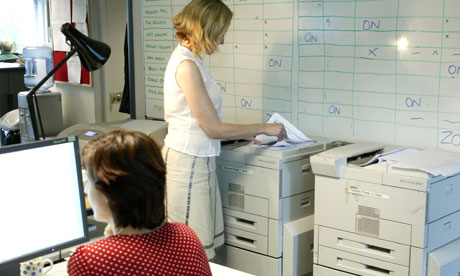
One of the problems of trying to make corporate IT greener is that it tends to be the hi-tech stuff that gets the attention. Magazines are full of articles aimed at IT managers about virtualisation (running several "virtual" computers on one machine) and other wizz-bang ways to make the data centre more energy efficient, but rarely do you read about what can be saved through rationalising printing in the sales department.
Research from printer company Kyocera, published in May, seems to back up the need for more effort in the area. The research comprised 1,000 online interviews with office workers and another 200 with IT managers in companies of 500 or more people.
The survey found that printing had gone up over the past year. Overall 37% had increased their printing and 22% decreased it. The office workers reported that the major reasons for wasted printing were: printing the wrong document, leaving printouts behind, printing too many copies and preferring to read on paper. But they also freely admitted it was their own efforts that would have the most positive impact, rather than being forced to by company policy.
There is also clear resistance from office workers to some aspects of reducing printing. For instance, there are concerns about confidentiality and convenience in sharing printers, although those who already shared were less concerned than those that still had their own printers.
There is much that can be done to reduce printing. Everyone knows it is wasteful, but short of trying to educate people to only print when they really need to, use both sides of the paper and recycle waste, there's not a lot of effort that goes into making printing more sustainable. Apart from the green benefits there are cost savings to be made.
Often users simply need a nudge in the right direction. Asking people to print on both sides of the paper needs them to take specific actions, so it's better to make duplex printing the default.
There are also other solutions that can help individuals reduce their printing. For example, software such as Fineprint and GreenPrint. They can act as the default print option and make it easy to remove unwanted text or images from the final print job. GreenPrint is more automatic in its approach and reports back to the user on the savings made.
There's a great deal of ink that can be saved, and not just by printing less. For example, the University of Wisconsin in the US changed its default font for Microsoft Outlook across campus to Century Gothic. It seems that the font uses 30% less ink than Arial, the most common default option. Ink costs the university around £6,000 a gallon and accounts for 60% of the cost of the printed page, so it's potentially a significant saving.
To go even further, there are specially designed eco-friendly fonts. With Ecofont, for example, you can type with their usual font but print using the ink-saving variant. These type of fonts have additional holes to reduce ink use with apparently no impact on legibility. Preton, on the other hand, combines both ink and paper reduction by deleting unnecessary pixels from all aspects of a print job. It also provides the capability to eliminate unneeded text or graphics, and providing analysis of print usage and savings.
The options above are just a few examples of what is available on the market. The main point is that addressing economical printing is a much easier and quicker option than many other aspects of sustainable ICT, and it may not even need the involvement of the IT department.
This content is brought to you by Guardian Professional. Become a GSB member to get more stories like this direct to your inbox