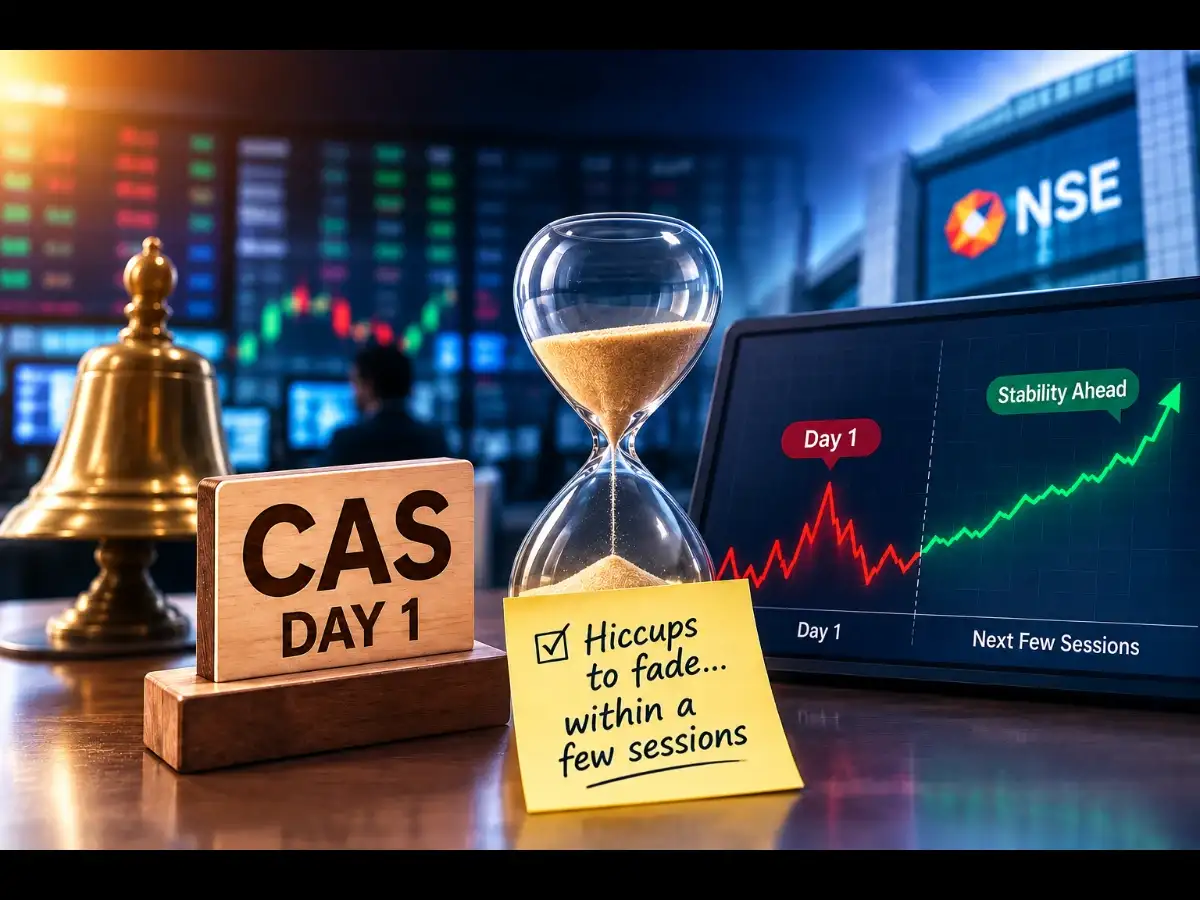
India has historically determined its closing prices as a volume-weighted average during the last half hour of trading. However, for the first time, the closing price was established using a method long employed by markets in London, Frankfurt, Hong Kong, and New York: a closing auction. In this process, the entire market’s end-of-day interest is consolidated into a single event and finalised at one price.
Day one proceeded largely as anticipated. Those familiar with closing auctions in other countries recognise the pattern well: the most liquid exchange handles the majority of trades. This was evident here, as NSE accounted for nearly 100% of the auction volume by day's end, effectively receiving all closing orders in the market at a single venue. The resulting closing prices reflected the overall direction of the pooled order flow—rising when buying interest was stronger and falling when selling interest prevailed. This demonstrates an auction, closed by design, performing its fundamental function.
The concentration of volume is both expected and unsurprising. An auction yields a single price for each stock at each venue, and the significance of that price depends on the volume backing it. Participants naturally direct their closing orders to venues where they anticipate finding counterparties, and more volume tends to attract even more. Index funds and ETFs needing to trade at the official close have strong incentives to stay where the volume is rather than spreading out across multiple venues. This pattern was evident when Hong Kong's closing auction was introduced, and earlier, across European exchanges. Indian exchanges, operating under the same Sebi framework, also show participants selecting venues based on liquidity.
The only area where the picture appeared less consistent was in derivatives. Participation in the futures segment during the closing window was less extensive and less deep than in the cash auction. Consequently, the futures market did not fully synchronise with the cash close, as expected. The desks responsible for keeping cash and futures prices aligned are naturally cautious, and few were willing to take positions through a mechanism they had never seen operate live. They scaled back and observed. As these desks become more comfortable and reintroduce their usual participation, the two segments will realign as they have traditionally done. Every market that has adopted closed auction for the first time has experienced this brief lag, which always closes quickly..
Operationally, the day was smooth and uneventful, which is the best outcome for a launch of this size. No technical issues or reconciliation errors occurred. The auction captured the full market interest at closing, prices were calculated and distributed promptly, and final files to brokers, the clearing house, and depositories were transmitted successfully on the first attempt.
Remember, this was only the first session. Today’s orders arrived late in the auction window because desks preferred to observe the price formation before acting, and overall participation across segments was more cautious than it will be in a month. This is typical for a first day, and these issues tend to resolve with increased familiarity. As desks get used to, orders will be placed earlier, market depth will grow, the futures connection will strengthen, and the closing process will become routine. This should stabilise within a few sessions, as has been the case wherever this mechanism has been implemented.
For investors, this change is subtle but significant. The closing price—used for mutual fund NAVs, index calculations, and settlements—is now an actual collectively determined price rather than a calculated average. It is determined through open market activity, by the power of supply and demand, making it auditable, with real buyers and sellers involved. The transition was smooth on day one, and future sessions are expected to make this the standard practice, with markets benchmarking themselves against global best practices.
(The author is Partner, MCQube)
(Disclaimer: Recommendations, suggestions, views and opinions given by the experts are their own. These do not represent the views of The Economic Times)