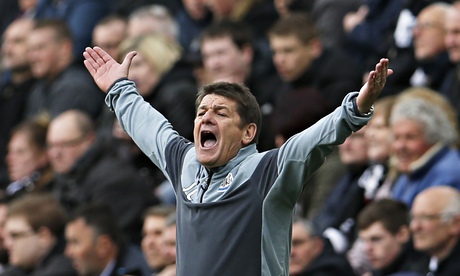
John Carver detests his depiction as a latter-day Edward J Smith but the comparisons between Newcastle United’s head coach and the captain of the Titanic are increasingly compelling. While Tynesiders fear Carver is navigating their club towards relegation, few at St James’ Park believe Alan Pardew’s successor can survive a disastrous five-month stint at the helm featuring a recent eight-game losing run.
The exceptions are those who remember the Ruud Gullit and Sir Bobby Robson eras and recall how expert the 50-year-old is at extricating himself from the tightest of corners.
In 1998, Gullit elevated Carver from the obscurity of the academy to the first team practice pitches where his status as the then boss’s blue-eyed boy ensured the one-time Cardiff City full-back stepped into a political minefield.
With Gullit engaged in a bitter civil war with a group of powerful senior players including Alan Shearer, Rob Lee and Duncan Ferguson, the newly promoted lieutenant found himself eyed suspiciously. The awkwardness was exacerbated by the Dutchman’s habit of addressing him as “lovely boy”.
When Robson subsequently swept in, accompanied by his loyal assistant Mick Wadsworth, Carver’s future looked clouded. But the newcomers were quickly won over and he remained very much part of Newcastle’s furniture as Robson’s first season concluded with a tour to the West Indies.
In Trinidad, Carver gathered senior professionals together and spoke frankly about his conflicting emotions towards Gullit and misplaced loyalty. After acknowledging he had made some big mistakes he vowed to be his own man in future. The players, swayed by his appealing blend of honesty and Geordie humour, agreed the past would be forgotten and when Wadsworth left for Southampton, Robson replaced him with Carver.
A mini “golden age” ensued on Gallowgate with the team twice qualifying for the Champions League. “John was a fantastic coach,” says Jermaine Jenas, the former Newcastle and England midfielder. “He was absolutely brilliant with the players.”
Jenas reflects a wider consensus. Significantly when Gary Speed, another star of the Robson era, took charge at Sheffield United, he immediately hired Carver. According to Bradford’s Mark Yeates, then a Bramall Lane winger, the coach was brilliant, producing top-class sessions.
Such sentiments are echoed by Kevin Blackwell, who employed Carver during his time as Leeds United manager and lauded the high-level input of a man who routinely wore a black and white striped shirt beneath his official Leeds kit.
The Tynesider’s ambition of playing for his boyhood heroes had died when injury forced his retirement as a professional at 20. Carver’s riposte was to enrol on every coaching course going and eventually convince Newcastle to place him in charge of the academy. The downside was that Kevin Keegan, then in his first incarnation as manager, abolished the reserves, effectively destroying the pathway to the first team. “JC did a wonderful job in very difficult circumstances,” says Shaka Hislop, Keegan’s former goalkeeper.
Ben Harmison plays cricket for Kent but turned out for Newcastle’s academy sides. “I feel sorry for John,” he says. “I played for him when I was 15 to 16 and he’s an excellent coach. He’s been hung out to dry. He’s working with players who don’t have his passion. He’s been thrown in at the deep end with a depleted squad not trying their hardest for him.”
Allied to a chronic lack of leadership in a largely francophone dressing room, the refusal of the owner, Mike Ashley, to strengthen an alarmingly slender squad and an unprecedented injury crisis have made Carver’s position perilous, partly due to events beyond his control. “I feel sorry for John,” says Freddy Shepherd, Newcastle’s former chairman. “He’s under extreme pressure and being harshly criticised but he didn’t sign these players.”
Even so, concerns regarding Carver’s adequacy for the role remain. If an often volatile character has matured since the days when he wrestled Craig Bellamy to Newcastle airport’s floor after a parking dispute, his media relations have, at times, proved horribly naive. Alleging that Mike Williamson had got himself deliberately sent off at Leicester – something the defender denied – rang assorted alarm bells.
Tellingly, a warm, generous, immensely likable character disinclined to bear grudges quickly made peace with Williamson. It was a rapprochement typical of a man now such good friends with Bellamy that he holidayed at Carver’s Toronto home. That sojourn came during Carver’s stint in charge of the city’s MLS side. Rather mixed, it ended in resignation after 15 months with the Englishman citing excessive interference from his board and the League. After impressing in Toronto with new ideas, including a pioneering use of detailed statistical analysis, Carver began to appear stressed. On his departure, Mo Johnston, then the club’s general manager, spoke of a popular figure feeling pressure and hinted that the strains of a first managerial posting had affected Carver’s health.
Fast forward to the present and Steven Taylor – sidelined by a ruptured achilles tendon but a Carver loyalist dating from their academy days – recently expressed similar worries, saying he had seen Newcastle’s manager age during 2015.
Taylor, though, has a message for those delighting in lampooning his boss. “He hasn’t had the players to do anything different,” he says. “José Mourinho or Sir Alex Ferguson couldn’t do anything different.” Being Gullit’s patsy is one thing, serving as Ashley’s fall guy quite another.