Walking around residential areas in Tokyo's Minato Ward, such as Azabu and Mita, I spot many buildings with the flags of foreign countries. These are embassies -- the ward is home to about 80 of them, more than half the embassies based in Japan. Why are so many here and not in Chiyoda Ward, where many Japanese government bodies are located, or in Chuo Ward, which used to have an enclave for foreign residents?
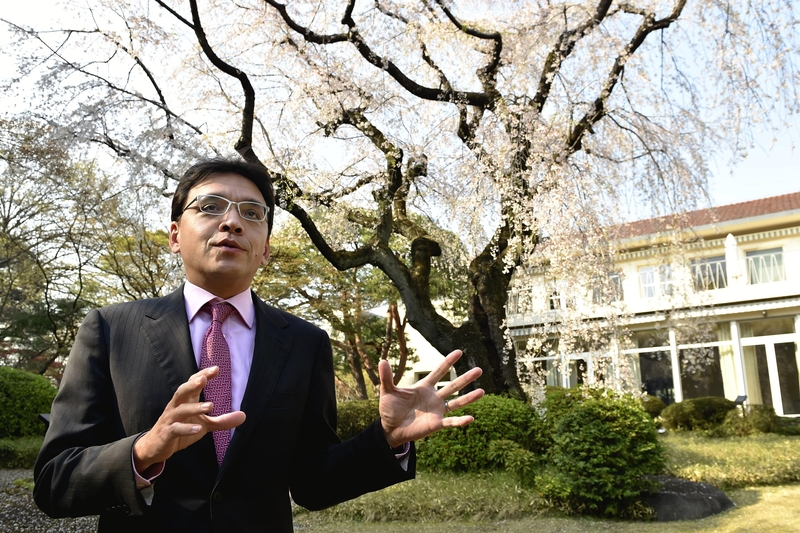
The German Embassy is located in the Minamiazabu area of Minato Ward. In the garden of the ambassador's official residence, there is a cherry tree about 150 years old, as well as an old bell and a small shrine.
"A samurai house used to stand on this site during the Edo period (1603-1867)," said Mario Krebs, 43, a diplomat in charge of public relations at the embassy.
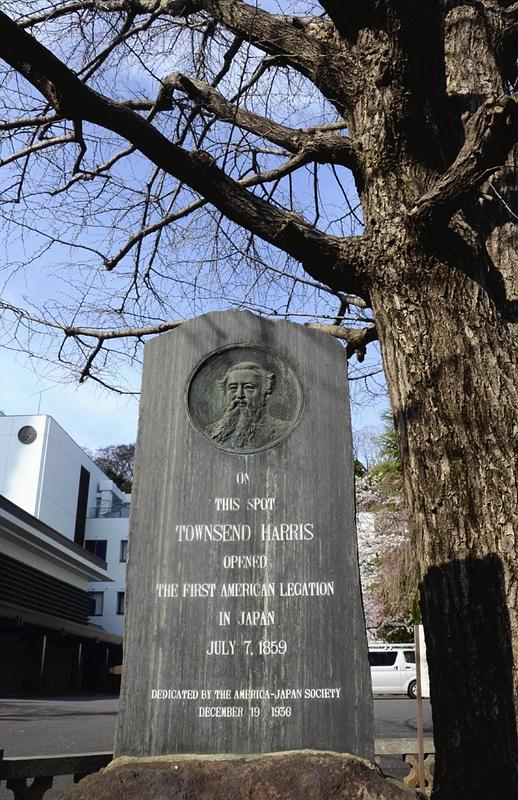
According to the Foreign Ministry, 155 countries, including the Delegation of the European Union to Japan, had embassies in this nation as of the end of last year. Of them, 83 embassy facilities are located in the ward, far more than the 23 embassies in Shibuya Ward, which ranked second.
Germany (then West Germany) set up an embassy at its current location in 1960. Most of the about 15,000 square meters of the premises was once part of the residence of a hatamoto retainer of the Tokugawa shogunate, according to the embassy. It later became a politician's house sometime from the Taisho era (1912-1926) to the Showa era (1926-1989).
After World War II, the Japanese government sounded out the German side about the construction of the embassy and ambassador's residence on the site.
Feudal domains in the Edo period are believed to have begun setting up residences outside Edo Castle to disperse their bases following the Meireki no Taika (Great Fire of Meireki) in 1657.
In the current Minato Ward area, there used to be many houses for daimyo feudal lords and hatamoto. These compounds are usually quite large.
"The sites of these houses are in a prime central Tokyo location and offer a lot of space, making them ideal for embassies," said Narumi Seino, 46, who was a director of Global Community, Art and Culture Planning at the Minato Ward Office through the end of March.
Krebs said, "I like my workplace because I can carry out my duties at a historical location while feeling a bond between Japan and Germany."
Temples as diplomatic offices
There are many temples in the ward, which seems to be another key to the number of embassies in the area.
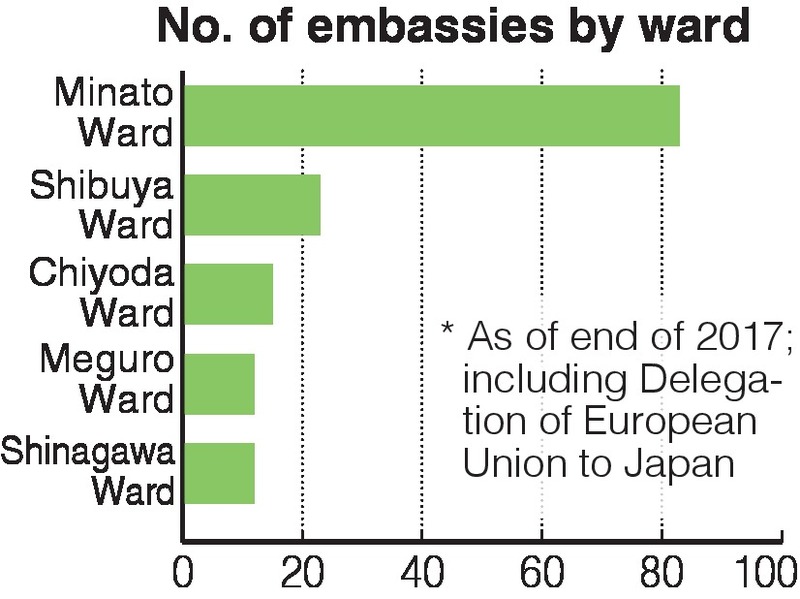
Townsend Harris, the United States' first consul to Japan, moved to Zenpukuji temple in Motoazabu in the ward in 1859. He is also known as a negotiator of the Japan-U.S. Treaty of Amity and Commerce. The temple preserves diaries that describe diplomats' lives at that time.
"We often have foreign tourists visiting our temple," said a temple official.
Britain likewise had its base at Tozenji temple in Takanawa, while France was based at Saikaiji temple in Mita.
Why were temples chosen as diplomatic offices?
"After Japan opened its doors to the world, the anti-foreign sentiment in Japan was quite strong, so temples, which were usually spacious and solidly built, were a perfect place for a diplomatic establishment," said an official of the Minato City Local History Museum.
However, temples could be found in other areas than Minato Ward, so why did many foreign countries choose to have their embassies here?
"At that time, ships were the only means of transportation between Japan and foreign countries, so being close to Yokohama, which operated as an open port, gave them a great advantage," the official said.
Many countries that started their diplomatic operations based in temples later opened their official embassies in the same area, which is now part of Minato Ward.
"When Japan was still an unknown land to many foreign diplomats, they could probably easily exchange information in the Minato Ward area because many countries were based there," Seino said.
"I think the area [present-day Minato Ward] already had an established status as an embassy district in the Meiji era (1868-1912)," Seino added.
New era, new style
The ward nowadays sees an increasing number of embassies in a new style.
A building in Nishiazabu is home to embassies of 12 countries, mainly from Latin America.
Ecuadorean Ambassador Jaime Barberis, 60, said he was first surprised to learn the embassy was located inside an office building. As a diplomat, he has served in such countries as Germany, Switzerland and Austria, and all the embassies he previously worked at were independent buildings.
The ambassador believed having an embassy inside an office building could be particular to Japan, where land is very limited.
However, having an embassy in such an environment comes in handy, Barberis said. For instance, when Latin American countries jointly negotiate with the Japanese government, they can easily gather for meetings.
Twenty-five organizations, including embassies in the ward, took part in a March 25 event at the foot of Tokyo Tower to introduce their cuisines and cultures.
Mai Toriyama, 31, a homemaker in the ward who participated in the event, said, "I'm having a great time here, as I can experience various cultures at the same time."
Walk around the ward and you'll get the feeling that you're traveling around the world, walking in the footsteps of history that embassies have also seen.
Read more from The Japan News at https://japannews.yomiuri.co.jp/