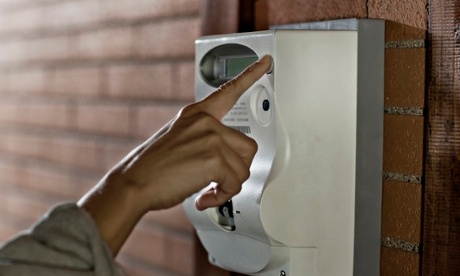
When you turn on the boiler, the tumble drier or the dishwasher, one benefit of a smart meter is obvious: the display tells you how much electricity is now being used, and exactly how much it is costing you.
Such real-time feedback clearly helps customers use energy more efficiently and cut bills. But beyond this, smart meters will be vital for monitoring, managing and distributing energy more intelligently in the future – enabling, for instance, renewables to be used to their full potential or helping to reduce power cuts in developing countries. The meters are also seen as a big step on the road to smart cities.
The first prototype smart meters were introduced by Boeing during the 1970s, before inventor Ted Paraskevakos took his idea and turned it into the world’s first fully automated remote meter reading and load management system.
The technology then lay largely dormant until energy multinational Enel began looking at it. In 2001, it became the first utility company in the world to commit to the meters with the launch of the Telegestore project. This ambitious scheme put a smart meter in every Italian home. Involving some 32 million people, it took 10 years to complete.
The fundamental benefit smart meters offer consumers is more control over their energy use, as the amount used and money spent are transparent. Connected to the utility company, the meters also put an end to estimated bills, with invoices based on actual consumption. Enel’s Telegestore meters display the energy used, the power being drawn, and the tariff and contract the customer is on. The company says its meters not only make energy use transparent but also speed up contract changes such as connections and disconnections, as this can all now be done remotely. It says the meters have largely eliminated errors and disputes over bills.
For network operators, the meters collect data on electricity supply and monitor the service in real time, enabling a swift response if part of the grid breaks down. In Italy, for instance, by automating the network Enel says it has halved the average time of service interruptions. Wireless technology allows the energy supplier to communicate with the meters directly, remotely and at any time.
In short, explains Enel’s chief executive Francesco Starace, smart meters add “brains” to the grid.
Systems such as Telegestore also open up the electricity market by allowing customers to switch suppliers easily. People can also select different, flexible tariffs – where the prices they are paying might vary according to the season or day of the week – as well as manage their accounts remotely.
Now the rest of the world is catching up with the Italians as across the globe smart meters are replacing traditional ones.
In Spain, Enel has begun automating the network through its subsidiary Endesa, a project that will ultimately replace 13m traditional electro-mechanical meters with smart ones. A further five million Enel devices have been supplied to other European countries, with a further million destined for Romania.
For those interested in greener power, an important advantage of smart meters is that they support renewables, enabling the grid to host the energy they produce. Enel’s devices can measure the flows of energy between grid and customer both ways and thus support users exchanging energy with the local network. This is important for so-called “prosumers” — not only consumers but also producers of renewable energy. Enel predicts such prosumers will be increasingly involved in the electricity system. By controlling how they consume energy and when they release their own renewable energy back to the grid, they can save on bills and help the environment.
“Digitising the network goes hand-in-hand with renewable energy,” says Starace. “As renewables hit 30-40% of the energy mix and because, invariably, renewable energy plants tend to be smaller, the importance of how the grid behaves and how a variety of loads are distributed across it, becomes more important. If the grid is not self-adjusting to these variations, then you hit a limit [for renewables], but if it’s digitised that limit is automatically removed and renewables can penetrate a lot deeper.”
In 2012, Enel established Meters and More, a non-profit association to share the protocols of the world’s most used smart metering technology, and spread the benefits around the world. It currently has 50 members, including electricity distribution system operators and meter manufacturers, as well as research and certification bodies.
Through Meters and More, Enel is testing a range of technologies linked to smart meters in Brazil, Chile and Colombia, with the aim of boosting the development of energy networks and smart metering in Latin America.
Livio Gallo, head of global infrastructure and networks at Enel, predicts this will trigger a radical change in the Latin American energy market. “Allowing remote consumption reading, flexible tariffs and faster identification of faults will enable active participation of people with the system, and completely change the relationship between electric distribution utilities and their customers,” he says.
In Africa, Enel hopes to use the technology to reduce the impact of power outages that leave businesses reliant on back-up diesel generators, increasing their energy bills and carbon footprint.
For instance, Gallo explains that in South Africa “load shedding” — interrupting supply to some users as a last resort when there is too much demand — is still necessary to keep the system stable. Smart meters will tackle this by allowing better management of demand and maximising use of new energy sources. This is particularly relevant in South Africa, which is the world’s fourth largest investor in renewable energy.
“With full scale smart metering in place it will be possible to manage the demand of energy and reduce the losses. It will also support the implementation of cheaper distributed generation from renewable sources.”
Overall, Gallo believes such technology and better grid management could deliver a 60% reduction in a network’s unreliability and a 40% improvement in operational efficiency. Smart meters also make it easier to manage prepayment for energy. Thiscould help in countries where there are problems collecting bill payments.
Looking further into the future, smart meters will play a big role in extending the use of electricity and in building smart cities in general. For instance, a key element of the smart city vision is electric cars: such meters will monitor the energy smart vehicles use to charge and also — in so-called “vehicle to grid” systems — allow measurement of how much energy each driver feeds back to the grid from the batteries of cars not being used.
Ultimately, the usefulness of smart meters seems to come down to the wealth of information they provide, allowing us to know everything from exactly how much energy a single dishwasher is using to the precise pattern of energy demand and supply across an entire nation. Information, it seems, really is going to give us power.
Content on this page is paid for and produced to a brief agreed with Enel, sponsor of the energy access hub at the Guardian Global Development Professionals Network.