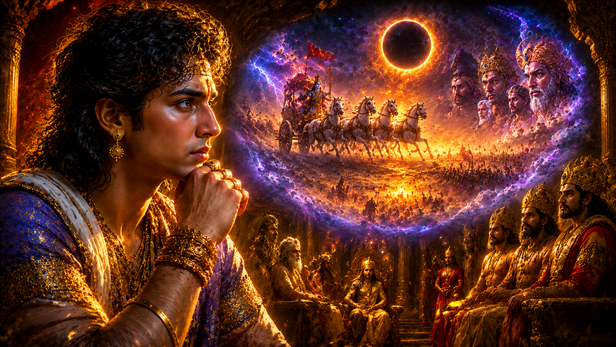
Imagine knowing exactly what is going to happen tomorrow. Now imagine knowing who will win a war, who will die, and how history will unfold. Would you stay silent? Most people wouldn't. Yet according to one of the most fascinating traditions associated with the Mahabharata, Sahadeva the youngest Pandava possessed extraordinary knowledge of the future. He understood events that others could not see. He knew truths that could have changed everything. And still, he remained silent. Why? The answer is one of the most mysterious and thought-provoking stories in the Mahabharata.
The Most Overlooked Pandava
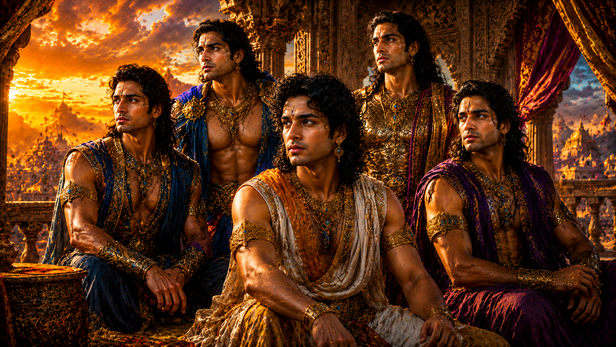
The quietest Pandava often carried the deepest wisdom.
When people discuss the Mahabharata, Sahadeva is rarely the first name mentioned. He lived in the shadow of larger personalities and legendary warriors. Yet many traditions describe him as one of the wisest figures in the epic. Unlike others who sought attention through action or leadership, Sahadeva remained calm and observant. His strength was not physical power or political influence. It was knowledge. While others focused on battles, Sahadeva focused on understanding the forces shaping those battles. His silence often concealed extraordinary insight.
The Strange Gift That Changed Everything
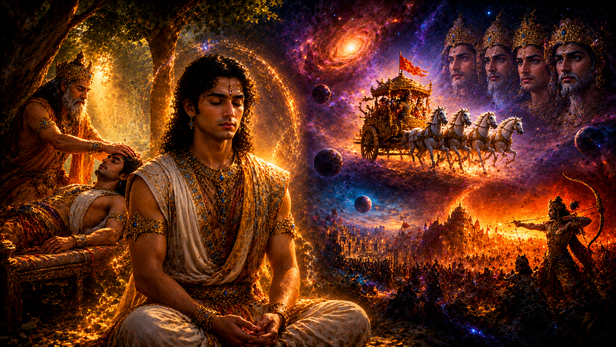
mysterious event is said to have granted Sahadeva extraordinary wisdom.
One popular tradition states that Sahadeva gained knowledge of past, present, and future through a divine event connected to his father, Pandu. After acquiring this knowledge, he understood truths hidden from ordinary people. He could see patterns, consequences, and outcomes long before they unfolded. But this gift came with a burden. Knowing the future did not mean he had the freedom to alter it. Instead of empowerment, his knowledge often brought responsibility. Sometimes the hardest part of wisdom is carrying it alone.
The Curse Behind His Silence
According to traditional accounts, Sahadeva faced a restriction that prevented him from freely revealing what he knew. If someone asked him directly, he would answer truthfully. However, he could not openly interfere with destiny by revealing everything. This creates one of the most fascinating dilemmas in the epic. Imagine possessing answers to history's greatest questions yet being unable to share them. Sahadeva's silence was not weakness. It was obedience to a higher order that governed the unfolding of events.
Why He Could Not Stop the War
A common question arises: if Sahadeva knew the future, why didn't he stop the Mahabharata war? The answer lies in one of the epic's central themes. The Mahabharata repeatedly suggests that some events emerge from collective choices, karma, and destiny. Duryodhana's greed, Shakuni's manipulation, and the repeated rejection of peace created a path toward conflict. Sahadeva understood the destination, but the journey belonged to everyone involved. Knowing an outcome does not always grant the power to prevent it.
Wisdom Is Not the Same as Control
Most people assume knowledge automatically creates power. Sahadeva's story challenges that belief. He understood more than many around him, yet he could not control every outcome. This lesson remains relevant today. We often believe that if we knew more, we could eliminate uncertainty completely. Reality is different. Wisdom helps us navigate life, but it does not place us above its challenges. Sahadeva teaches that true intelligence includes accepting what cannot be controlled while acting responsibly within what can be.
The Lesson Hidden in His Silence
Modern culture often celebrates those who speak the loudest. Sahadeva represents a different kind of strength. He understood that not every truth must be announced immediately. Sometimes patience serves a greater purpose than reaction. His silence was not passive. It was deliberate. He recognized that wisdom includes timing, restraint, and humility. In a world where everyone wants to be heard, Sahadeva reminds us that understanding when not to speak can be just as valuable as knowing what to say.
Why Sahadeva Matters Today
Sahadeva's story resonates because it reflects challenges we all face. We cannot predict the future, but we often encounter situations where we see consequences others ignore. We know some outcomes are likely, yet we cannot force people to change. His journey teaches patience, responsibility, and acceptance. It reminds us that wisdom is not measured by how much we know, but by how we use that knowledge. In many ways, Sahadeva's quiet strength may be more relevant today than ever before.
Unlock insightful tips and inspiration on personal growth, productivity, and well-being. Stay motivated and updated with the latest at My Life XP.
Frequently Asked Questions (FAQs)
1. Who was Sahadeva in the Mahabharata?Sahadeva was the youngest of the five Pandavas and the son of Madri and Ashwini Kumaras. He was known for his intelligence, wisdom, and deep understanding of astrology and destiny.
2. Did Sahadeva really know the future?
According to several traditional retellings and regional interpretations of the Mahabharata, Sahadeva was believed to possess knowledge of past, present, and future events. However, this detail is not emphasized uniformly across all versions of the epic.
3. How did Sahadeva gain knowledge of the future?
A popular legend states that Sahadeva gained extraordinary knowledge after a divine event connected to his father, Pandu. Through this experience, he became aware of many future events and hidden truths.
4. Why did Sahadeva remain silent if he knew the future?
Traditional stories suggest that Sahadeva was bound by a divine condition or curse. He could answer truthfully if asked directly but could not freely reveal future events or interfere with destiny.
5. Did Sahadeva know the outcome of the Kurukshetra War?
According to popular folklore and later interpretations, Sahadeva knew many details about the war's outcome. However, he was unable to alter the course of events because destiny had already been set into motion.