Writers often come across inspiration by accident. That’s what happened with my 2009 novel, City of Ghosts, which is partly set during the first world war.
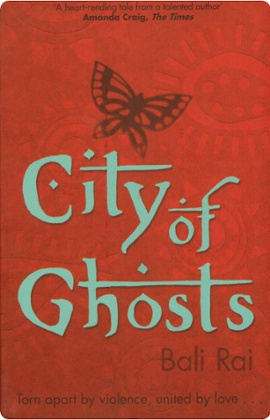
I was reading the excellent Bloody Foreigners by Robert Winder when a particular passage slapped me in the face. Winder stated that almost one third of all British troops during the war were non-white. As a lifelong history buff, I was shocked, and a little flustered at my lack of knowledge. Inspired, I jumped into the topic, desperate to know the truth. Not only was Mr Winder correct – apparently, it was common knowledge. Not for me, it wasn’t. I was taught about the first world war as a core topic in history classes so how was it possible that I’d never heard about these Caribbean, African and Indian soldiers before? I’d learned about Wilfred Owen and Siegfried Sassoon in English lessons, too, and remember being particularly taken by Sassoon’s poem, “Dreamers” – which made plain the awful, everyday human tragedy of war. What I wasn’t taught was the involvement of so many “empire soldiers” – the non-whites ones, that is. I’d read letters from troops, seen photograph after photograph and learned all about the horrors of trench warfare, yet not once was I told of men who resembled my Sikh grandfather, walking into battle along French and Belgian roads.
The harder I looked, the more I found, but nothing was straightforward. Many of the most pertinent articles were hidden in the shadows, far from the limelight. Angered and frustrated, the desire to write City of Ghosts intensified.
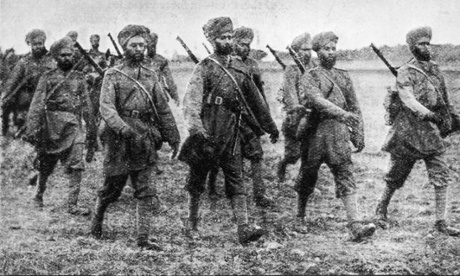
Two photographs in particular provided great inspiration. The first was of Sikh troops marching in formation along a road in northeastern France, close to Lille. A local woman was shown reaching across a Sikh soldier, possibly pinning something to his uniform. The man in question reminded me of older Sikh family members. The image shocked and jarred. It didn’t tally with anything I’d ever been taught about the war.
The second image was of Brighton Pavilion.
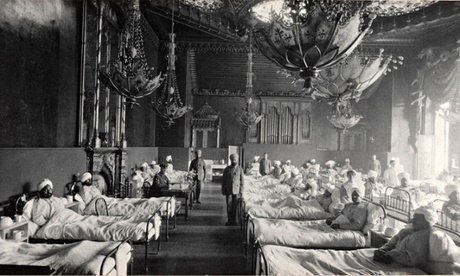
It was surreal – rows of beds occupied by injured Indian troops, lying under ornate chandeliers and surrounded by medics and armed guards. Having visited the Pavilion long before my research commenced, this came as another surprise. Why wasn’t this stuff in the history books, right next to images of Ypres and the Somme, and the good old British Tommy? Was the omission deliberate? Had they been forgotten? The answer was no, not entirely. There was mention in a few places, particularly on military websites, but not enough. What was missing was detail about these troops, nationwide remembrance of their sacrifice as compared to their white peers, and a general understanding among the wider population that Muslims, Sikhs, Jamaicans and many others fought to defend our country. And that is scandalous.
Today, it is ever more important that these men and women gain greater acknowledgement. We’re not talking small numbers, after all. Over a million Indian troops gave service alone, and died in huge numbers. The Caribbean – with its tiny population in comparison to India – sent nearly 16,000, the majority from Jamaica. Chinese workers were co-opted to do menial tasks, Africans from British and French colonies were conscripted, and in Britain itself, black British soldiers such as Walter Tull also served. How many of their names are remembered by the general public or taught in schools? Khudadad Khan – a devout Muslim who won the first Victoria Cross for a non-white? Indra Lal Roy – the ace fighter pilot? Lionel Turpin? Gobind Singh? The list of names forgotten, or never known by most, is long.
The historical link between Britain and former colonies such as India, Jamaica, Kenya, Nigeria, and many more, is complex and multilayered, but it is also strong. The involvement of so many colonial troops during the war proved it. My British Asian (rather than Indian) heritage and culture, today, proves it. But that history is missing key contributions, and attempts to rectify this are relatively recent.
According to Robert Winder, a commemorative gate to the sacrifice of “empire soldiers” only appeared at Hyde Park Corner in 2001, a year after colonial veterans were allowed to take part in London remembrance services again. How many people know about the memorial plaque in Westminster Abbey or the Chattri Monument on the South Downs? It’s time to bring this forgotten history to the fore.
As a multicultural country, it is vital that we remember all who fought and died during the first world war (and all the conflicts that followed). We live in a time of amplified Islamophobia, of continued lazy labelling of black men, and politically-engendered fear of the Other. If we taught our children that many of those being stereotyped come from countries, religions and cultures that stood alongside Britain during our hour of need, we would increase understanding and, with it, tolerance. We would ensure that the history being taught was more accurate, more representative of the truth. It cannot be right that our children must actively search for the participation of non-white troops during the first world war. It must become something they learn as a matter of course.
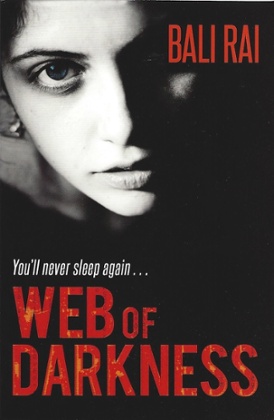
Bali Rai’s most recent book is Web of Darkness.