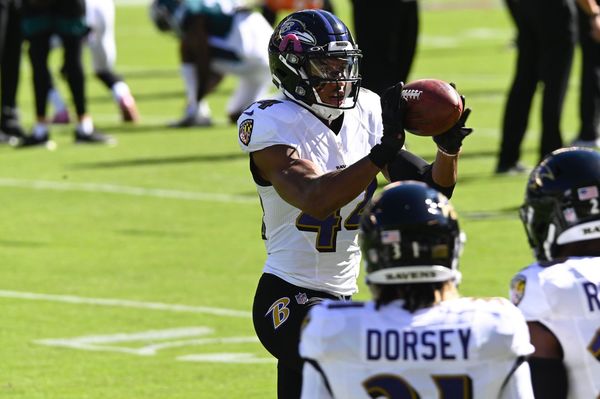
BALTIMORE — After undergoing coronavirus testing at the Ravens' team hotel Sunday morning, cornerback Marlon Humphrey arrived at M&T Bank Stadium at about 10:30. His game against the Pittsburgh Steelers kicked off just after 1 p.m. It ended more than three hours later. He headed home shortly thereafter.
Then, late Monday morning, Humphrey announced that he'd tested positive for COVID-19. Now, what happened in those six-plus hours Sunday could be crucial to the Ravens' next five days. Coach John Harbaugh has already ruled his All-Pro corner out of Sunday's game against the Indianapolis Colts. He also acknowledged Monday that even more players' availability could be in limbo this week.
Under the NFL and NFL Players Association's COVID-19 protocols, anyone with "high risk" close-contact exposure to an infected individual must be isolated for at least five days, even if the high-risk player tests negative and remains asymptomatic. From the locker room to the sideline to the field, Humphrey interacted with dozens of players and a handful of coaches and staff members Sunday.
The Ravens said in a statement Monday that they've begun the process of contact tracing, in coordination with the NFL, and have entered the league's intensive protocol, which mandates virtual meetings and masked practices.
"We don't know who the close contacts are at this point; they're going through that right now," Harbaugh said Monday. "We have a lot of technology to determine that, certainly. So we'll know more on that throughout the course of the day."
As for how complicated the next few days could get, he said: "I think we're all waiting for the answer on that. We're just going to approach it like we're business as usual in a different kind of way, and we'll go to work."
As the NFL grapples with a wave of COVID-19 infections, Humphrey's diagnosis could present unique challenges for the Ravens and league officials.
Most infections have been identified after testing at a team facility, where masks and social distancing are required, except while at practice. But Humphrey, whom Harbaugh said tested negative every day last week, was one of two players to test positive before a game Sunday; Green Bay Packers running back A.J. Dillon was the other.
Both players underwent PCR testing Sunday, but the results of the molecular tests — which are more accurate than rapid-response tests — weren't available until well after their games ended. Harbaugh said he didn't learn of Humphrey's positive test until 6 a.m. Monday.
After a coronavirus outbreak on the Tennessee Titans in late September and early October, the NFL expanded its near-daily testing of all players to game day. Humphrey and Dillon are believed to be the first players under the league's tightened protocols to play on the day they tested positive.
"This is going to be a very small experiment, and a very unfortunate experiment," said Dr. Zachary Binney, an epidemiologist at Oxford College of Emory University.
While Humphrey played all 53 defensive snaps Sunday, the NFL's medical experts have said that, through eight weeks, they have found no evidence of on-field transmission. The Minnesota Vikings reported no positive tests after they played a Titans team in late September that, within a week, had nine more positive cases among players.
But because Tennessee players were not tested the day of their game against the Vikings, it's unclear whether they were infectious when they played. That's not the case with Humphrey and Dillon. Binney said they are the NFL's "first two data points" in determining whether the virus can be transmitted to opposing players.
"The NFL wants to opt for the more accurate (PCR) test, but they also take longer to come back," Binney said. "So the price that you pay for that accuracy is that you can't get a read on everyone's status on Sunday morning of the game. Which means you risk putting someone out there on the field" with an infection.
Humphrey started to self-quarantine Monday, according to the Ravens, but experts warned about the potential risks of earlier exposure. Molly Hyde, an infection control practitioner at the Greater Baltimore Medical Center, said people with COVID-19 are generally most infectious at the beginning of their illness. An infected person could be contagious days before the onset of symptoms, Hyde said, and even those who are asymptomatic are considered infectious.
The circumstances of Humphrey's close contacts are also significant. While COVID-19 transmission is considered far less likely outside, where respiratory droplets disperse in the fresh air, Humphrey spent significant periods inside the team's locker room with teammates, coaches and staffers.
Under new NFL protocols, M&T Bank Stadium's locker rooms have been reconfigured to allow 6 feet of space between each player and to add Plexiglas dividers between lockers. Players are expected to maintain physical distancing, and the league has instructed teams to ensure that locker rooms have sufficient air flow and filtering, along with hand sanitizer and other hygiene materials.
"All else equal, I would be more concerned about people spending 15 minutes together in a locker room without masks than I would 15 minutes on the sideline without masks," said Binney, who noted that proper ventilation and face coverings would help limit risk. "Now, how does that all rank next to each other when you take all those factors into account? I would just have to say, I don't know."
Contact tracing, experts said, will be key. In Green Bay, the NFL has already determined that Packers running back Jamaal Williams and linebacker Kamal Martin had high-risk close contacts with Dillon.
Last month, the Las Vegas Raiders had to practice an entire week without their starting offensive line because of high-risk close contacts with starting right tackle Trent Brown, who'd tested positive for COVID-19. And in Buffalo, after Dawson Knox tested positive, three fellow Bills tight ends who had been in close contact with him were placed on the reserve/COVID-19 list.
With Humphrey's diagnosis, the scope and speed of contact tracing will be critical. The goal, Hyde said, is to create a "ring" around the infected person by identifying anyone they could've contacted, as well as any subsequent contacts among that group.
"If you say, 'Well, we'll give it some time, we'll see what happens,' the problem with that is that anyone who was actually infected will then spread it to their family, who will then turn and spread it to multiple people," Hyde said. "And it really just ends up with an exponential spread. And so that's why it is important for contact tracers to move quickly."
The hope in Baltimore, and in Green Bay, is that one positive test won't snowball. Binney cautioned that if there was any COVID-19 transmission among teammates or between teams Sunday, it likely wouldn't result in positive tests until at least Thursday or Friday. According to the Centers for Disease Control and Prevention, the median incubation period for the coronavirus is about four to five days.
"So it's going to be a waiting game," Binney said.