CHARLOTTE, N.C. _ What a wild ride the regular NFL season has been.
And not just for the Carolina Panthers, who are on the precipice of a playoff run following Sunday's contest in Atlanta.
Throughout the NFC South specifically, the competition has only increased as the weeks have passed, and the time when a 7-8-1 record won the division and sneaked Carolina into the playoffs has passed.
That kind of a year won't cut it any more in the NFC South, where the New Orleans Saints and Panthers sit at 11-4 and in the postseason (albeit jostling each other for top billing), and the Falcons (9-6) need to win Sunday to make the playoffs.
No other division in the NFL has three such teams stacked upon each other this season. In fact, the NFC South has the edge over every other division in wins and losses, at 35-25 (the next closest is the NFC North, at 32-28).
"It's cyclical," said Panthers coach Ron Rivera this week, while reminiscing about the 2010 NFL season, in which the Falcons (13-3) and Saints (11-5) made the playoffs but, at 10-6, the Buccaneers did not.
But why is the cycle so strongly swiveling back to the NFC South?
"The biggest thing we have going for us in the (NFC) South is that everybody has a franchise quarterback," Rivera said. "I think that's one of the keys."
Panthers quarterback Cam Newton agreed this week.
"It's a very stout division, led by _ look at every single team _ a very talented quarterback. ...Everybody's capable of being a franchise quarterback, and that's what you're seeing," he said.
A franchise quarterback of the caliber of those in the division _ Drew Brees (Saints), Newton, Matt Ryan (Falcons) and Jameis Winston (Buccaneers) _ can keep a team afloat despite early-season struggles. Carolina, New Orleans and Atlanta all know this story well: Each team started inconsistently (4-2, 4-2 and 3-3, respectively), but gained steam down the stretch thanks in part to the play of their quarterbacks. And even a languishing Buccaneers team (4-11) was sparked to life and almost beat Carolina last week (nearly spoiling a playoff clinch) after Winston threw for 367 yards.
"When New Orleans started off 0-2 everybody was writing them off, everybody thought they (were) done," said cornerback Captain Munnerlyn. "They were like, 'Man, this is going to be a rough year for New Orleans. They might try to get rid of Drew Brees,' and all that. I'm like, 'Man, what? It's only two games!' They came out and they got hot. I think they ran the table like eight games in a row."
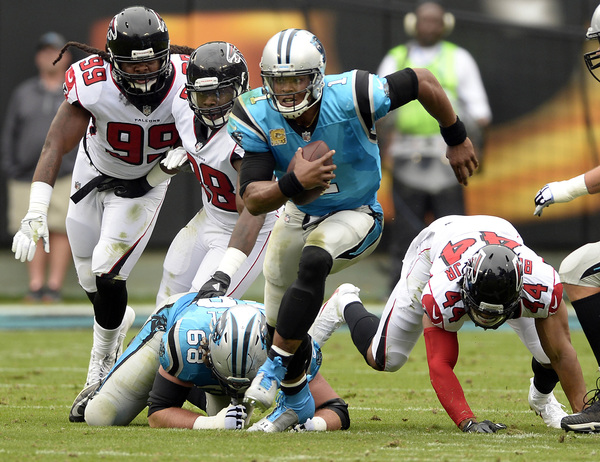
And in Carolina, Newton has helped his team to a 5-1 record in its past six games with 11 passing touchdowns, two rushing touchdowns, two interceptions (after throwing 11 in his first eight weeks of the season) and 59 rushing yards per game.
Success throughout the division is also about having an elite receiver, said linebacker Luke Kuechly.
"I don't know what it is, wide receivers are just good in this division," he said. "You look at the teams we play, Mike Evans, stud. Michael Thomas, I don't think he gets enough credit for what he does ... And then Julio (Jones) is a monster. I just think it's one of those things that regardless of who you play in this division, there are going to be good quarterbacks and good wide receivers.
"And now running backs, too."
Kuechly pointed out that while each NFC South team puts its own spin on the position, each features a tandem: Carolina has rookie pass-catching back Christian McCaffrey (who leads the team with 75 catches this year) and power back Jonathan Stewart. Atlanta has Devonta Freeman and Tevin Coleman. New Orleans has Mark Ingram and rookie of the year candidate Alvin Kamara, and Tampa Bay has Doug Martin and Charles Sims.
"There's always a physical guy, and a guy that can change up in space," he said.
"There's good quarterbacks, there are good running backs (and receivers), and this division makes it hard on us defenders because it doesn't matter who you play.
"Regardless of who it is, you're going to have a bunch of good players that deserve your attention."