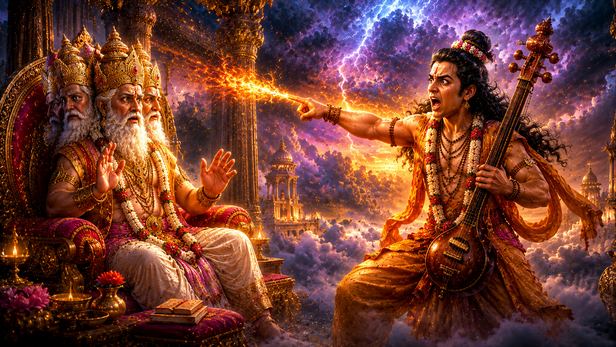
Why is Lord Brahma, the creator of the universe, worshipped in so few places despite being one of the most important deities in Hindu tradition? The answer lies in a forgotten story filled with devotion, anger, destiny, and a curse so powerful that it changed the spiritual landscape of the universe itself. At the center of this extraordinary tale stand a father and son Brahma and Narada. What began as a disagreement over duty soon turned into a cosmic conflict that would reshape divine history for ages to come.
When Narada Refused His Father's Command

Narada Muni respectfully declines Brahma's request to expand creation.
After creating Narada, Brahma entrusted him with the responsibility of helping populate the universe. However, Narada had a different vision. His heart was completely devoted to Lord Vishnu, and he wished to spend his life spreading devotion rather than becoming involved in worldly attachments. While Narada's decision came from spiritual purity, Brahma saw a growing problem. Several beings had already chosen renunciation over creation. If everyone followed the same path, the purpose of creation itself would remain incomplete. This disagreement planted the seed for one of the most dramatic events in Hindu mythology.
The Fear That Entered Brahma's Mind

The creator worries about the balance of the universe.
Brahma's concern was not personal pride alone. He feared that if all his children chose asceticism, the cycle of life would stop before it truly began. The universe needed families, societies, and future generations to fulfill its purpose. To Brahma, creation and spiritual growth were meant to exist together. Yet Narada's refusal reminded him of earlier disappointments. His frustration slowly transformed into anger. What started as concern for cosmic balance soon became an emotional reaction. Sometimes even divine beings face moments where emotions cloud judgment, and this moment would prove costly.
The Curse That Changed Narada's Fate
Consumed by anger, Brahma cursed Narada to be born as a Gandharva named Upabarhana. The irony was striking. Narada, who wanted to avoid worldly pleasures, would now experience them deeply. In his new life, he became known for beauty, music, luxury, and attraction to worldly enjoyment. The curse forced him into exactly the life he had hoped to avoid. Yet hidden within this punishment was a lesson. Spiritual wisdom becomes even stronger when tested by temptation. Narada's journey would prove that true devotion can survive even the strongest distractions.
A Son Questions His Father's Judgment
Narada accepted the curse, but not without expressing his pain. He questioned why his elder brothers, the Sanat Kumaras, were allowed to pursue renunciation while he was punished for the same choice. His words reflected a deeper concern about fairness and equality. Narada did not rebel against destiny, but he wanted his father to understand the hurt caused by unequal treatment. This moment transforms the story from a simple mythological event into a timeless lesson about relationships. Even divine families experience misunderstandings, expectations, and emotional wounds.
The Blessing Hidden Inside The Curse
Before departing, Narada requested one blessing from Brahma. No matter what form he took, no matter where he was born, his devotion to Lord Vishnu should never fade. Brahma granted the request. This blessing became more powerful than the curse itself. Although Narada would experience worldly life, his inner connection with the divine would remain unbroken. The episode reveals a profound truth: circumstances may change, but genuine devotion can survive every challenge. External situations influence life, but inner faith determines destiny.
The Curse That Reached The Creator
The pain within Narada had not fully disappeared. Feeling that he had been unfairly punished, he responded with a curse of his own. Narada declared that for three cosmic ages, Brahma would receive little worship across the three worlds. According to many traditions, this curse explains why temples dedicated to Brahma are extremely rare compared to those of Vishnu and Shiva. The event demonstrates that actions have consequences, even for divine beings. In mythology, power never stands above responsibility, and every decision carries lasting effects.
A Cosmic Battle Of Two Great Ideals
At its heart, this story is far more than a conflict between father and son. It represents a timeless philosophical debate. Brahma symbolizes creation, responsibility, and participation in worldly life. Narada symbolizes renunciation, devotion, and spiritual liberation. Both paths have value. Society cannot function without creators, yet spiritual growth cannot flourish without seekers. The beauty of Hindu philosophy lies in recognizing the importance of both. Rather than declaring one side correct, the story teaches the necessity of balance between worldly duties and higher spiritual goals.
Unlock insightful tips and inspiration on personal growth, productivity, and well-being. Stay motivated and updated with the latest at My Life XP.
Frequently Asked Questions (FAQs)
1. Why did Brahma curse Narada?According to the legend, Brahma cursed Narada because Narada refused to participate in expanding creation and wanted to dedicate himself entirely to the devotion of Lord Vishnu.
2. What curse did Narada receive?
Narada was cursed to be born as a Gandharva named Upabarhana, where he would experience worldly pleasures and attachments he had originally wished to avoid.
3. Did Narada accept the curse?
Yes. Narada accepted the curse but expressed his disappointment, believing he had been treated unfairly compared to his elder brothers.
4. What blessing did Narada ask for?
Narada requested that regardless of his birth or form, his devotion to Lord Vishnu should never leave his heart.
5. Why did Narada curse Brahma?
Narada felt that Brahma had punished him unjustly and cursed him so that he would receive very limited worship in the three worlds.