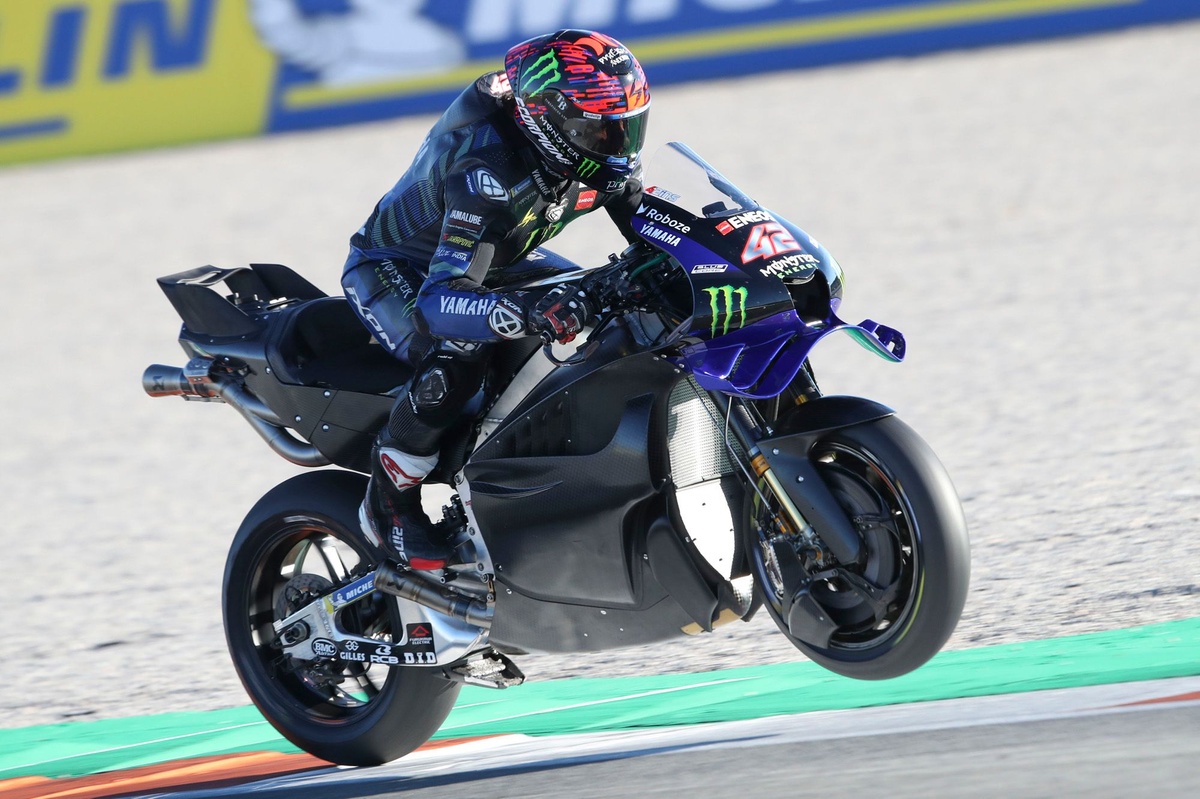
Jack Miller and Alex Rins believe Yamaha’s V4 project has the greatest outright potential in the prototype heading into the 2026 MotoGP season.
Yamaha has abandoned its long-running inline-four motor in favour of an all-new V4 for its M1, as it makes a late push to improve its competitiveness in the final year of the current regulation cycle.
The V4-powered M1 made its latest public appearance at the Valencia test last month, where star rider Fabio Quartararo set a time that was only half a second down on pacesetter Raul Fernandez on the Trackhouse Aprilia.
The Japanese manufacturer also held a private test at Circuit Ricardo Tormo the following day to gather additional data from the bike before the winter break.
While Quartararo remained “more neutral” about the performance of the bike after a difficult first outing in the Misano test, Yamaha stablemates Miller and Rins stressed there were plenty of reasons to be optimistic about the brand’s prospects for 2026.
Pramac rider Miller felt the pace of the V4 was already looking promising, even as he admitted the bike was far from a finished product.
“There's potential. The potential's obviously going to be bigger. We wouldn't go with it if we didn't think it was going to be bigger than what we got,” he said.

“A bit over half a second off already is a promising sign, considering the engine [being tuned down] and so on. But we're pretty steady at the minute with the engine, so that was a decent time.
“The electronics needed a lot of work. We've got to play around with just that sort of stuff. Just the same sort of stuff that I kind of did this year when I hopped on the M1 this time last year. The TC is not too bad. It's just the way it works; getting the fuelling [engine maps] right, getting the bike running crisp, so it's not spinning on the first touch and stuff like that.”
Rins echoed Miller’s sentiment, explaining how the switch to the V4 motor has improved the M1 under braking.
“The bike has slightly improved. They didn't change anything in terms of gearbox or big items, but I felt better than in Misano,” the Spaniard explained. “The shift shock that we were struggling with quite a bit, especially at this track, is working better.
“In braking, it is much better than the inline-four. The problem with the inline-four was that we were stopping the bike only with the front tyre. With this bike, we are able to use both tyres. And as soon as you brake, the bike goes a little bit sideways, and this is really helpful.”
One of the strongest points of the current M1 is its predictable and stable front end, which allows Yamaha riders to carry more speed into corners. Like Quartararo, Miller believes this is one area where the V4 bike will need to catch up to its predecessor.
“Obviously coming off the [inline-four] M1, which is a bike that's got a remarkable front end, you're always going to feel like you're taking a back step in that sort of department,” he said.

“But we've got a clear direction that we need to go. I can understand Augusto [Fernandez’s] frustration and lack of confidence in the front end. There's some work that definitely needs to be done in that. But I believe once we've got a direction, which I think that [the] boys do, that's going to be an easy solution.”
Meanwhile, Rins identified a lack of traction as the V4’s weak point based on his own experience with the 2026 prototype.
“It's true that we can pick up the bike better than the inline-four because it's moving less [and there is] less shaking," Rins explained. “But picking up the bike like this, we are not able to find the traction. So it's the main target.
“Leaving apart the speed, [an area] that Yamaha said they are coming with some updates in Sepang, I would like to improve the traction.”
Miller said the V4-spec M1 still carries some traits of the current-generation bike, but also feels markedly different in several areas.
“I think it has the Yamaha DNA about it,” he said. “It has a little bit of a Honda/KTM kind of sound about it and a Ducati feel in terms of weight.
“But just in terms of the weight and the inertia that you get out of the engine, then it has its own sort of character in terms of the torque progression and the way the power comes on.”













Read and post comments