In the preface to his new book, Cricket As I See It, former Australian Test captain Allan Border pauses to consider the nondescript, anti-climactic manner in which his Test career ended on a foreign field during his side’s 1994 Test tour of South Africa.
In that game at Durban it wasn’t so much a case of raging against the dying light as a man coming to terms with the frustrations of a game that had gripped and absorbed him for decades but which he was now prepared to leave behind. It was the fault of the Proteas thought Border, that the Test was heading for a dull draw so he “batted out the last day with that firmly in mind, almost out of spite for the way South Africa had played its first innings.” He walked off Kingsmead Oval knowing his time was up.
He mightn’t have considered it at the time, but an attritional draw was perhaps a fitting way for Border to go. It was AB vs the rest of the world, rugged and grumpy AB proving one last point, bloody-minded AB having the last say. It was ugly in a sense that, with the benefit of hindsight, seems poetic and apt.
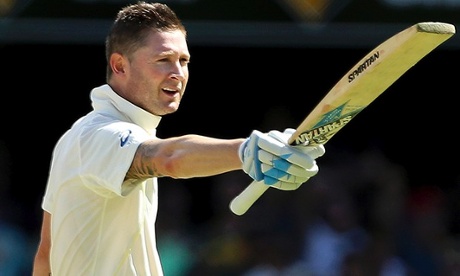
Not every Test captain bows out in a manner that reflects their character but there would be something equally symbolic about Michael Clarke – now at a crossroads after his body failed him again in Adelaide – departing Test cricket much the same as he’d come in, with a nation’s eyes fixed upon him and delivering a captivating century in a win against India.
There might be a far more compelling story to come out of the Adelaide Test, one that shows us more accurately the physical hell Clarke put himself through not just in making that determined century but by taking the field at all. His primped and preened exterior has long obscured the physical turmoil that each innings places him under, but not even Clarke can affect an illusion of vitality now.
The hamstring has gone again but it’s the dodgy back that’s troubled him his entire career, an ailment that has gradually worsened in a curve running the opposite direction as his public approval rating. The irony at play here is that a man nicknamed “Pup” and for whom youth and glamour always seemed bywords should gradually succumb, after 108 matches and 8,432 runs at an average of 50.79, to an injury of gnarled old-timers.
Many Test captains go out as Clarke might do now – their bodies completely defeating them before opponents or waning hunger had. Beyond cricket, there is perhaps a more accurate comparison to be considered between twilight period Clarke and late-career NBA legend Larry Bird, a team-defining superstar hobbled so badly by degenerative back injuries that he spent the last years of his career lying on the ground beside the bench because sitting was too painful.
On Saturday evening Clarke spoke to the press with an almost relaxed frankness that seemed to speak volumes. It looked like a dress rehearsal. Only two weeks back and against general consensus, the hobbled Australian skipper seemed hell-bent on getting his own way and playing in the opening Test of the summer. That his employer publicly contradicted him was a significant embarrassment blown away by the swirling winds of grief.
Yet in the afterglow of that magnificent win at the weekend, after everything that he and his teammates have been through in the most testing fortnight of their careers, he appeared resigned and philosophical at the fact that it might be all over. Publicly-expressed self-doubt is not Clarke’s normal style.
If he does finish up, and there’s certainly no guarantee he will, Clarke would leave an ageing but reinvigorated team in an assuredly better place than when he first took the job. In almost every sense he could feel something like closure and a relief that might never quite set in should he battle on to next winter’s Ashes.
No-one could begrudge Clarke listening to what his body is telling him in less than subtle terms. Into his place for at least the remainder of the Australian summer steps 25-year-old Steven Smith, a player now remarkably assured for his age. If his nimble footwork and ceaseless fidgeting at the crease are a measure of his mind’s dexterity and restlessness, he’ll be as proactive in the field as the man he succeeds.
There is another section in Border’s book when Australia’s longest-serving Test captain runs the rule over Clarke’s leadership. His strength, says Border, is that he never lets a game drift, that he gambles with creativity and flair to conjure results like the one we saw in Adelaide on Saturday.
That judgment and the ability to read the mood, you also sense, might perhaps now come to the fore as Clarke considers his own cricket mortality. The Australian captain, Border concludes with some poignancy, “has a feel for those things”.