

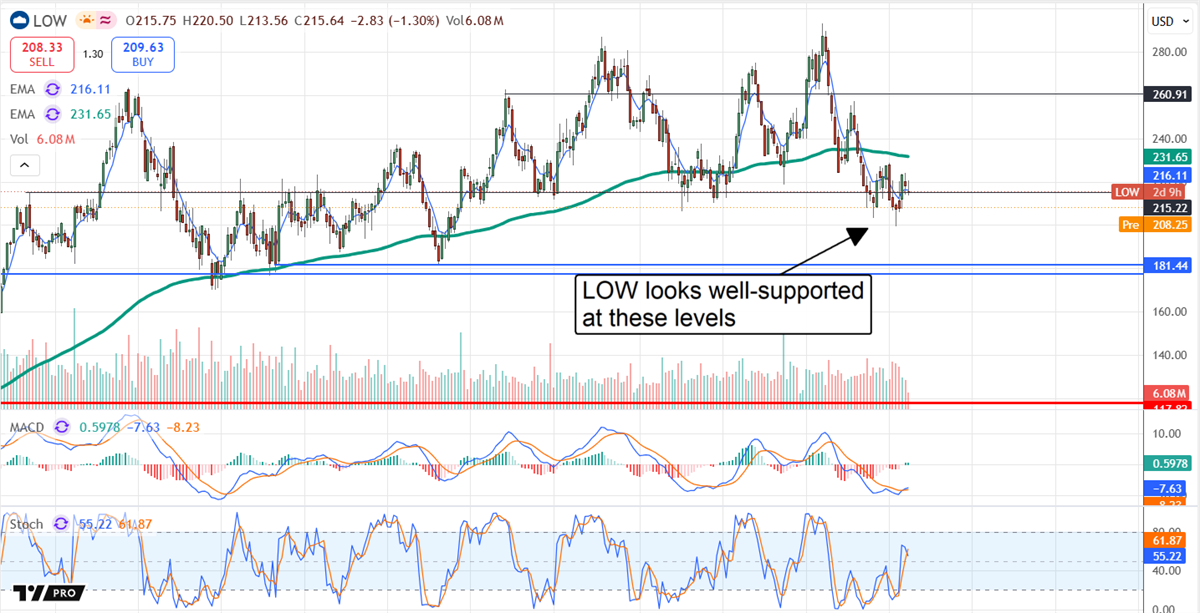
Lowe’s (NYSE: LOW) continues to face headwinds in 2026; however, the stock's value, capital returns, and long-term catalysts make for a compelling setup. Trading in the low $200s, LOW is near multi-year lows and at the bottom end of its historic price-to-earnings (P/E) range, setting the stage for a significant rebound.
Until then, the dividend is reliable and market-beating, yielding 2.3% compared to the low 1% range for most S&P 500 stocks, and it is a growing distribution. Lowe’s is a Dividend King with over 50 years of consecutive increases to its credit and the capacity to continue with annual increases long into the future.
Lowe’s Has Near-Term and Long-Term Catalysts
Lowe's has many near-term catalysts, such as its Pro pivot, capital allocation, and unsticking housing markets. The Pro pivot—Lowe's strategic shift toward professional customers like contractors, remodelers, and builders, rather than the DIY weekend shopper—helps sustain growth and margins today and is underpinned by an aggressive acquisition posture in 2025.
Additions such as Foundation Building Materials and Artisan Design Group not only strengthened Lowe's position in Pro markets, but also expanded its offerings and created cross-selling opportunities.
Capital allocation is critical, as the company paused its aggressive buyback plans to fund acquisitions and now to reduce debt. Capital allocation could provide a triple catalyst: the dividend outlook is strengthening, the balance sheet is improving, and a path to future share reduction is emerging. As it stands, it will take a few more quarters for debt reduction to do its magic, but the shareholder deficit is falling sharply, providing evidence that the company’s strategy is working.
As for housing markets, when they unstick is anybody’s guess, with oil prices running high, inflation following suit, and the FOMC on track to hold, if not hike rates. The takeaway, however, is that Lowe’s is positioning itself for success today and for accelerated growth and profitability when housing markets improve. Between then and now, investors can take advantage of low stock prices to build a position and reap the dividend.
Lowe’s Mixed Results Overshadow Inherent Strength
Lowe’s had a tough Q2 with revenue of $26 billion falling slightly short of the consensus estimates. The miss was attributed to persistent weakness in DIY projects, the company’s core driver. However tepid the result, the weakness was relative, with revenue up 8.3% year over year and analysts expecting worse.
Data shows that 100% of analysts lowered their targets since the quarter began, with most looking for results at the low end of the range, well below the consensus. Internally, growth was underpinned by a 0.2% comp store gain and strength in the Pro business linked to acquisitions. Digital was another critical component, up 15.7% year-over-year (YOY) and central to the comp strength.
Margin news was good, but the IEEPA tariff refund had an effect. Key details for investors are $2.4 billion in net income and $4.40 in adjusted earnings per share (EPS), which grew marginally from the prior year and outpaced MarketBeat’s consensus by a nickel. Looking ahead, the company expects persistent DIY weakness to weigh on the full-year outlook and guidance, but less than the market feared. The new target assumes results at the low end of the prior range, enough for YOY growth, healthy profits, and continued execution of the strategy.
Analysts Expected Worse for Lowe’s—The Bottom Is In
The good news is that analysts had already trimmed expectations ahead of the release, expecting worse news. In this scenario, sentiment trends remain steady and supportive for the market.
MarketBeat tracks 36 analysts rating LOW as a consensus Moderate Buy, with about 64% Buy-side bias and 20% upside to the consensus.
The range of recent targets is wide, suggesting some uncertainty in the group, but it centers around the consensus figure, providing a moderate level of conviction in the outlook. A move to the consensus $262 would put this market at the high end of its trading range, within easy reach of the all-time high.
Institutional activity suggests the downside is limited, now that Lowe’s stock has sold off. The group owns nearly 75% of the shares and has bought aggressively over the trailing 12 months (TTM). The group sold shares in Q1 2026, but overall in the TTM bought $2 for every $1 sold.
The likely outcome is that this group will continue to underpin support at the low end of Lowe’s trading range until sufficient catalysts emerge for the stock to regain traction.
The article "Why Lowe’s Could Be a Bargain Before Housing Recovers" first appeared on MarketBeat.