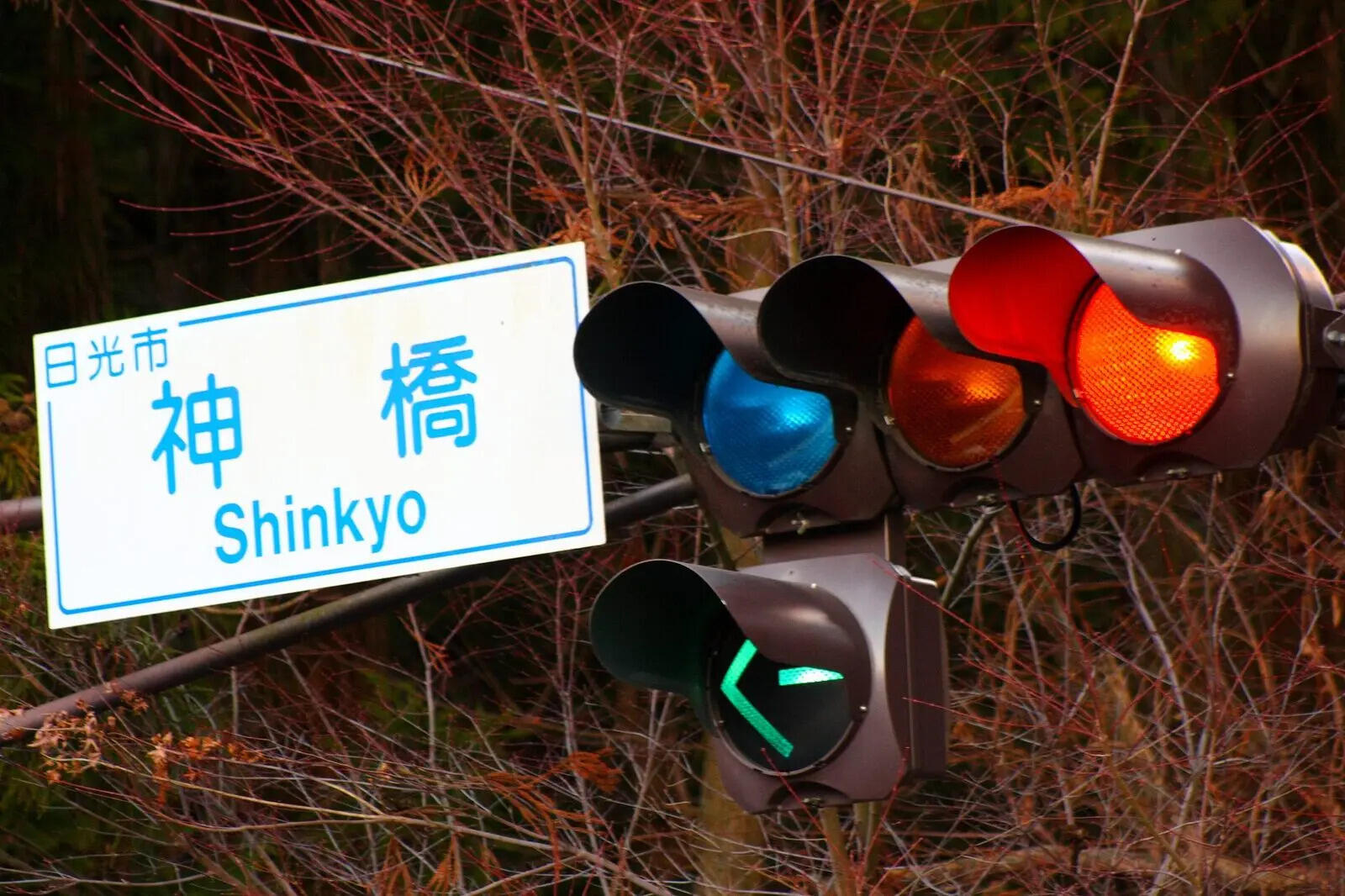
So, in case you ever get a chance to visit Japan and stand in front of a pedestrian crossing, you might find that the colour of the “go” signal is slightly blue rather than the usual bright green. It might seem like a simple design or technological variation. Yet, the truth behind this variation goes far deeper. The Japanese blue traffic lights are not really blue in the conventional sense. Yet, there is a beautiful mix of language, culture, and historical elements that have been around for centuries. It is a fascinating reminder that even something as ordinary as a traffic signal can reflect the deep-rooted interplay between language, perception, and tradition in a society, revealing how culture quietly shapes even the way we see colour.
Why does Japan call green traffic lights “blue”
The main cause of Japan’s so-called ‘blue traffic lights’ is based on language. The reason for this is that the Japanese language did not have a clear distinction between the two colours ‘blue’ and ‘green.’
The two colours were described by a single word, ‘ao’ (青), which meant that ‘green’ things such as leaves and vegetables were considered to be ‘blue.’ The influence of this is seen even today. For example, green apples are referred to as ‘aoringo’ (blue apples), and ‘blue’ traffic lights are referred to as ‘ao shingos’ (blue signals).
As Metropolis Japan puts it: “the clearly green traffic lights… are described as aoshingos”
The history behind Japan’s traffic light colours
Atlas Obscura reveals that, in the 1930s, Japan introduced traffic lights, which followed the standard colours of red, yellow, and green. But again, because of the linguistic tradition, the green light came to be referred to as “ao,” which means blue.
Later, with the signing of the Vienna Convention in 1968, there was greater emphasis on the standardisation of traffic signals. Although Japan is not technically bound by this convention, it still follows the global standard.
This posed a unique dilemma. How can the international standard be followed while still being mindful of the linguistic tradition? It was solved in the simplest way possible. Japan went with the “bluest possible shade of green.”
So, what is perceived as blue is actually green, albeit with a slightly different wavelength.
Japanese culture and colour perception
But the story of Japan’s traffic lights is not really about rules. It is about how people view the world. Traditionally, the colours used in
Japan were not as detailed. They were grouped into fewer basic colours, such as black, white, red, and blue.
However, the word for green, called midori, did come into existence. But the point is, people take time to change. Even today, people still use the original terms.
This is important because it shows us colours are not really about the physical properties of light. They can differ in different cultures. Green can be seen as blue in one culture.
Are Japan’s traffic lights really blue
The simple answer to this question, however, is no, not really. The technical explanation behind this, of course, is that the Japanese traffic lights are still green, just like what the rest of the world follows.
The only problem, however, lies in the fact that these traffic lights have a slightly blue colour to them, and they are still called blue. In other words, these traffic lights can be described in the following ways:
- Scientifically: They are green
- Visually: Slightly blue-green
- Linguistically: Called blue
The slight colour difference, as seen in traffic lights, is a reminder that a whole lot more is at play, especially when one considers history, language, and identity. The Japanese "blue" traffic lights, for example, serve as a reminder that even the mundane, such as crossing a street, has a history.
In a world that appears to crave standardisation, such a detail is noteworthy, as it subtly illustrates how tradition and innovation can coexist, not only in terms of traffic flow, but also in terms of understanding the world.