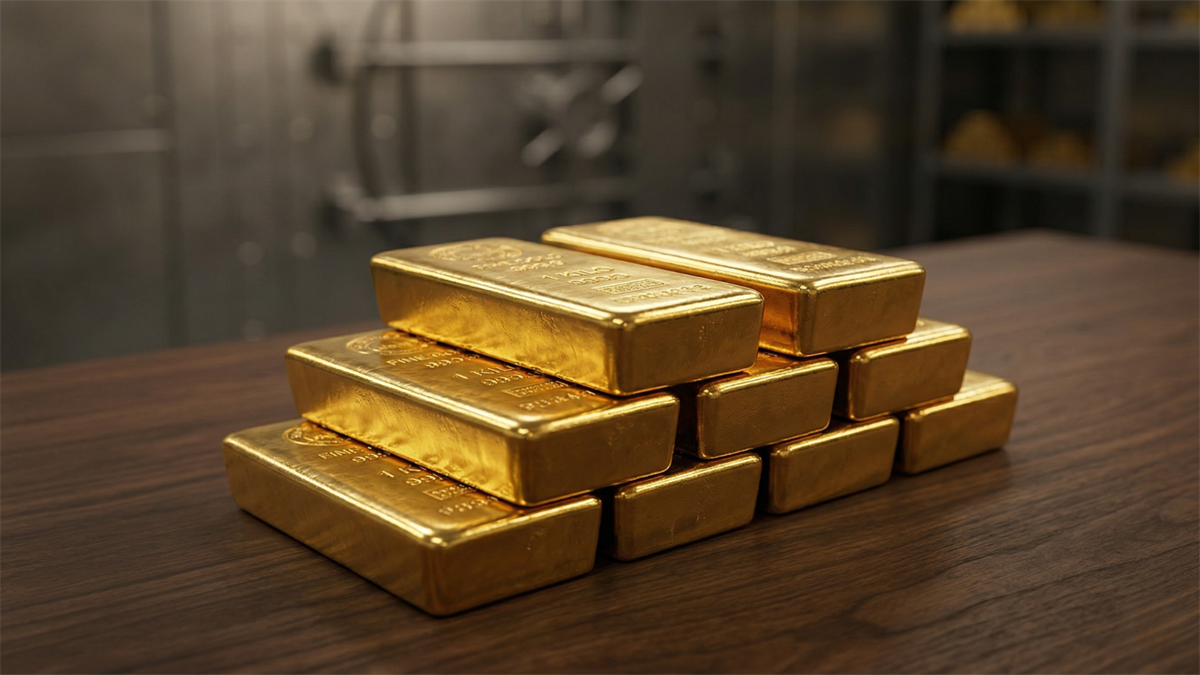
What’s going on with gold? After surging above $5,000, gold has fallen back about 20%. That’s not surprising after such a strong move, but it does beg the question of why? The conventional wisdom is that the dollar is stronger because, while the U.S. economy has its own debt problem (more on that later), it’s still the best house in a bad global neighborhood. And much of the world’s business is still denominated in dollars.
Since the dollar and gold typically move in opposite directions, gold would have to drop. There’s some merit to that, perhaps. It's also likely that many speculators who hopped on the gold train as it was chugging higher decided to cash out.
It’s foolish to try to forecast exactly what the gold price will be next week or next month, let alone one year or five years from now. But the trend for gold, as well as many other basic materials, is likely to be higher. The evidence for that came straight from the federal government.
U.S. Debt Strengthens Gold’s Long-Term Case
In March 2026, the U.S. government released a document titled “Financial Report of the United States Government for fiscal year 2025.” This is an annual report issued by the U.S. Treasury that gives an accounting of what the country owns... and what it owes.
This year’s report showed that the government has assets of $6 trillion, against liabilities totaling nearly $48 trillion. In accounting terms, that means the country’s net worth is a negative $42 trillion, the worst deficit in history.
You don’t have to be an accountant to know that is problematic at best. But what makes the report even worse is that it doesn’t include the “unfunded mandates” like Social Security.
Making the situation more precarious is the rising rates on the 10-year Treasury note, which is at 4.34% as of March 25. That’s roughly where it’s been for two years, but there’s an important distinction. In past times of crisis (e.g., the Iran crisis), the world would buy U.S. Treasuries as a safe-haven asset. That’s not happening.
Now consider that the United States is seeking an emergency $200 billion in funding for the operations against Iran. If the conflict doesn’t end soon, that will be just a down payment. If the Treasury lacks the revenue to pay for it, more money printing is coming, and with it, higher inflation. All of which is bullish for gold prices.
Gold’s Role Is Wealth Preservation, Not Growth
As mentioned above, one reason the price of gold has fallen is that speculators have cashed out. That’s their right, and Warren Buffett was correct when he said that gold is “just a metal.” The fact is that the reason to own gold is to preserve wealth, not to build it.
In fact, most gold owners would say that, in a perfect world, they wouldn’t have any reason to own gold. But as the U.S. government itself admits, the world is not perfect. Gold is insurance for that imperfect world.
Gold will always have its detractors, but even Morgan Stanley (NYSE: MS) recently suggested investors could allocate up to 20% of a traditional portfolio to gold. There are options beyond owning physical gold. Here are three compelling choices.
GLD ETF: A Simple Way to Track Gold Prices
The SPDR Gold Shares ETF (NYSE: GLD) tracks the price of physical gold bullion stored in vaults, offering direct exposure without storage hassles. With a low expense ratio of 0.40%, it provides liquidity and ease for portfolio integration.
The GLD fund is ideal for conservative investors seeking a hedge against inflation and dollar weakness, as highlighted by recent U.S. debt concerns. However, it’s important to note that shares of the fund serve as “paper gold.”
Therefore, it may not be suitable for long-term holders (i.e., over several years) due to counterparty risks in crises.
GDX ETF: Leveraged Exposure to Gold’s Upside
If gold is going to make a sustained move higher, buying mining stocks today will be a smart play. Rather than picking a specific miner, the VanEck Vectors Gold Miners ETF (NYSE: GDX) holds a diversified basket of major gold mining companies, amplifying returns when gold prices rise due to operational leverage. Its 0.51% expense ratio balances cost and broad sector coverage. Suited for those wanting higher upside potential amid geopolitical tensions like U.S.-Iran funding needs.
Newmont: Income and Stability in a Volatile Market
Newmont Corporation (NYSE: NEM), the world's largest gold producer, offers direct equity in proven miners with strong reserves and production growth. Trading at attractive valuations post the gold pullback, it benefits from cost efficiencies and dividends yielding about 1%. Newmont is a pick for blending income with gold's safe-haven role in uncertain fiscal times.
Where Should You Invest $1,000 Right Now?
Before you make your next trade, you'll want to hear this.
MarketBeat keeps track of Wall Street's top-rated and best performing research analysts and the stocks they recommend to their clients on a daily basis.
Our team has identified the five stocks that top analysts are quietly whispering to their clients to buy now before the broader market catches on... and none of the big name stocks were on the list.
They believe these five stocks are the five best companies for investors to buy now...
The article "Why It's Not Time to Give Up on the Gold Trade " first appeared on MarketBeat.