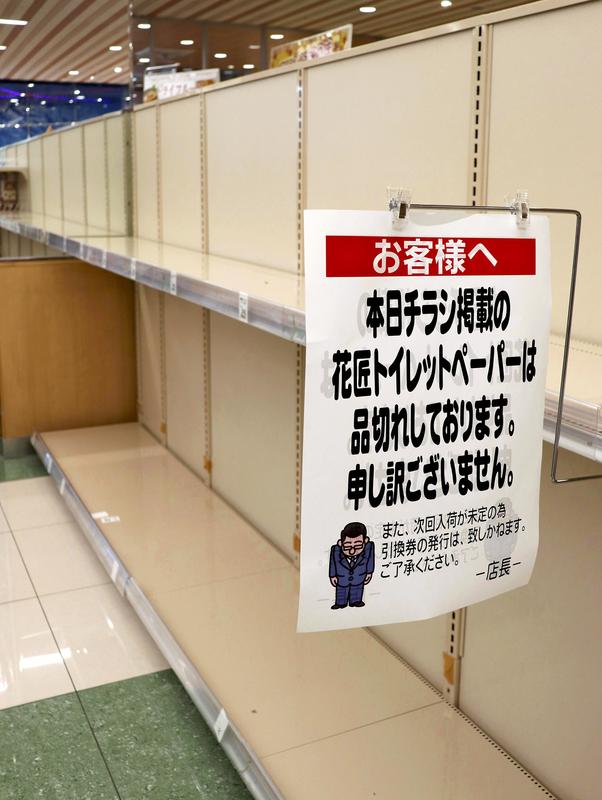
Back in March, a man in his 40s living in Tokyo got in his car and drove around to about 20 supermarkets and drugstores. The object of his quest? Toilet paper.
As the novel coronavirus began spreading around the world this spring, it was accompanied by another phenomenon far less based on science ― panic-buying, and in particular, toilet paper.
Even Japan was caught up in the maelstrom, which might seem odd in that an exceptionally high amount of households in the country is equipped with electronic bidet toilets. Led by the TOTO washlet, these devices are spraying bottoms in 80% of Japanese homes.
Given that, why was toilet paper in such desperate demand?
The man who made the rounds of stores eventually purchases two packs of toilet paper rolls.
Despite suspecting that a Twitter post that "[toilet paper] will run short" was a false rumor, he was unable to stand idly by as he saw long lines forming at stores. Anticipating a second wave of infections, he says that even now, he makes sure to have at least five packs at home.
Initially, the paper manufacturing industry was worried that the breakout of the coronavirus would put a crimp in its business.
"With a decline in foreign visitors, we saw a fall in sales for toilet paper for commercial use, including for hotels and department stores, which account for 30% of domestic demand," said s director of Tokushu Tokai Paper Co.
But what actually happened was the opposite, and the association of paper manufacturers was flooded with complaints. This led to the organization to twice issue a statement emphasizing "there is enough in stock" and calling for calm.
Such hoarding was also seen overseas, and even led to a brawl between customers in front of a store in Australia. In the United States, people unable to make a purchase resorted to calling the emergency 911 number (equivalent to 110 in Japan), leading police to call for citizens to refrain from making such calls.
Only a small percentage of households in the United States and Europe had electronic bidet toilets. Thus it small wonder that many people scramble for toilet paper.
Taking the situation in reverse, a leading U.S. toilet maker launched a sales campaign in North America that claimed the use of electronic bidet toilets could save an average of 250 rolls of toilet paper annually per household. The result? A doubling of sales and the company running short of stock, a company official said.
--Coexistence and co-prosperity
Many people outside of Japan consider that having an electronic bidet toilet alone is enough to get the job done. Why is it different in Japan?
Actually, when electronic toilets started to gain widespread use in Japan in the 1980s, a sense of panic prevailed in the domestic paper manufacturing industry that toilet paper would become obsolete. However, in the 40 years that followed, demand for toilet paper has steadily risen almost in sync with the spread of electronic toilets.
Japanese people use the toilet five to seven times a day, with each person using an average of 59 rolls of toilet paper annually. That is about double the amount used in Brazil and China, where there are almost no electronic toilets outside of major cities.
It has been noted that when the Japanese go to the toilet, many use toilet paper for the sake of assurance in addition to the cleaning function of the electronic bidet toilet.
"This underscores the Japanese consciousness about cleanliness that is recognized globally and often casts us as neat freaks," Shigenori Yamaji, 72, a toilet researcher who has written three books on the subject said in analyzing Japanese behavior.
Seventy percent of electronic toilets sold by LIXIL Corp., a major domestic housing equipment maker, are equipped with a drying function. Even so, there is still a sense that moisture can be removed quicker with toilet paper. The possibility for the continued "coexistence and co-prosperity" between toilet paper and electronic toilets remains high for the future.
That said, there is also the viewpoint that the Japanese propensity for excessive cleanliness works against electronic toilets.
A survey conducted by the Nagoya-based Japan Sanitary Equipment Industry Association shows in households that have electronic toilets, 23% of them are not used at all. A large percentage of those are seen to be woman and young people.
One factor behind this is that they regard the nozzle section from which warm water is sprayed as unsanitary, even when used only among members of the same family. Given the price at several tens of thousands of yen, it can be said that nonuse is tantamount to sitting on a gold mine.
While the notion of toilets as unclean and the culture of keeping distance from them has taken root worldwide, in Japan, a song lauding them as a place where gods exist became a big hit, so that keeping them clean is said to be a virtue. It is possible to get a glimpse of the consciousness of cleanliness peculiar to Japanese by looking at toilets and their place in our lives.
--Near total domestic production
The hoarding of toilet paper also occurred during the oil crisis of the 1970s and in the aftermath of the 2011 Great East Japan Earthquake. Both are believed to have been sparked by false rumors and were affected by economic chaos and psychological anxiety in times of crisis.
As much as 98% of toilet paper used in Japan is produced domestically, with recycled paper comprising much of the raw materials. Pointing out that because about 40% of production is concentrated in Shizuoka Prefecture, distribution could be greatly disrupted in time of disaster, the Economy, Trade and Industry Ministry has called for individual households to stockpile a one-month supply of toilet paper.
The electronic bidet toilet was originally developed in Europe and the United States for use in medical treatment. Due to a feeling of resistance to washing one's bottom with water in the toilet, electronic bidet toilets did not catch on in typical U.S. households. In Europe, where the bathtub or shower and toilet are often in the same room, the difficulty of securing a power source became a bottleneck. Even in countries with the highest usage, the percentage is only in the single digits.
In Japan, Ina Seito (now LIXIL Corp.) started sales of the first domestically made shower toilet in 1967. To advertise its washlets in 1982, Toto Kiki (now TOTO Ltd.) used the slogan "Even the bottom wants to be washed," which caught on widely and created the opportunity for greater use. Total washlet sales, including overseas, exceeded 50 million last year.
Read more from The Japan News at https://japannews.yomiuri.co.jp/