
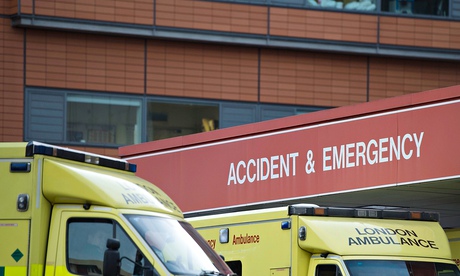
Pressure on A&E has reached critical levels. In the week leading up to Sunday 4 January, NHS England statistics showed that emergency departments across England treated just 79.8% of patients within the four-hour target. This performance was officially the worst ever and the NHS figures indicate the service is on the brink of a winter crisis.
Record numbers of patients have also been forced to spend between four and 12 hours on trolleys waiting to be admitted - a further sign that the service is struggling to meet the rising demand for care, despite ministers giving it an extra £700m from elsewhere in the Department of Health’s budget. Ambulances have had to queue for at least 30 minutes outside an A&E unit in England, unable to hand over their patients to A&E staff because the emergency department was too busy.
Up to 15 hospitals have declared major or significant incidents, signifying that they cannot cope with the volume of patients. This has also led to 626 urgent operations being cancelled so far this winter, up from 506 in the same period last year.
Andy Burnham, the shadow health secretary, said the growing number of postponements showed problems in A&E were now affecting other NHS services.
“The A&E crisis is intensifying and spreading to other parts of the NHS. An operation being cancelled is an experience that causes a great deal of stress and anguish and it’s one nobody should have to go through,” he said. “Patients in all parts of the NHS are now being made to feel the effects of the crisis in A&E.”
The prime minister, David Cameron, said on 6 January that a lot of the pressure on emergency departments came from frail, elderly people but he insisted that around 2,500 more patients were being seen within four hours every day than four years ago. “We’ve got a short term pressure issue which we need to meet with resources and management,” Cameron told the BBC. “We’ve got a longer term issue which is making sure that there are named GPs in your local area which are responsible for every single frail, elderly person. A lot of the pressure on A&E is coming from frail, elderly people, often with many different health conditions and the best place for them, frankly, is not A&E. They should be being looked after by the family doctor or in other health settings and I think the long term challenge is to make sure those sorts of settings are more available.”
Why has this crisis come about? How is it affecting patients, NHS staff and other hospital departments? What role do GPs, social services and charities play in alleviating the crisis? What solutions are there? Is extra funding the answer?
Join our panel of experts to answer these questions and more on Friday 16 January from 12pm until 2pm.
The live chat is not video or audio-enabled but will take place in the comments section (below). Get in touch via sarah.johnson@theguardian.com or @GdnHealthcare on Twitter. Follow the discussion using the hashtag #GdnAandE.
The panel
Rekha Shah, chief executive officer, Pharmacy London and Kensington Chelsea & Westminster LPC @KcwLpc
Grant Ward, emergency physician, A&E @FrontlineDoc
Nigel Sweet, ambulance technician, South East Coast Ambulance service staff-elected governor @sweeternigel
Kate Brittain, policy and projects officer, Acevo @KateBrittain4
Tim Ballard, vice chair, Royal College of GPs
Emily Kruger, assurance and delivery project officer, NHS England
Julia Clarke, steering group member on the NHS Confederation’s community health service forum @JuliaClarkeBCH
Simon Bottery, director of policy, Independent Age @blimeysimon
Glen Burley, chief executive, south Warwickshire NHS foundation trust
The panel starts by explaining if there is an A&E crisis:

I'm not certain that "crisis" is the right word. It seems to suggest suddenness - whereas the difficulties we're seeing at the moment are not new or sudden. Things "on the shop floor" have felt very difficult throughout 2014. Some of the reasons why things are difficult - which I'm sure we'll come to discuss here - have been brewing away for a decade or more. But perhaps we have finally reached a point where the supply/demand curve is starting to fall down.
Having said that, in the years just before I became a doctor, it wasn't unusual to see patients waiting in A&E for 12 hours or more - and that's rare now. So maybe things have been worse!
 Guardian contributor
 It must feel like a crisis to some of the people caught up in it. We had a recent case where a woman in her 60s - an ex-nurse as it happens - who fell in a car park. It took 1hr 10 minutes for the ambulance to arrive, on a freezing cold day. Her A&E experience was also a very poor one - the corridors were filled with trolleys and it took a long time for her to be seen.

I can say that in my experience in our ambulance trust area of Sussex, Surrey and Kent A&E ambulances (the blue light and siren sort of ambulance) staff at all levels have never been more pressured. Officially, we're operating at what ambulance services call REAP 4 which means we're towards the limit of what we can cope with. Most other ambulance trusts are also at REAP 4 and two other ambulance trusts are at REAP 5 - approaching service breakdown. The festive period - especially New Year's Eve - is always a busy time for us but this year has been much worse. 999 calls are up, 111 calls are up and I believe its only because ambulance services like ours are conveying a smaller proportion of our patients to A&E than ever that the NHS is able to cope at all. All our clinicians actively seek to refer suitable patients to services other than A&E eg paramedic practitioners, local crisis services, and out of hours GPs. If ambulance services had not massively improved our performance for patients over the last few years, the NHS crisis would have been undeniable.
Emily Kruger from NHS England explained why the crisis is happening now:
 Guardian contributor
 we have significantly reduced bed capacity in the NHS over the years , tied with a an ever growing and ageing population. The bed capacity in mental health is lower than ever, care homes are overrun, PFI hospitals often have less bed capacity than the previous buildings. There is also more competition with the independent sector and in times of pressure when the NHS hospitals need to use IS capacity they often only accept the minor cases and every time they accept a patient it reduces the income for the NHS Trusts.

It seems to me that this is a perfect storm type scenario. That is a combination of factors coming together. But its a combination of trends rather than random factors. The ageing population, the increasing prevalence of frailty and long term conditions, social factors such as changes in behaviours, changes to the way services are configured and let's be honest reductions in funding or funding which has not kept pace with demand leading to downsizing of acute bed base, loss of community beds, cuts in social care provision and LA budgets. Maybe we have just got to the crunch!
Will the crisis get worse?
 Guardian contributor
 We are seeing quite a bit of flu at the moment. I am always cautious about debating whether things may or may not get worse. We have talked a lot about demand and frailty but we should also look inside our organisations and ask whether we had full capacity over the festive period, particularly with the way that the bank holidays fell. We run hospitals at a very high level of occupancy, so it doesn't take much of a flow problem to tip us over the edge. And then we admit patients to the wrong beds and it all becomes dysfunctional
Well it could do couldn't it. In our area all the health providers are working very hard to manage current demand and staff are going above and beyond. We have additional resources in terms of staff and community beds. A further demand surge would be very difficult indeed on top of this. However, if things settle down following the usual post-Christmas peak we have at least learnt a lot about how to work together and manage this level of demand.
The next few weeks will be critical. We seeing a fair bit of 'flu: if that spikes, we could have a real problem. It's not just the wards and A&E that are full: patients are waiting in resus for ITU beds often for hours at a time, too. If we see lots of critically ill 'flu patients, I'm not sure where they will go.
If things do settle down, though, we can only hope that all this recent coverage will prompt us all to look at how we are going to address demand, social care shortages, A&E recruitment & retention (nurses and doctors), and all those other factors we've discussed so that we don't see a repeat of this in winter 2015.
Summer 2014 was the hardest I've experienced in our emergency department. So the end of winter doesn't necessarily mean things will get a lot better.
Guardian contributor With so little extra capacity currently in the NHS system, any extra strain will cause major problems. Bad weather of all sorts is always a major problem for ambulance services when we have to get to patients quickly, and convey some of those patients to hospitals. We have contingency plans for snow, floods etc with 4x4 vehicles etc. but a widespread sickness problem among staff would probably be the most serious blow to the NHS ability to cope. Widespread staff flu vaccination, proper timely hot meals during shifts, and sufficient rest and relaxation between shifts may be our best defences?
How can GPs help?

I agree completely that there is a problem with people attending A&E who could be seen and dealt with elsewhere in the system. Some people of course don't need to be seen anywhere in the system and developing individual health literacy and personal health resilience. General Practice of course has a lot to offer and is a very effective solution to the problem but at the moment General Practice like A&E is at or over capacity and that is why people are struggling with timely access. With appropriate funding General Practice can play it's part in dealing with problems upstream before reaching A&E.
Over the last decade funding has dropped for General Practice both in it's share of the NHS budget and in real terms. Only around 8% of the budget is spent on General Practice when it delivers 90% of the patient contacts.
Investing in GP really makes sense. Currently the payment for one individual for a year for as many consultations as they need is less than an attendance at A&E.
The pressure A&E faces in winter is always higher as it is across the whole system
It is happening at this time of year because cold weather inevitably brings more illness particularly to our elderly, frail patients who are susceptible to flu, colds and other winter illnesses.
General Practice is particularly well placed to manage increasing complexity and multi morbidity but we need more resources to deliver this. A generalist approach is better suited to the management of chronic disease and also providing holistic care for the individual which is focussed on the person rather than the disease. At the heart of patient care in General Practice is the long term relationship with patients which has been shown to lead to decreased hospital admissions.
In general practice demand is consistently high. GPs and our teams make 1.3m patient consultations everyday – this has risen by 150,000 a day from five years ago. But with the increase in demand, we have actually seen a decrease in resources for general practice. We are also desperate for more GPs and practice staff to deal with this increasing demand.
Guardian contributor I think that we are heading to a system where we combine A&E and GP urgent access through one single point of access, including remote triage supported by technology. This can then route patients to the right part of the system, at the right speed. GPs and hospital and community specialists can then work together to focus on management of patients with long term conditions. GPs also play a vital role in supporting nursing and residential homes and in having those difficult conversations which ensure that we help to manage end of life care better.
GPs are experts in health promotion, managing chronic conditions, and dealing with minor emergencies. Our GPs can play a huge role in keeping patients out of hospital - by keeping them well in the first place, and by treating less serious emergencies in the community.
The value of a GP in coordinating all of a patient's care is poorly understood by patient. Your GP has access to all your hospital letters, test results, and your medical history perhaps all the way back to when you were born. Your GP can also refer you on for specialist investigation and treatment, and tie up all the different strands of your healthcare, understanding your unique needs, so that you are treated as an individual.
When patients come to A&E and apologise to us for not going to see their GP, the two reasons they cite are "I couldn't get an appointment" and "I only get 5 minutes with my GP, so I don't feel s/he can deal with everything I need". I don't see any way of improving that situatyion without recruiting many more GPs and funding their services better.
The role of social care and how money should be spent:
Guardian contributor To start with, we should spend more money on prevention. It makes no sense to be using expensive hospital facilities and medical staff to treat a broken hip which could have been prevented by fitting a £5 grab rail in a bathroom. We should also be funding voluntary and other organisations to provide the 'little bit of help' that so many older people ask for but can't get - changing a light bulb, nailing down a carpet. More money too on falls prevention - we typically only refer to a falls prevention clinic after a person has had their first fall. But of course that fall could have already caused a broken hip, which has a really poor impact on future conditions. And we also need to be properly funding formal social care in homes and residential care. Only today we've had a report about the number of people being admitted to hospital from care homes suffering from dehydration.
Guardian contributor Some of this is quite low level stuff. Just having places where older people can meet would be helpful. Sometimes it is just about keeping active, dealing with loneliness, making sure that they are eating, that their can afford to put their heating on, that they are taking (or that the understand) their medication.
How can charities help?
 Guardian contributor
 There needs to be a greater recognition of the role that charities and social enterprises can play in relieving pressure on acute settings. They can, and do, work alongside the NHS to help frail, elderly people have better health outcomes.
The British Red Cross currently has supportive 'home from hospital' schemes in 162 locations in the UK. A programme run by the Royal Voluntary Service at Royal Free hospital in London on integrating clinical and voluntary care has seen readmission rates fall from about 20% to 3.5%.
Modern charities work with trained and professionally managed volunteers who can provide support alongside, and take direction from, clinical staff. This includes arranging transport and follow-up care, making home visits to prevent readmission and providing much needed company to people during their recovery. There can, and should be a major expansion of the services already delivered by charities in partnership with trusts.
Can NHS 111 help? How should it be promoted?
Promoting 111 is important but it is also important to continue to build into 111 an experienced clinical tier to support the non clinical staff working there. We need to keep improving 111 so that it becomes even more the obvious Smart call to make.
I had high hopes for NHS 111 when it was introduced. There were promises that patients could be given an appointment at their local GP out-of-hours service directly through 111, and others would be directed to the most appropriate service for their needs.
But in practice, we are seeing far too many ambulances sent to 111 patients, and far too many 11 patients being advised to attend A&E. I cannot count how many patients see me in A&E and apologise for being there: "I know it's nothing, but 111 said I had to come..."
111 is a local service, so there is no excuse for it not having much better links with local GP practices and local out-of-hours services, as well as district nurses, mental health crisis teams, and other community teams. That would be an improvement.
And, as Tim and Glen have already said, introducing an experienced clinical back-up to the non-clinical call handlers should both improve the safety of the service and make their A&E / ambulance referrals more appropriate.
Guardian contributor The Government "launch" of NHS111 has been shambolic. The service started on the backfoot in 2013 but has since recovered and runs well in many areas nationwide. In Kent, Sussex and Surrey its run by our ambulance trust SECAmb with private sector partners Care UK, and despite bottle-necks in demand at the weekend, helps provide a worthwhile and low cost alternative to the previous NHSdirect service. Only a tenth of NHS111 calls result in an ambulance being dispatched, and around half of those patients get taken to A&E, with referrals and self-treatment as alternatives. (ie 5% of callers taken to A&E)
The NHS111 service deserves proper government support and a publicity campaign worthy of the name!
How have staff responded to the crisis?
Guardian contributor Throughout this period our staff have been outstanding. There is a danger that the intense media and political scrutiny of the situation implies that they are in some way failing. So we should focus on how hard they are working and how fantastic the NHS is. Over the past few weeks I have had many comment from patients who have seen the pressure that the system is under but were amazed at how unruffled, professional and caring the staff have been.
So I have been making sure that our staff know that, not just those in A&E as the response here has been system-wide. Our NHS staff should be proud of themselves. We hope to get our local system back to 'normal' soon so that they can have time to reflect and recover.
Guardian contributor Before we close this debate, we really need to say that our NHS is probably the most efficient healthcare system in the world. Clearly there are problems - and equally clearly some of those problems are not in health but in social care - but we shouldn't lose sight of the huge amount that is achieved by some tremendously committed staff. We now need to build on that achievement as we plan services in both health and social care that can meet the needs of a changing, ageing society.







.jpg?w=600)






My view is that if there is a crisis it isn't just in A&E. The pressures are being felt all across the system in primary care, in community services and in social care. It's just that when other services cannot support patients safely the default is A&E because its the safest place even if the waits are long. So that's where the symptom of system pressure is most obvious. Other symptoms can include extended lengths of stay because people are having to wait for a suitable place to move on to, an assessment or a support package at home.