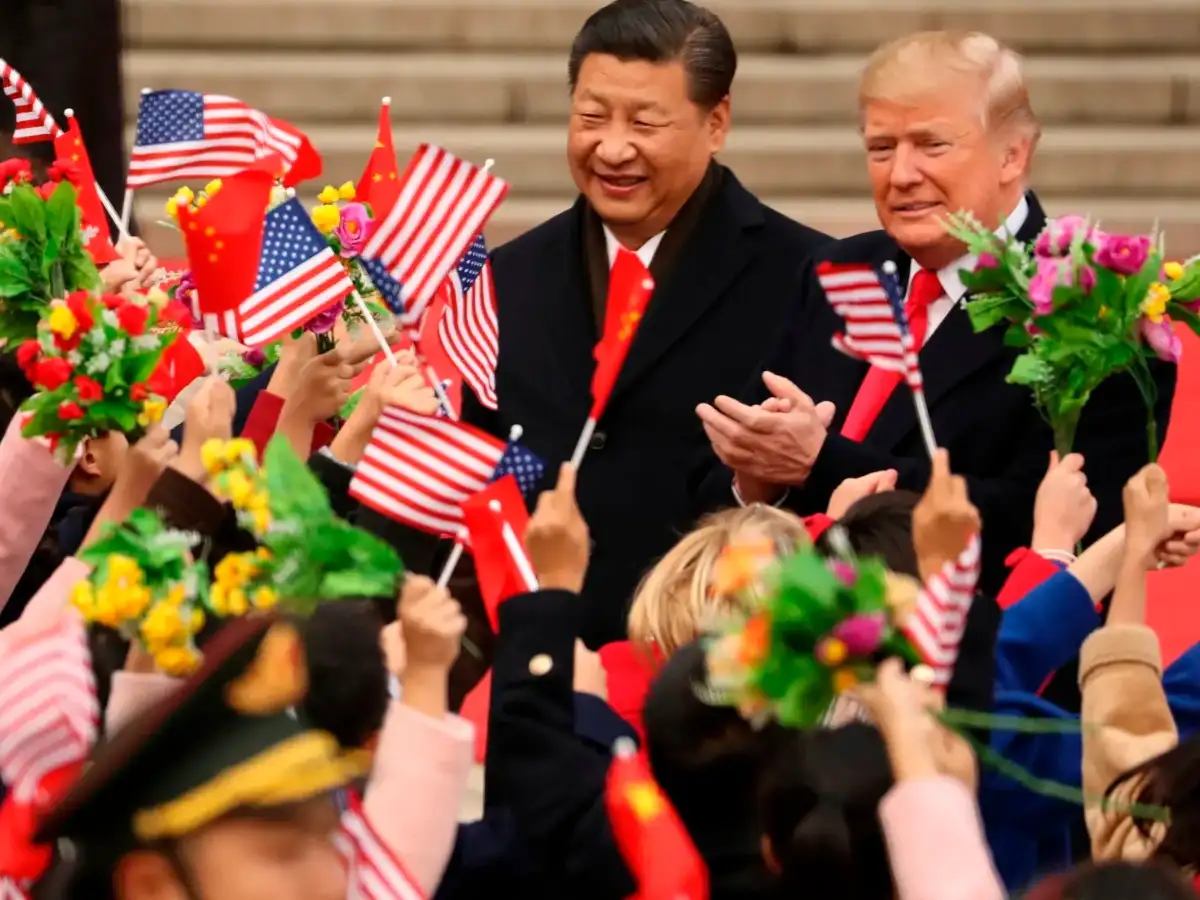
US President Donald Trump is wrapping up a two-day state summit with Chinese President Xi Jinping in Beijing today. Trade, tariffs, Iran, artificial intelligence, and rare earths were all on the agenda.
But at the opening of the summit on Thursday, in a closed-door meeting that ran more than two hours, Xi Jinping made clear where his priorities lie.
Also read: China's Xi lauds 'new positioning' in ties with US
"The Taiwan question is the most important issue in China-US relations," he said. "If mishandled, the two nations could collide or even come into conflict, pushing the entire China-US relationship into a highly perilous situation."
US Secretary of State Marco Rubio, who is with Trump in Beijing, confirmed Taiwan was discussed, and that the Chinese "always raise it on their side, we always make clear our position and we move on to the other topics."
Taiwan has shadowed every major US-China exchange for decades. So what exactly is the island, why does Beijing claim it, why does Washington care and why does a strip of land in the Pacific keep reshaping global politics?
How did this dispute begin?
Taiwan, officially the Republic of China (ROC), is a self-governing island of roughly 23 million people located across the Taiwan Strait from mainland China. The roots of the dispute go back to a civil war.
As documented by the UK National Archives, the Chinese Communist Party defeated the ruling Nationalist government in 1949, at which point Nationalist leader Chiang Kai-shek fled to Taiwan and continued to govern from there, while Mao Zedong proclaimed the founding of the People's Republic of China on the mainland.
The two sides have existed in a state of unresolved political separation ever since. The People's Republic of China has never governed Taiwan but, according to the Council on Foreign Relations, considers it a breakaway territory that must eventually be reunified with the mainland, by force if necessary.
Today, Taiwan operates as a functioning democracy with its own elected government, military, currency, and foreign policy. Most countries, including the United States, officially recognise only the People's Republic of China. Only 11 states and the Holy See maintain formal diplomatic ties with the island.
Why do semiconductors make this the world's most consequential dispute?
Before getting to the geopolitics, it helps to understand what is actually at stake economically, because Taiwan is not just a political flashpoint. It is the nerve centre of the global technology supply chain.
Also read: 'Can US, China avoid Thucydides Trap?' Xi puts Trump on the spot, ‘We need to be allies, not rivals’
According to the US International Trade Commission, Taiwan accounts for nearly 70 percent of global foundry revenue and approximately 92 percent of manufacturing capacity for the most advanced chips in the world.
The US Department of Commerce's International Trade Administration notes that Taiwan's semiconductor industry generated over $165 billion in revenue in 2024, representing approximately 20.7 percent of the country's GDP.
Taiwan's Ministry of Economic Affairs has separately stated that the sector contributes 60 percent of the island's total exports.
At the centre of this is TSMC, the Taiwan Semiconductor Manufacturing Company, which holds roughly 70 percent of global foundry market share and serves as the primary manufacturer for Apple, Nvidia, AMD, and Qualcomm, among others.
Any conflict over Taiwan would not just be a military crisis. It would sever the supply chains that underpin the global technology industry, from AI and consumer electronics to defence systems. That risk is why countries far removed from the Taiwan Strait, including India, have a direct stake in how this dispute unfolds.
Why does China consider Taiwan a core national interest?
For Beijing, this is not just a territorial claim. At the heart of the dispute is something called the "1992 Consensus," an understanding reached between representatives of both sides in Hong Kong. No formal agreement was signed at the time, but both sides settled on a formula in which each insisted on a "One China" principle while deferring to their own interpretation of what "China" meant. For Beijing, it means the People's Republic. For Taiwan's then-ruling Nationalist party, it meant the Republic of China.
Xi Jinping has staked much of his political legacy on this question. The Council on Foreign Relations (CFR) notes that 2049, the centennial of the People's Republic, is widely seen as a critical deadline, and that Xi has framed reunification with Taiwan as central to what he calls the "Chinese Dream," his vision of China's restored great-power status.
Beijing has backed this political position with escalating military pressure. In December 2025, the People's Liberation Army conducted its largest military drills around Taiwan since 2022, a two-day exercise named "Justice Mission 2025."
According to the PLA's Eastern Theatre Command, the drills focused on "sea and air combat readiness patrols," blockading key ports, and "three-dimensional external line deterrence."
The Global Taiwan Institute, a Washington-based research body, noted the exercises involved more than 130 aircraft sorties into Taiwan's air defence identification zone, alongside 14 warships and at least 15 coast guard vessels.
What do the Taiwanese people actually want?
Taiwan's population has a view that diverges sharply from Beijing's. Most Taiwanese support maintaining the current status quo. According to a June 2023 survey by National Chengchi University, nearly 63 percent of the island's residents identified as exclusively Taiwanese, down from around 40 percent a decade earlier who identified as both Taiwanese and Chinese. Only 3 percent identified as exclusively Chinese.
An overwhelming majority reject the "one country, two systems" model Beijing has proposed, a sentiment that has hardened since Beijing's crackdown on political freedoms in Hong Kong.
Taiwan's current president, Lai Ching-te, belongs to the Democratic Progressive Party, which holds that Taiwan is already a sovereign entity and does not need to formally declare independence.
What is the US position and how did it get so complicated?
The United States does not recognise Taiwan as an independent country, but it also does not endorse China's claim over it.
In 1979, the Carter administration shifted diplomatic recognition from Taipei to Beijing. That same year, Congress passed the Taiwan Relations Act, signed into law on April 10, 1979. The Act, accessible in full on the American Institute in Taiwan's official website, declares its US policy to maintain "extensive, close, and friendly commercial, cultural, and other relations" with Taiwan, and commits Washington to providing Taiwan with arms "of a defensive character."
Underpinning all of this is what the Center for Strategic and International Studies (CSIS) describes as "strategic ambiguity," under which the United States has deliberately declined to state whether it would intervene militarily if China attacked Taiwan.
The logic is that this uncertainty deters China from attacking while also discouraging Taiwan from making moves toward formal independence that could trigger a conflict.
The CFR draws a sharp distinction between the US "One China policy" and China's "One China principle." Under the US policy, Washington acknowledges, but does not endorse, Beijing's claim, a difference built into the very word "acknowledges" in the 1972 Shanghai Communique.
How has Trump changed the equation in his second term?
Trump's second administration has introduced significant uncertainty. According to the CFR, in February 2025, the State Department quietly removed language from its Taiwan factsheet that explicitly said Washington does not support Taiwanese independence, drawing criticism from Beijing and praise from Taipei.
Also read: ‘Terrible mistake’ if China takes Taiwan by force; US position unchanged: Rubio
Trump's desire to reach a trade deal with China has also introduced fresh complications. On May 11, ahead of the Beijing summit, Trump said publicly that he would raise the issue of arms sales to Taiwan with Xi Jinping, a move that broke with the so-called Six Assurances, which since 1982 have committed the US not to consult Beijing before making decisions on arms sales to Taiwan.
At the same time, Trump has maintained arms sales to the island, including an $11 billion package that includes HIMARS rocket systems, howitzers, and Javelin anti-tank missiles, according to Reuters.
As the Beijing summit continues through Friday, no resolution on Taiwan is expected. Xi told Trump that if the Taiwan question is "handled well, the relationship holds; handle it badly, the two countries risk collision or conflict." Trump, for his part, told Xi that "the relationship between China and the USA is going to be better than ever before."
What the two sides decide behind closed doors on Taiwan, arms sales, and the language of American commitment to the island's security will be watched closely in Taipei, Tokyo, New Delhi, and every other capital that understands this remains an undecided question in the most consequential bilateral relationship in the world.