With an estimated 130,000 Russian troops stationed near the Ukrainian border and another 30,000 in Belarus, fears that Vladimir Putin was planning an invasion of his western neighbour have loomed since December.
The UK has now warned that the incursions have begun, a day after Russia moved to recognise the breakaway regions of the Donetsk People’s Republic and Luhansk People’s Republic as independent states, allowing it to openly move its forces into the rebel-held separatist regions of Donbas in the name of protecting an ally.
The international community hit out at the decision, with the United Nations Security Council expressing “great concern” and the US suggesting, apparently correctly, that the play was a pretext for a full-scale military assault.
Vassily Nebenzia, the Russian ambassador to the UN, insisted there would be no “new bloodbath” in eastern Ukraine but warned the West to “think twice” before making matters worse.
“We remain open to diplomacy for diplomatic solution,” he said. “However, allowing bloodbath in Donbas is something we don’t intend to do. We are forced to note the negative role played by our western colleagues led by the US.”
UK prime minister Boris Johnson has already promised that Russia will face a “barrage of sanctions”, with the US and EU expected to take similar actions as a deterrent.
The standoff comes eight years after Russia annexed the Crimean Peninsula and sparked fighting in the industrial heartland of Donbas, where a low-level conflict that has since killed more than 14,000 people is still rumbling on between Kyiv and the pro-Russian separatists.
Although the West still hopes to alleviate tensions and avert the prospect of bloody war in Eastern Europe at the last minute, diplomatic talks between the Kremlin and the Nato allies have made no ground so far.
The North Atlantic military alliance has previously said it is sending additional ships and fighter jets to deployments in neighbouring eastern states like Poland and Lithuania – who are bracing for an influx of refugees in the event that fighting should erupt – while the US and UK have withdrawn diplomats’ families from Ukraine as a precaution and some airlines have stopped making flights into Kyiv.
Antony Blinken, US secretary of state, has flown to Europe in recent weeks in a bid to defuse the situation, urging Russia to avoid a return to Cold War-era hostilities as he held talks with his Russian counterparts, Ukrainian president Volodymyr Zelensky and other European leaders.
UK foreign secretary Liz Truss, French president Emmanuel Macron and German chancellor Olaf Scholz have all in turn visited Moscow on the same mission.
US president Joe Biden was invited to follow suit but the Kremlin dismissed the prospect, saying that US-Russian relations are currently “on the floor”.
Mr Biden and Mr Scholz recently huddled in Washington to talk strategy, with the pair threatening Russia that its Nord Stream 2 natural gas pipeline running to Germany under the Baltic Sea will be shut down in the event of incursions into Ukraine.
Should Mr Putin go ahead and make that “gigantic mistake”, as it now appears he has done, the western allies will be expected to take other measures beyond economic sanctions, including backing Ukraine with further military resources.
The UK and the US have already provided Ukraine with some additional forces, the former flying anti-tank weapons to the country and stationing 350 soldiers in Poland, with another 1,000 on standby.
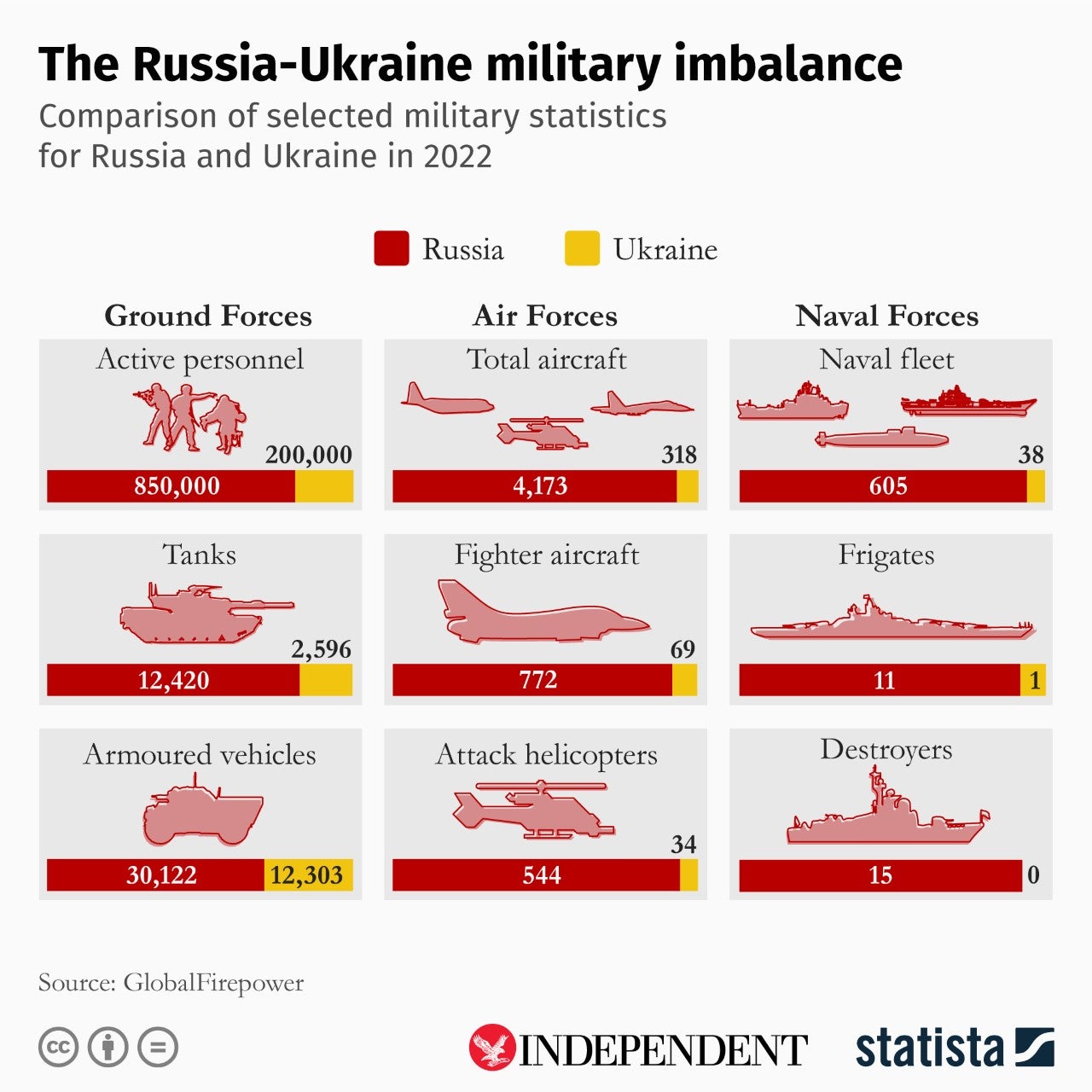
However, such gestures are likely to prove cold comfort to Kyiv if as it stares down a Russian attack, given the significant gulf in military strength between the two combatants.
While Ukraine has under 250,000 troops and is looking to add a further 130,000 to its ranks, Russia has almost a million soldiers at its disposal. It also has much more sophisticated and abundant military hardware.
Speaking of the disparity between the two armies, Vadym Prystaiko, Ukraine’s ambassador to the UK, said it is unfortunate that his country is not part of Nato.
“We are not part of this family and we are facing the biggest army in Europe by ourselves,” he said.
Mr Putin is believed to view the current situation as the first step towards correcting what he regards as Nato’s encroachment into countries like Ukraine that were previously ruled by the Soviet Union prior to its collapse in 1989.
With polls showing that a large majority of Ukrainians would like their country to become a member of the military alliance, Moscow wants the West to promise that this will never come to pass, something Nato has categorically ruled out.
Mr Putin laid out his own thoughts on Ukraine and its relationship with Russia in a 5,000-word essay published last summer.
Entitled “On the Historical Unity of Russians and Ukrainians”, the treatise was “one step short of a declaration of war”, in the opinion of Anders Aslund, a senior fellow at the Stockholm Free World Forum.
The Russian president reiterated his claim that Russians and Ukrainians are “one people”, suggesting that his homeland was “robbed” when Ukraine won its independence from the USSR.
Elsewhere in the essay, he offered more overt threats towards Kyiv, declaring: “I am confident that true sovereignty of Ukraine is possible only in partnership with Russia.”
A matter of months later, he dispached his tens of thousands of troops to the border.
Kremlin spokesman Dmitry Peskov had repeatedly denied that Russia intended to invade and countered that it was really Western weapons being delivered to Ukraine, the country’s own military manoeuvres and Nato aircraft flights overhead that are really to blame for the rising tensions.
But, perhaps as a prelude to the coming storm, more than a dozen Ukrainian government websites were hacked in January.
The country’s foreign ministry initially said it was too early to say who was to blame but added pointedly that “there is a long record of Russian cyberassaults against Ukraine”.
The hackers left an ominous message on the websites they had disabled. “Ukrainian! All your personal data was uploaded to the public network. All data on the computer is destroyed, it is impossible to restore it,” it read.
“All information about you has become public, be afraid and expect the worst. This is for your past, present and future,” the message added.