My first lesson in the politicisation of the poppy came early and at the hands of an old history teacher in my first year at secondary school. I recall that a lucky older pupil had been given time off double maths to tour all the classes with a box of poppies. The idea was for us all to take one in exchange for a tiny donation to what was then called the Earl Haig Fund for the injured servicemen being cared for at the Erskine hospital. On this day, though, my teacher, a man for whom we all had a great deal of affection, simply dismissed the older lad before we had a chance to obtain the little red scrap on a stick. For the remainder of the session, he told us his views on the poppy and its patron, Field Marshal Douglas Haig, 1st Earl Haig.
Put simply, his narrative went something like this: Earl Haig was the privileged fop scion of a hated aristocratic dynasty that had become rich on the blood, sweat and tears of a million downtrodden families like ours. During the Battle of the Somme, he sent 500,000 brave men to their deaths while he remained well out of danger sipping champagne and eating kedgeree in a country mansion with others of his kind.
The fact that the poppy fund for wounded servicemen had been named for this cruel and sneering toff was sufficient reason to withhold our money and it was only right that he had made our decision for us and that we knew the truth of the matter.
My dad was appalled when I included this little vignette among my list of the day’s activities. Many other parents evidently expressed similar concerns and the teacher was quietly removed from the school a few months later amid scurrilous accusations that the chap was a damned communist, there being no worse thing for a teacher to be in a nice Catholic school.
Yet what was worse: that we had been fed such biased views by an adult who had abused his privileged position a little or that most of us had reached our early teens not really knowing about the horrors and sacrifices of the Great War?
Since then, I have been a mildly interested bystander at Remembrance Sunday and at the civic events leading up to it every year. My path through this life has never really seen me brush up against those for whom the poppy holds a great deal of emotion, albeit wrapped up in ideas of Britishness, loyalty to the crown and a mourning for the passing of old certainties.
It’s not, I convinced myself, that I and my crowd had a haughty, liberal disdain for the poppy it was just that, well… there was never an urge to wear one and no one minded if we didn’t.
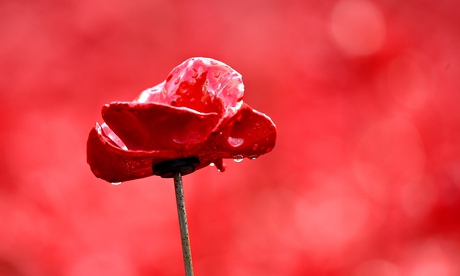
But if I’m being honest, then yes, my political, cultural and social outlook on life did have a bearing on this. Many of us who like to portray ourselves as liberal, leftwingers do disdain the poppy because we have decided that we know what it stands for, rather than simply accepting it for what it is: a tiny, pure and quiet token of appreciation for the sacrifice of others.
We will glibly cite the rise of “poppy fascism” as a reason not to wear this wee paper flower. But what do we really mean by that? Certainly I think that a creeping militarism has been abroad in the UK this past decade or so, manifest in the absurd celebration and acclaim for “Our Boys” and for armed aggression in those places where the shadow of England long ago caused geopolitical chaos and where the locals are making a nuisance of themselves.
And I think that the government and its various agents of social control have used this to avert our eyes from the way in which the gap between unearned wealth and poverty in this country has become a chasm. Royal occasions, grossly expensive sporting events, the armed forces: all the bread and circuses by which the elite have always exerted control over hoi polloi. And yes, I think there is now a – how can I put it – strident expectation that we all must wear the poppy in November and that this in itself runs contrary to what this innocent little flower was chosen to convey. What was the sacrifice of those who fell all about if it didn’t include the right to dissent?
I am now though sensing among those of us on the left a similar totalitarianism over the wearing of the poppy. It has now been deployed as a test of just how genuine your left-wing credentials are. I reject this way of thinking utterly; it is a betrayal of what I thought real socialism is all about.
In a military cemetery in Mons in August, I experienced a rude epiphany that was conveyed by the simple expressions of grief and sorrow left by desolate parents on the stones that marked the final resting places of their young sons; these and those beautiful words by Rudyard Kipling carved on to the tablets that marked unidentified remains: “A soldier of the Great War, Known unto God.”
I experienced the same feelings last week while visiting the graves of two young soldiers buried near each other on a remote island in Scotland’s western Highlands. Does it really matter that the poppy does not now commemorate the dead of the 20th century’s two great “just” wars and that it also includes those who are dying in Britain’s more tendentious 21st-century military adventures?
How can you rate by degrees the grief and desolation of parents whose children have fallen in battle depending on how “ideal” was their war?
I have been wearing the poppy, not with any sense of pride but with a sense of deep, deep humility. Who cares whether I do or not? Possibly, just possibly, a mother still mourning her dead son in Iraq or an old woman who still remembers the father she waved off to war in 1942.