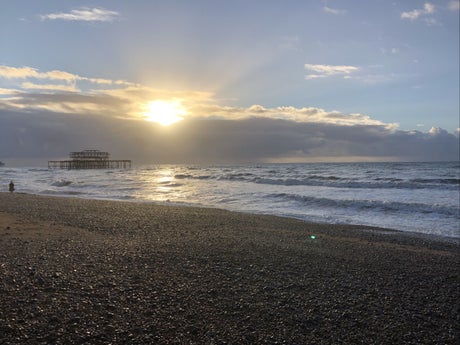
he pebbles of Kemptown beach slick with ice, I half crunch, half slide towards the water. The chill of a northerly breeze makes me shiver as I reach the shore line and look out towards Rampion Wind Farm on the horizon. The sea is calm, the waves lapping gently. The air temperature is around zero; the water is around 5C. It’s winter, and it’s time to go swimming.
I wade in and feel a shock jolt through my body, before slowing my breathing and sliding my shoulders beneath the surface. I swim close to the shore in random directions, sometimes on my back admiring the pink hue of the sunrise over the ugly marina to the east. I do not time my dip or measure its distance. After a few short minutes I stagger back to my feet and stride back to my bag, drying off quickly, my mind quiet, my body bright red and tingling.
I have been lucky enough to live on Brighton seafront for five years. On windy days, the sea here rages and is a no-go zone for swimmers, no matter their experience. Yet on days like today, I am gripped by an unerring urge to strip down to a pair of trunks and push out into the water in search of a deeper connection, both with myself and the natural world.
Read more:
- Travel industry fury at ‘coordinated campaign’ to undermine holidays
- How the ‘traffic light travel’ system could work
- Summer holidays would bring ‘real risk’ of Covid variants, says scientist
- When can we travel again? Key lockdown easing dates
This is my fourth winter of “swimming through”. And while I love the languid pleasures of a long summer swim, drying out in the sun afterwards, the visceral thrill of doing so in winter, and the peace that descends afterwards, is to me more powerful and addictive. I suffer from anxiety and nothing soothes its edges and brings me back into the moment like a winter wild swim.
The science behind cold water immersion and its curative properties for mental health is still developing. But a growing body of anecdotal evidence suggests that swimming in cold water has positive benefits.
Dr Heather Massey, from the University of Portsmouth’s Extreme Environments Laboratory, studies how cold water can affect mental health and co-authored a 2017 paper exploring its benefits. She says that while the science is still in its early stages, there is small scale evidence surrounding cold water’s anti-inflammatory properties.
“For about 30 to 35 percent of people with depression and anxiety, their condition is linked to inflammation and there are anti-inflammatory properties to immersion in cold water.” A now renowned 2018 study conducted by the BBC’s Dr Chris van Tulleken and Dr Mark Harper from Brighton and Sussex University Hospital, who is working with Dr Massey on new research into cold water swimming’s benefits, found that daily dips significantly eased one patient’s anxiety and depression, so much so that she was able to come off antidepressant medication.
Of course, this is only one person, and coming off medication is a step which should be taken in full consultation with your GP. But it does bode well for Dr Massey’s latest project, which has enlisted more than 50 participants in Cornwall to take part in a pilot study into cold water’s effects.
“There is quite a growing literature of anecdotal experiences, but what we need to do is build on those in terms of scientific knowledge as well,” she says. “That’s not to poo poo anecdotal experiences, they are all important. It’s really the first level of research in the area.”
Massey points to the fact that much wild swimming is done socially, with clear benefits from sharing the experience. Then there’s the fact that it’s exercise, which she says is “a proven source of reduction in depressive symptoms”.
“Being in a blue or green environment is also linked to improved mental health,” she adds. “We can’t actually separate any of these from the physiology, sociology or the psychology of the situation. There are lots of things happening that we can try to unpick, but we’re not there yet.”
Standing on the beach after my brief but wondrous swim, bundled up in multiple layers to ward off the cold, my feelings of serenity and a oneness with the world are undeniable. When I swim, I feel infinitesimal in the most powerful way. There is something almost cosmic in the way that winter swimming shrinks me down and shows me my tiny place within the universe. I feel more attuned to the deep squawk of the herring gulls and the way the common terns slice through the air and dive beneath the surface for their prey.
Those who want to try winter wild swimming should always put safety first. It helps to have swum during the warmer months so you’re acclimatised. It’s also vital to develop a good, working knowledge of the conditions of your local patch. I never swim when the wind is strong or the waves and swell too powerful: respect for the water is paramount.
“I like to see people enjoying themselves in the cold water,” says Dr Massey, “but doing so safely. I have no problem with people going into the water as long as they take precautions, they’re looking after themselves and those that they’re with.
“There has been a large increase in coast guard callouts [during lockdown]. Yes, it’s a fun activity to undertake but also quite a dangerous one if you don’t have the knowledge of the environment you’re going into. Learn about the environment and go with somebody that is local and knowledgeable about what you’re about to do.”
It is currently not permitted to exercise in groups, including wild swimming. But find a friend, pack some extra layers, fill a flask with sweet, hot coffee and you’ll find a beautiful new hobby is waiting for you at the water’s edge.
Joe Minihane is the author of wild swimming memoir Floating: A Life Regained