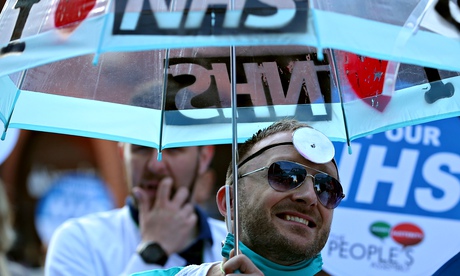
I am ashamed to say that I crossed the picket line outside Herrison hospital in September 1982. A working-class Oxbridge graduate, I was a finance trainee in the NHS, and had not yet joined a union. It wasn’t until the 1982 strike that I realised that the objective to obtain fair pay for NHS workers would be a perennial struggle in the years to come, and that this struggle was consistent with saving the NHS and not destroying it. Many things have changed over the past 30 years, but the NHS is still the subject of continuing debate regarding how much taxpayers’ money we should spend on it.
I chose a career in the NHS because I admired it. I felt honoured (and still do) to work in it. I looked for the intrinsic worth of the role rather than the financial package. I didn’t bother to compare my starting salary with what I would have received had I gone into the City or a blue chip company because they didn’t interest me. When I started work, the NHS was one of the most efficient and trusted healthcare systems in the world. One of the reasons for its efficacy and efficiency is that people are given care according to their needs and irrespective of their means. This ethos belongs to its workers as well as to the organisation; for people who work for the NHS, it is a vocation, and they care deeply about what they do. Now, however, cost-cutting is accepted as part of the solution for the NHS; in a business where more than 70% of costs are staff related, the next leap of logic is that staff pay must be cut. This is interpreted and delivered in a number of ways, all of which serve to undermine the quality and energy of the NHS workforce and which include pay freezes, dilution of skill mix, reducing management costs and the outsourcing and privatisation of individual components of the NHS.
When the ballot paper came through my letterbox, there was no question as to how I would vote. When I strike, there will be no impact on my work because I will ensure that I will cover everything I need to do in advance. Other professional groups are explicitly targeting areas where patients will not be at risk and I have no fears for patient safety. I am striking not to inconvenience my employer, but to demonstrate how strongly I disagree with government policy regarding NHS funding – including the continuing downward pressure on the real value of NHS pay. The government does appear to have singled out NHS staff for harsh treatment. The NHS pay review body (NHSPRB) was established in order to provide an independent and expert view of NHS pay settlements taking into account all economic and technical matters. In 2013, the government told the NHSPRB that the average increase in pay for 2014 should be no more than 1%, but when the NHSPRB recommended an increase of 1% as being the minimum compatible with staff retention and morale, the government chose to ignore their recommendations and the majority of staff will get no cost-of-living increase at all. This is the only pay review body the recommendations of which the government has ignored. And it is not just this year – staff in the NHS have lost 12-15% of their purchasing power since the last general election. The process of reorganisation and marketisation in the health service has also resulted in NHS pay becoming more unequal. Since 2006, the gap between the bottom and top pay scales has increased by 10%. And 40,000 NHS staff earn less than the living wage of £7.65 per hour or £8.80 in London.
I am striking because I am dismayed at the continuing and relentless reorganisation, marketisation, privatisation and fragmentation of the NHS. I want to work in an NHS with a collaborative rather than a competitive ethos. Where decisions about care are driven by the needs of the patient, not by the scope for profit. Where quality is a prerogative always, not just when it helps to win a contract. Where the entire NHS budget is used to provide and support patient care.
I am striking because NHS workers are bearing the brunt of the rhetoric and dogma at the heart of current policy, being presented as a cost rather than a benefit, a burden on the state, the costs of whom must be minimised. We have to “tighten our belts” like everyone else – but it’s not like everyone else because the richest 1,000 people in Britain – are now worth double that of five years ago and up 15% on a year ago. This is in the context of further cuts in staffing to come, and more work for those that are left; for example, NHS England reduced its management costs by 10% in 2014/15 and is required to reduce them by a further 15% in 2015/16.
And finally, I am striking for a properly funded, publicly provided NHS. Ultimately, I hope, this will benefit the wellbeing of our nation, and our pockets.
The writer is a head of finance in NHS England
If you would like to write a blogpost for Views from the NHS frontline, then please read our guidelines and get in touch by emailing healthcare@theguardian.com.
Are you a member of our online community? Join the Healthcare Professionals Network to receive regular emails and exclusive offers.
Read more
• Why are NHS staff going on strike?
• As NHS strike looms, survey shows scale of anger on pay
• NHS pay is complicated, unfair and frankly absurd