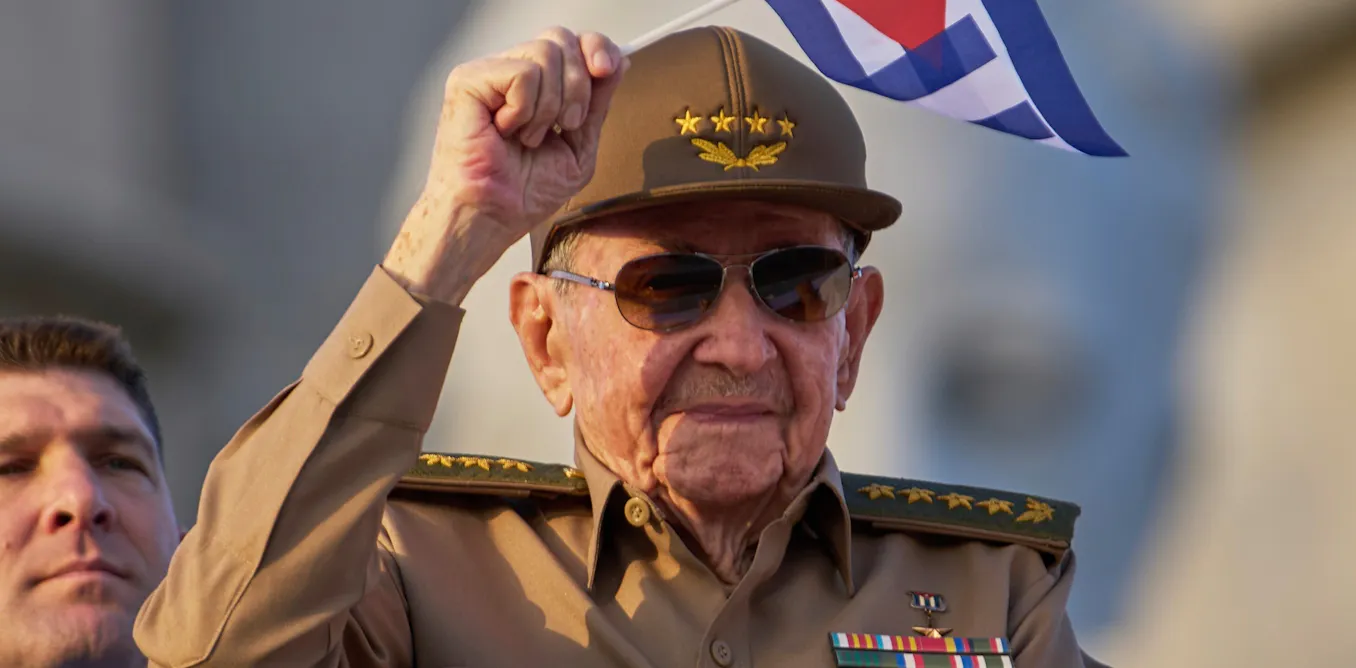
After a week of speculation, the US Department of Justice has officially indicted Raúl Castro, the 94-year-old ex-president of Cuba.
The charges relate to a 1996 incident in which the Cuban military allegedly shot down two unarmed civilian planes operated by Brothers to the Rescue.
The news comes amid mounting US pressure on the ailing Cuban Republic to change its system of government after 67 years of revolutionary rule.
So why did the United States act now, and what will happen next?
Who is Raúl Castro?
Raúl Castro is the younger brother of Cuban revolutionary leader, Fidel Castro. He joined Fidel’s movement to overthrow the authoritarian US ally, Fulgencio Batista, starting in 1952. He participated in the assault on the Moncada Barracks on July 26 1953, becoming a founding member of the M-26-7 guerrilla movement, the leading organisation in the Cuban revolution.
In 1958, he rose to the rank of comandante of the Second Eastern Front. He came to Washington’s attention in June when he kidnapped a group of 50 US Marines to prevent the continued aerial bombardment of his troops and local villagers.
This was a pivotal moment when Raúl become more than Fidel’s brother – he was now a key leader of the revolution.
By late 1958, Raúl Castro’s army had liberated much of eastern Cuba from the Batista regime and began marching on Havana to conclude the revolution.
From January 1959, Castro became the defence minister at a time when fighting was ongoing. For decades, he was the face of Cuba’s military and the island’s defence.
When, in April 1961, a group of 1,400 Cuban exiles, supported by the US Central Intelligence Agency (CIA), attacked Cuba at the Bay of Pigs, Castro’s military secured a famous victory against the exiles, and the US.
He would also rise through the civilian and party ranks in Cuba. From 1976, he served as vice president and then succeeded his ageing brother as president from 2008, a position he would hold until 2019.
Raúl Castro remained atop the Communist Party until 2021 and is still viewed as influential in Cuba’s politics. Castro is a soldier, a politician and, above all, a revolutionary who toppled a pivotal US ally and resisted US pressure for decades.
However, Cuba is an authoritarian state that does not tolerate dissent. In 2003, Fidel Castro’s government, of which Raúl Castro was apart, detained dozens of pro-democracy advocates in an event dubbed the “black spring”. One of those detained, José Daniel Ferrer, founder of the Patriotic Union of Cuba, called on the US to stand with the opposition forces in 2025.
What is he accused of doing?
Cuba has been subject to a blockade by the US since 1960. It was also subject to an embargo by the members of the Organisation of American States (OAS), which includes almost all the countries in the Western Hemisphere, between 1964 and 2009.
The economic survival of Cuba has always been dependent on the support of a large nation willing to supply it with fuel.
During the Cold War, that was the Soviet Union, whose 1991 collapse was devastating for Cuba and its government. The “Special Period” following 1991 saw fuel shortages, declining food production, social unrest and large-scale emigration from Cuba.
Cuban exiles boarded unstable flotillas in their tens of thousands, hoping to join other exiles in Florida. The Clinton administration in the US eventually allowed for mass migration and the US Coast Guard was regularly helping to save stranded Cubans. Despite this, dozens of people drowned at sea.
A group of Cuban exiles, led by self-declared “Bay of Pigs veteran”, José Basulto, flew reconnaissance flights and reported the location of stranded Cubans to the Coast Guard.
But the flights had other motives. On several occasions, the planes flew into Cuban airspace, ignored warnings and dropped propaganda designed to trigger anti-government activity.
Records made public by William LeoGrande and Peter Kornbluh, authors of a book on the topic, reveal the US knew of these operations and feared Cuba would eventually shoot down the planes, creating an international incident.
On February 24 1996, the Cuban military indeed shot down two planes, killing all four people on board.
Now, 30 years later, the US Department of Justice alleges that Castro, the then-defence minister, and six others are criminally responsible for the murders of the four men, three of whom were US citizens.
The US attorney for the Southern District of Florida, Jason A Reding Quiñones, said “this passage of time does not erase murder”.
Why is the US acting now?
Cuba is again suffering under a US blockade, this time initiated following the removal of its fuel guarantor, Venezuelan President Nicolas Maduro in January.
New Venezuelan President Delcy Rodriguez was pressured into ending oil shipments to the island, as were Mexico and other regional partners under the threat of crippling tariffs.
Cuba declared last Thursday it had no fuel or diesel remaining at all. Meanwhile, the humanitarian conditions worsen. Amnesty International reported in 2025 that most Cubans were struggling to find sufficient food and medicine.
In a historic visit in recent days, CIA Director John Ratcliffe spoke with members of the Cuban government in a sign of potential regime change.
President Donald Trump has also highlighted his motives on Cuba this week, saying “to a lot of people it’s going to be one of the most important things, they’ve been looking for this moment for 65 years”.
Cuban-Americans have indeed been pushing for the removal of the Castros since the 1960s.
Secretary of State Marco Rubio, himself a Cuban-American, commemorated Cuba’s 1902 Independence Day by delivering the following message to the Cuban people, in Spanish:
and I want to tell you that we, in the US, are offering to help you not only to alleviate the current crisis but also to build a better future.
The message condemned the Cuban government, and Raúl Castro, as corrupt. He called for regime change, referring to the current Cuban president, Miguel Díaz-Canel.
The indictment of Castro is about more than justice for one man. It’s about Cuban-American politics in Florida, and it’s about the looming potential of regime change in Cuba, America’s primary regional foe for the past 67 years.
This article was originally published on The Conversation. Read the original article.