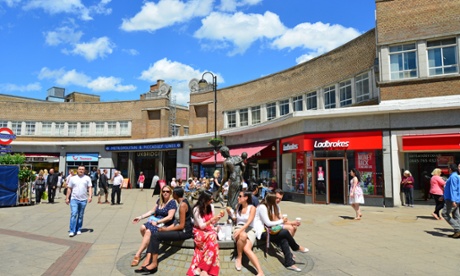
Some of the more striking trends confirmed by the last census concerned demographic changes taking place in London’s suburbs. The population of the Outer London boroughs had risen from 4.5 million in 2001 to nearly 5 million by 2011. They had become far more ethnically diverse, with the proportion who were white falling from 74% to 61%. The amount of private renting had almost doubled to 21% and 58% of all Londoners categorised as living in poverty were Outer Londoners compared with just 50% of them 10 years earlier.
Of course, the Outer London boroughs vary greatly. How much does Richmond have in common with Barking and Dagenham? Yet it was clear that the old, easy distinctions between gritty Inner and and leafy Outer, between the archetypes that formed EastEnders and Terry and June, were becoming increasingly blurred. Now, the Centre for London think tank is compiling a report on what it calls this “new geography of wealth and poverty in the capital” and its implications for public services, civil society and politics.
They’ve pulled some stats together in enlightening ways. For instance, the percentages of households defined as being “in poverty” were lower in most Inner London boroughs in 2011 than they had been in 2001, but higher than they’d been in most Outer ones. Poverty rate graphs for all 32 boroughs show a much more even distribution of low income households across Greater London than before. Newham, Tower Hamlets and Hackney still fill the top three places even though their rates are down. But Brent has soared from having the 12th highest rate to the fourth and Ealing from the 15th to the eighth. By contrast, Islington has plunged from fourth to mid-table 16th and Camden from seventh to 17th.
What explains these changes? Why has London’s poverty become more spread out? It may be tempting to ascribe it all to gentrification forced out or pricing out poor Inner Londoners, displacing them to Outer London boroughs - part of the pervasive “social cleansing” narrative. But the story is far more complex than that.
For example, falls in Inner London poverty rates have coincided with increases in the percentages of their residents in highly-qualified occupations. Might those poverty rates have changed more because of a growth in the numbers of affluent people living in those boroughs than any resulting, reluctant large-scale exodus by the poor?
Note that Tower Hamlets, despite a substantial 7% increase in residents in senior managerial, professional and associated occupations between 2004 and 2015, still has 39.3% of its children and 49.7% of its older people living in income deprived households according to government figures - in both cases, the highest percentages in England. By those measures, a greater number of affluent people in the East End’s social mix seems not to have resulted in any transformative purging of have nots.
At the same time, it’s not only the Inner London boroughs that have seen a growing presence of highly qualified people in their demographic spectrums. So have Waltham Forest, Croydon, Havering and Sutton, among others. Where have they come from? Have they migrated out from Inner London due to high house prices and private sector rents (anecdotally, I’d say that’s certainly the case with Waltham Forest)? Have they migrated in from elsewhere in the country and the world and settled in Outer rather than Inner London for much the same reasons? Have they been home grown, thanks to improving job options and better schools? Is it a combination of all three?
Disentangling the various factors driving the relative leveling out of the balances between poverty and prosperity across Greater London and identifying clear causal relationships between any of them is plainly no straightforward task. As far as I’m aware, none of the several fine academic minds that have applied themselves to the statistics claims to have completed it. Perhaps it simply isn’t possible.
What is very plain, however, is that many Outer London councils are having to learn to cope not only with increasing numbers of people living in their boroughs but also with growing percentages of those people having needs that require financial resources and expertise such councils haven’t had to provide on such a scale before.
How will they cope in this new, “inside out” London world? And, by the way, how will the London mayoral candidates adjust to the basis for the so-called “doughnut strategy” being, so to speak, devoured? The Centre for London plans to publish its full report in the New Year.