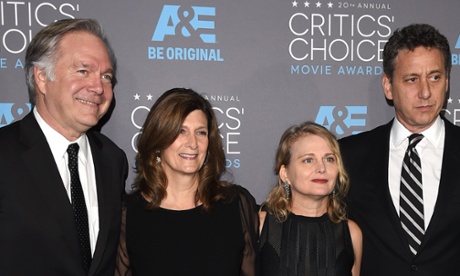
In an awards season that has dished out snubs with perverse generosity, the move by the voting bodies of the Academy and the Producers Guild of America to exclude two key creators behind Boyhood deserves a trophy of its own. Their decision to deny Jonathan Sehring and John Sloss a place alongside Richard Linklater and Cathleen Sutherland on the producers roster beggars belief.
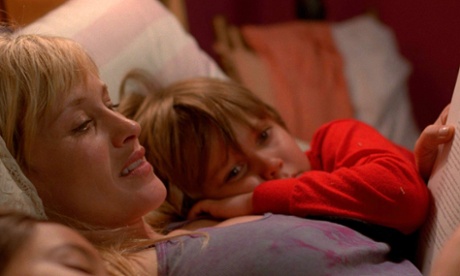
Mention Boyhood, one of the year’s most adored movies, and the first person who comes to mind should be Linklater. This is only right: it’s his baby. The whole crazy paean to youth sprouted from his feverish indie brain and he was with it every step of its 12-year gestation. You might also think of Patricia Arquette, frontrunner for best supporting actress, or Ethan Hawke, or the soulful newcomer Ellar Coltrane, or Linklater’s daughter Lorelei. You’d be right to do so: these four actors are the face of Boyhood and have earned their acclaim.
Yet three other people helped Linklater shepherd this beast. But in the eyes of the Academy and the PGA, only Cathleen Sutherland is worthy of her producer credit alongside Linklater. Sutherland joined the project as production manager shortly after it started in 2002, swiftly graduated to producer and stayed the course through to completion in 2013; she thoroughly deserves her producer credit. But so do the vastly experienced executives Sehring and Sloss. Yet the latter pair will not take to the stage on February 22 should Boyhood win the best picture Oscar, as many believe it will.
The Producers Guild of America (PGA) denied Sehring and Sloss the producer credit on Boyhood late last year. Even though it awarded its highest accolade to Birdman, the Boyhood decision still rankles, and now that we are entering the final straight to the Oscars the Academy’s ruling remains a sore point.
The whole thing is barmy. Boyhood would never have happened without Sloss and Sehring. The former is Linklater’s longtime attorney and was the first person to hear about the director’s vision as they walked along the Venetian canals in September 2001 after the world premiere of Waking Life – a movie Sloss helped put together. Linklater’s 12-year dream must have seemed like 12 years of sleepless nights to Sloss, but the executive did not balk and resolved to make it happen.
The first person the men went to – almost immediately – was Sehring. The president of IFC Films – an indie company that releases movies like The Trip and Frances Ha in the US – was also in Italy because he had invested in Waking Life. The budget for Boyhood was set about $4m. While Sloss set about arranging the legal and financial framework, Sehring went to his corporate paymasters – Rainbow Media at that time – and pitched them the crazy idea.
Every quarter for the next 12 years, Sehring would go before his bosses and make the case for Boyhood. He persuaded them to commit roughly $200,000 to the production each year, fully aware there was no guarantee they would recoup their money. Once the shoot got underway in Texas in July 2002, Linklater and his cast and crew (and before long, Sutherland) were sucked into the production. They would shoot, break everything down, go off and work on other movies for a year, then reconvene for another week or two of filming the following summer.
This happened each year until 2013. Throughout the process Sloss and Sehring were pulled in deep, too. They were not on set every day – they had companies to run – yet they never took their eyes off the requirements of the production and did everything they could to protect Linklater. If this had been a typical movie, there would be no doubt they were fulfilling the functions of executive producers. However, Boyhood is not your typical movie. It is an audacious slice of storytelling that required special care and Sehring and Sloss went above and beyond to administer that care.
They fully deserve to rank as producers alongside Linklater and Sutherland. The shame of all this is it does not look as if they will get their due. What a producer does is not always clear. However, sources say the rank and file voting producers in the Academy are likely to stick to a traditional interpretation that would reinforce the legitimacy of the Academy’s decision.
The Academy’s producer members, who decide who gets the credit, are likely to invoke the old-fashioned notion of the producer as a creative font, the ever-resourceful type who finds the script, finds the director and cast and acts as on-set chaperone fixing day-to-day problems.
Then there are the Academy members who are or were studio executives. These characters have always regarded themselves as creative types but seldom if ever did they earn the credit, so they’ll be damned if they are going to help other executives succeed where they failed.
Wouldn’t it be glorious if the Academy changed course and embraced its role as a champion of cinema? Its recognition of the extraordinary circumstances that governed Boyhood would be a cause for celebration, a slap in the face to bureaucracy and narrow-mindedness.
Sadly, this seems unlikely and that is dispiriting because Boyhood has been an unqualified success: from the moment it premiered in Sundance to a standing ovation in 2014, to its $25m US box-office run and awards-season triumphs. It would be only right if all four of the movie’s actual producers were hailed for what they have accomplished together.