It is an undeniable fact that the Thai economy needs to transform. Thai people cannot survive on GDP growth of just 2-3%. This is not because the country needs rapid growth to improve living standards or remain economically competitive with its neighbours. It is because it needs growth to service its debt.
Thai household debt stood at 85.9% of GDP in the first quarter of 2026. At an average interest rate of 9.4%, the economy requires nominal GDP growth of 8.07% — equivalent to about 5% real GDP growth — simply to cover interest payments. Growth below that level will inevitably lead to more non-performing loans. Without access to new borrowing, many Thais will have to rely on government handouts just to get by.
The government dreams of boosting GDP growth by transforming Thailand into a hub for high-tech, high value-added industries such as semiconductors, clean energy and, of course, data centres. However, there is a fundamental flaw in this glittering development strategy. The governor of the Bank of Thailand has acknowledged that the benefits of such industries would accrue mainly to foreign investors, who own both the capital and the technology.
By my estimate, fewer than 500,000 Thai workers would be employed in these new industries — just 1.2% of the country's 42.4 million-strong workforce. What, then, will become of the remaining 98.8% and their families? Will they simply rely on government handouts?
In my view, that is not a sensible development strategy. For an upper-middle-income economy, any development model should benefit at least half the workforce. Rather than pursuing entirely new high-tech industries, Thailand may be better served by strengthening existing industries that already have high employment potential.
I spent weeks trying to identify the best path forward for Thailand, taking into account its ageing population, widening income gap, weak education system, limited capital and mounting debt burden. I came to the conclusion that the country's priority should not be maximising GDP growth through an export-led economy, but preserving jobs and narrowing income inequality through import substitution.
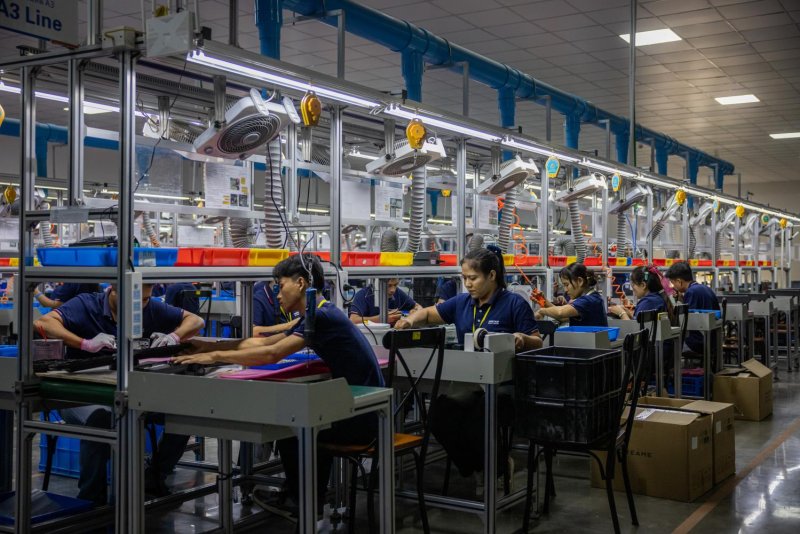
Thailand's economy has reached a dead end. It is struggling to move forward because it can no longer produce goods that meet global demand. Manufacturing capacity utilisation has fallen from a peak of 82% in 1996 to just 58% in 2026 as overseas markets have turned away from Thai-made products.
Many of the electronic goods that Thailand exports successfully today are semi-finished products imported from elsewhere, lightly processed and then re-exported. This is reflected in the apparent contradiction of industrial production contracting by 1.8% while exports expanded by more than 18.3%. Even more worrying is that the more Thailand exports, the larger its trade deficit becomes.
No economist would deny that Thailand must transform its economy. The real questions are: in what direction? Where will the massive investment required for that transformation come from? Where will the technology originate? How long will it take? Most importantly, does Thailand have the human capital needed to succeed?
The country already faces a rapidly ageing population. The median age is 41.3, compared with 33.9 in Vietnam and 31.2 in Indonesia. By 2050, when the government hopes to see the first "Made in Thailand" semiconductor chips, Thailand's median age will have risen to 53.25, with almost one-third of the population aged over 65.
The key question is whether Thailand can afford to wait for these new industries to develop. Debt must be serviced every day, and 65.5 million people need to earn a living while waiting for these industries to generate returns. GDP must continue to grow during that transition. How?
I believe economic policy should focus less on creating entirely new industries and more on strengthening those that already exist and can generate income immediately. Import substitution offers the most promising option. The objective should be to raise manufacturing capacity utilisation from below 60% to 75% within five years.
Highly efficient economies such as China, Japan and Vietnam operate at industrial capacity utilisation rates of around 72-73%. For them, investing in entirely new industries makes sense. For Thailand, perhaps not.
Thailand's GDP strategy (Y = C+I+G+X–M) should focus on reducing M (imports), not increasing X (exports), for the next five years. In other words, Thailand should take a step back before moving forward. Once the industries it already possesses have become competitive again, it can invest in the next generation of technologies.
Government policy should therefore shift away from attracting foreign investment into new high-tech industries and instead reinforce existing industries using domestic capital. Small and medium-sized enterprises should be at the heart of this strategy. For example, the 200-billion-baht budget allocated to the clean energy transition could instead be channelled into import-substitution industries.
The governor of the Bank of Thailand recently observed that Thailand's potential economic growth has fallen from around 7% before the 1997 financial crisis to just 2-3% today because the country has failed to invest sufficiently in maintaining and improving its productive capacity. Investment as a share of GDP has declined from 41.3% in 1995 to just 22.4% in 2025. Machinery has aged, factories have become less efficient and investment in new equipment has lagged.
A useful rule of thumb is:
- Investment below 20% of GDP merely maintains existing capacity using ageing technology.
- Investment of around 30% of GDP expands capacity over roughly 10 years, often relying on foreign technology, as seen in Vietnam.
- Investment of around 40% of GDP can expand capacity within five years while supporting the development of domestic technology, as demonstrated by China.
Outdated production facilities raise manufacturing costs, encouraging Thailand to import cheaper and better-quality goods rather than buy locally made products. Thailand's monthly trade deficit with China more than doubled, from US$2.4 billion in 2021 to $5.6 billion in 2025. More alarmingly, it reached $9.6 billion in June 2026 alone. Under such conditions, how can local industries survive?
Even more troubling is that Thai consumers have increasingly borrowed to finance purchases of imported goods. Household debt rose from around 40% of GDP to nearly 90%. Once households reached their borrowing limits, imports did not stop. Instead, the government borrowed more, pushing public debt from 45% of GDP to almost 70% within five years.
This is a model of economic self-destruction. Production weakens on the supply side while debt continues to accumulate on the demand side.
The critical question is what happens next. Once debt stops growing, economic growth slows immediately, as we are now witnessing. For four months, the government attempted to prop up the economy through cash handouts. Unfortunately, it too is now facing a liquidity squeeze. Financing the fiscal deficit is becoming increasingly difficult. Foreign capital inflows, largely supported by the current account surplus in the past, have begun to reverse. Thailand recorded a current account deficit of $16.3 billion in the first half of this year.
It is time to stop dreaming. Semiconductors, data centres and clean energy may be attractive, but they do not put food on the table today. Thailand should shift its focus from export-led growth to import substitution. In the GDP equation, it is "M", not "X", that deserves greater attention. An added benefit of this strategy is that it would make Thailand less vulnerable to rising global trade protectionism.
Everyone would rather drive a shiny, state-of-the-art vehicle than repair an old one. The question is whether Thailand can afford the new car.