
The oil price continues to fall and petrol has dropped through the £1-a-litre mark on at least one garage forecourt with others likely to follow suit soon.
It all points to falling inflation, and indeed analysts expect official figures tomorrow to show inflation hit a fresh 12-year low in December. At the same time, unemployment is also coming down. For a government heading into a general election, it sounds like the perfect economic cocktail.
But history would suggest the Conservatives should resist counting any votes before they are in, warns one new analysis of opinion polls and the so-called “misery index” - a combination of inflation and unemployment.
Martin Beck at thinktank Oxford Economics says that applying the economist’s tool of the misery index would suggest that very low inflation and a further fall in the jobless rate should see the UK economy in 2015 enjoy its happiest year in more than half a century. But he also found that there is “little, if any, association between movements in the misery index and the electoral fortunes of the governing party”.
In this chart, Beck looks at movements in the misery index and the gap in opinion poll scores between the incumbent party and the main opposition party.
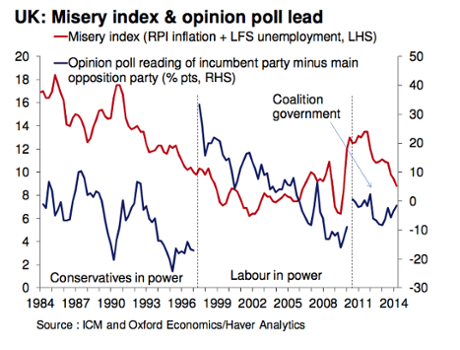
As Beck points out, a halving in the misery index from 1992 to 1997 did not stop an ever larger opinion poll deficit for John Major’s governing Conservative party. And while Labour won a series of election victories from 1997 to 2005, the low level of the misery index in that period was not enough to stop the party’s lead in the opinion polls – and at the ballot box – eroding away.
And what about the benefits of the latest drop in the misery index? Well, it has been accompanied by an improvement in opinion poll readings enjoyed by the Labour party relative to the Conservatives, Beck notes.
In other words, a happy economy on this simple measure does not guarantee happy days at the ballot box. One thing the misery index does not capture is the lack of real wage growth over this parliament as pay rises have failed to match inflation. Wages have in fact been falling in real terms, leaving many households feeling worse off.
As Beck concludes:
So a happy economy, at least on the narrow definition of the misery index, won’t necessarily translate into political joy for the government. This isn’t perhaps surprising. After all, there is more to economic contentment than having a job and seeing prices in the shops rise only slowly. A pay rise anyone?






.png?w=600)



